
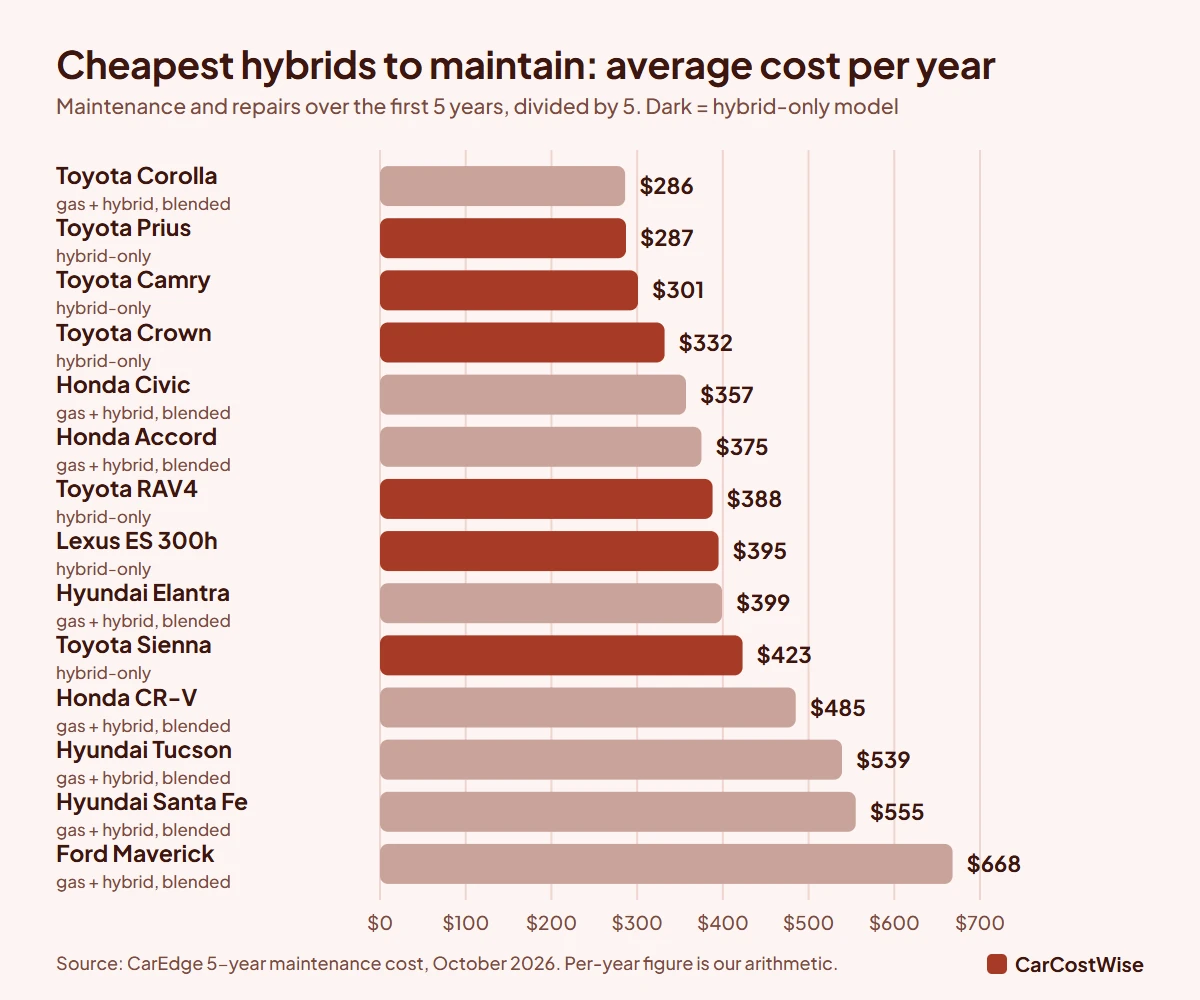
Direct answer: The cheapest hybrids to maintain are Toyotas. Over the first five years, CarEdge puts maintenance and repairs at $1,437 for a Prius (about $287 a year), $1,503 for a Camry ($301) and $1,662 for a Crown ($332). Among hybrid SUVs, the RAV4 is cheapest at $1,938 ($388 a year). A CR-V costs $2,425 ($485).
Which hybrids are cheapest to maintain?
Toyota holds 12 of the 18 spots below, and the Corolla, Prius and Camry lead at about $286 to $301 a year. We took CarEdge’s five-year maintenance and repair cost for every 2026 nameplate sold in the US with a hybrid powertrain. CarEdge is a car-buying service that estimates the cost of scheduled maintenance plus repairs for a new car’s first five and ten years, from industry data. It ranks 186 mainstream models and separately ranks luxury models. One table, one method: that makes these numbers comparable with each other, even though no single estimate will match your own bills.
| Rank | Model | Hybrid-only in 2026? | First 5 years (CarEdge) | Per year (our arithmetic) | First 10 years (CarEdge) |
|---|---|---|---|---|---|
| 1 | Toyota Corolla (Corolla Hybrid trim) | No | $1,430 | $286 | $4,434 |
| 2 | Toyota Prius | Yes | $1,437 | $287 | $4,359 |
| 3 | Toyota Prius Prime (plug-in) | Yes | $1,472 | $294 | $4,427 |
| 4 | Toyota Camry | Yes | $1,503 | $301 | $4,580 |
| 5 | Toyota Crown | Yes | $1,662 | $332 | Not listed |
| 6 | Honda Civic (Civic Hybrid trims) | No | $1,786 | $357 | $5,632 |
| 7 | Toyota Corolla Cross | No | $1,852 | $370 | Not listed |
| 8 | Honda Accord | No | $1,874 | $375 | $5,807 |
| 9 | Toyota RAV4 | Yes | $1,938 | $388 | $6,004 |
| 10 | Lexus ES 300h | Yes (hybrid trim) | $1,975 | $395 | $5,952 |
| 11 | Toyota Venza (2021-2024) | Yes | $1,981 | $396 | $6,089 |
| 12 | Hyundai Elantra (Elantra Hybrid trim) | No | $1,996 | $399 | $6,338 |
| 13 | Toyota Crown Signia | Yes | $2,041 | $408 | Not listed |
| 14 | Toyota Highlander | No | $2,048 | $410 | $6,224 |
| 14 | Hyundai Sonata (Sonata Hybrid trim) | No | $2,048 | $410 | $6,443 |
| 16 | Toyota Grand Highlander | No | $2,086 | $417 | Not listed |
| 17 | Toyota Sienna | Yes | $2,113 | $423 | $6,408 |
| 18 | Honda CR-V | No | $2,425 | $485 | $7,636 |
Sources: CarEdge model maintenance pages and its 5-year maintenance cost ranking, accessed October 2026. Hybrid-only status from Toyota’s 2026 announcements as reported by InsideEVs. The Venza was sold only as a hybrid and ended after the 2024 model year.
Read the table with one caution. CarEdge reports a nameplate, not a powertrain, for most mainstream models. For hybrid-only models (Prius, Camry, Crown, RAV4, Sienna, Venza) the figure is close to a pure hybrid number, though it can blend in older gas Camrys and RAV4s. For a Corolla, Civic or CR-V, it blends gas and hybrid versions. The Lexus figures below are the only ones split by hybrid trim, and they show the hybrid costs almost the same as the gas twin.
Hybrid maintenance cost: published figures compared
No single source prices every hybrid the same way. Here is what each one we checked says. CarEdge prices models, Argonne prices powertrains, AAA prices vehicle categories, and Consumer Reports counts problems rather than dollars.
| Source | Figure | Data date | Link |
|---|---|---|---|
| CarEdge | Toyota Prius: $1,437 in maintenance and repairs over the first 5 years, $4,359 over 10 | Read October 24, 2026 (re-check blocked November 2) | CarEdge Prius |
| Argonne National Laboratory (U.S. DOE) | Scheduled maintenance: $0.094 a mile for a hybrid, $0.101 for a gas car, $0.061 for an EV | 2021 presentation, checked November 2, 2026 | DOE slides |
| Argonne National Laboratory (U.S. DOE) | Repair cost multiplier for a hybrid car: 0.91 times a gas car | 2021 presentation, checked November 2, 2026 | DOE slides |
| AAA, Your Driving Costs 2025 | Hybrids rank third lowest in maintenance costs of 9 categories; the all-category average for maintenance, repair and tires is 11.04 cents a mile | September 2025 (5 years, 75,000 miles), checked November 2, 2026 | AAA fact sheet |
| Consumer Reports, via Jalopnik | Hybrids have 15% fewer problems than gas cars on average | February 14, 2026, checked November 2, 2026 | Jalopnik |
The sources agree on direction: a hybrid costs about the same as a gas car to maintain, or a little less. Argonne’s scheduled-maintenance gap is 0.7 cents a mile. AAA does not publish a hybrid-only maintenance figure in its fact sheet, only the ranking. For a specific model, the CarEdge ranking above is the closest like-for-like measure we found.
How much does a hybrid cost to maintain per year?
A cheap hybrid costs about $200 in its first year and about $400 by its fifth, and the pricier ones roughly double that. CarEdge’s year-by-year tables show how fast the bills climb as warranties run out and wear parts come due:
| Model | Year 1 | Year 5 | Year 10 | Chance of a major repair in 10 years |
|---|---|---|---|---|
| Toyota Prius | $199 | $402 | $636 | 11.58% |
| Toyota Camry | $207 | $422 | Not shown | 12.28% |
| Toyota RAV4 | $261 | $551 | Not shown | 16.61% |
| Toyota Sienna | $292 | $591 | Not shown | 17.03% |
| Honda CR-V | $319 | $699 | Not shown | 21.74% |
| Hyundai Tucson | $349 | $783 | Not shown | 24.76% |
| Ford Escape | $379 | $861 | Not shown | 27.48% |
CarEdge counts any job over $500, parts and labor, as a major repair. Its Prius page puts the Prius’s 10-year total $659 below the average hatchback, and the Camry’s five-year cost $1,181 below the average sedan.
The averages hide a range. A Prius driver doing 15,000 miles a year reaches tire, brake fluid and 12-volt battery jobs sooner than one doing 8,000. Treat the yearly figure as a budget line, not a quote.
Are hybrids cheaper to maintain than gas cars?
Slightly, and in normal use the difference is small. The cleanest test is the same car sold both ways. CarEdge splits Lexus models by powertrain, and the hybrid and gas versions land within $16 of each other over five years:
| Lexus model | Gas version, first 5 years | Hybrid version, first 5 years | Hybrid extra (our arithmetic) |
|---|---|---|---|
| ES | ES 350: $1,961 | ES 300h: $1,975 | $14 |
| NX | NX 350: $2,485 | NX 350h: $2,488 | $3 |
| RX | RX 350: $2,566 | RX 350h: $2,577 | $11 |
Source: CarEdge luxury maintenance ranking, October 2026.
Over a longer life, the US Department of Energy’s Argonne National Laboratory put scheduled maintenance at about 9.4 cents a mile for a hybrid and 10.1 cents for a gas car, in its 2021 DOE slides; CarBuyer and Government Fleet summarized the same study. At 12,000 miles a year, that 0.7-cent gap is worth about $84 a year (our arithmetic). The same slides set hybrid car repair costs at 0.91 times a gas car’s.
Reliability points the same way. In Jalopnik’s February 2026 summary of Consumer Reports’ data:
“on average, hybrids have 15% fewer problems than gas-powered cars” (Jalopnik, reporting Consumer Reports)
Plug-in hybrids and EVs had 80% more problems, by the same measure. Of about 30 hybrid models CR sampled, only the Hyundai Sonata and Lincoln Nautilus scored below average.
Why the savings? Regenerative braking does much of the stopping, so pads and rotors last longer, and the gas engine shuts off at stops and low speeds, as Cars.com explains. Brakes are a real line item: a pad and rotor job runs $322 to $586 per axle. Before you buy, also check whether the engine uses a timing belt or chain, since a belt is one more big scheduled job; see timing belt vs timing chain.
What is the cheapest hybrid SUV to maintain?
The Toyota RAV4 is the cheapest hybrid SUV to maintain, at $1,938 over five years, or about $388 a year. It went hybrid-only for 2026. Here is how the hybrid SUVs and minivans stack up on the same CarEdge five-year measure:
| Hybrid SUV or van | First 5 years | Per year (our arithmetic) |
|---|---|---|
| Toyota Corolla Cross | $1,852 | $370 |
| Toyota RAV4 | $1,938 | $388 |
| Toyota Venza (used, 2021-2024) | $1,981 | $396 |
| Toyota Crown Signia | $2,041 | $408 |
| Toyota Highlander | $2,048 | $410 |
| Toyota Grand Highlander | $2,086 | $417 |
| Toyota Sienna (minivan) | $2,113 | $423 |
| Honda CR-V | $2,425 | $485 |
| Lexus NX 350h | $2,488 | $498 |
| Mazda CX-50 | $2,529 | $506 |
| Kia Niro | $2,640 | $528 |
| Subaru Crosstrek | $2,643 | $529 |
| Kia Sportage | $2,659 | $532 |
| Hyundai Tucson | $2,694 | $539 |
| Subaru Forester | $2,718 | $544 |
| Kia Sorento | $2,736 | $547 |
| Hyundai Santa Fe | $2,773 | $555 |
| Ford Escape | $2,948 | $590 |
The Corolla Cross edges the RAV4 on this measure, but its figure blends in the gas version. If you are choosing between the two best-sellers, our RAV4 vs CR-V maintenance cost comparison goes model year by model year. CarEdge puts the RAV4’s first five years $1,892 below its average SUV.
Which hybrid sedan has the lowest maintenance cost?
The Prius and the Camry. Both are hybrid-only now, so their CarEdge numbers mostly reflect hybrid ownership. The Prius is the cheapest pure hybrid on the list at $1,437 over five years and $4,359 over ten. The Camry is close behind at $1,503 and $4,580. The Corolla’s $1,430 is $7 lower over five years, but it is mainly a gas car’s number.
Honda’s hybrids cost a little more to keep. The Civic, which added hybrid trims for 2025, comes to $1,786 over five years, and the Accord, a hybrid on most trims, $1,874. Hyundai’s Elantra ($1,996) and Sonata ($2,048) follow. If you want luxury, the Lexus ES 300h costs $1,975 over five years, $2,232 below CarEdge’s luxury sedan average and close to a mainstream RAV4.
Which hybrids cost the most to maintain?
The Ford Maverick ranks highest of the hybrids here, at $3,341 over five years, about $668 a year. The Escape ($2,948), Santa Fe ($2,773) and Sorento ($2,736) also sit in the most expensive third of CarEdge’s 186-model ranking. Brand averages explain most of this: CarEdge’s five-year brand figure is $1,814 for Toyota, $2,185 for Honda, $2,256 for Hyundai, $2,335 for Kia and $3,296 for Ford.
That does not make them bad buys. A Maverick hybrid is a pickup at a compact-car price, and Hyundai and Kia offer longer hybrid battery warranties than most rivals (see below). It means you should budget about $260 to $380 a year more for upkeep than with a Prius (our arithmetic from the five-year figures).
Does the battery warranty keep these numbers low?
Yes. On a new hybrid the high-voltage battery is the maker’s bill for a decade or so: Toyota and Lexus cover it for 10 years or 150,000 miles, and Hyundai and Kia for 10 years or 100,000 miles, per Jalopnik, which is why the five- and ten-year figures above rarely include a battery. What the federal and California warranty rules actually require, and how to judge an older battery that is out of warranty, is covered in our guide to the best used hybrids under $15,000.
What maintenance does a hybrid actually need?
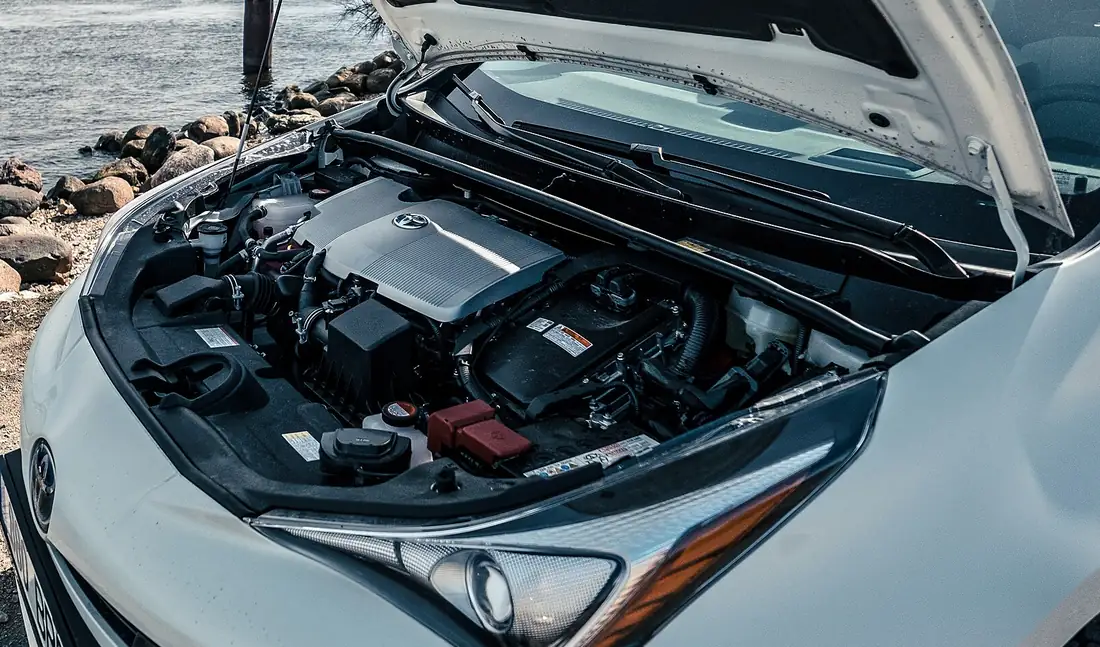
The same basics as a gas car, with a few extras. CarEdge’s Prius schedule lists an oil and filter change plus a tire rotation every 5,000 miles, with fluid, filter and bigger services at set milestones up to 150,000 miles. Your owner’s manual has the final word on intervals.
- Oil, filters and tires. These are the bulk of early-year costs. Tires do not care what is under the hood; see how much new tires cost.
- Brake fluid, even when pads last. Regenerative braking saves pads, but fluid still ages.
- The 12-volt battery. Hybrids still use one to boot the system, and it wears out like any car battery. Our car battery replacement cost guide has prices.
- Spark plugs at the interval. Long-life plugs still come due; we explain why spark plug replacement can be expensive ($250 to $900).
- Hybrid-specific items. Check the owner’s manual for anything extra, such as inverter coolant or a battery cooling-air filter, and when it is due.
How do you keep a hybrid’s maintenance costs low?
Pick a model from the top of the table, then protect the warranty. Keep service records, because a warranty claim on the battery or inverter goes smoother with a full history. Use an independent shop for routine work once the free maintenance period ends; oil changes and brakes on a Prius or RAV4 need no dealer. And compare the fuel side too, since that is where a hybrid really pays you back: our hybrid vs gas break-even guide shows how many miles it takes.
If you are buying on a tight budget and looking at older cars instead, our list of the cheapest used cars to maintain under $10,000 uses RepairPal data for older model years. For more help choosing, see all our buying guides.
How do maintenance, fuel and price add up?
Maintenance is only one line. A Prius saves you about $200 a year in upkeep against a CR-V (our arithmetic from the five-year figures), but fuel and the hybrid’s price premium usually move more money. How many years a hybrid takes to pay back that premium is worked out, with a calculator, in our hybrid vs gas break-even guide. For a per-mile view that includes maintenance, see our cost per mile to drive a car.
FAQ
Which hybrid brand is cheapest to maintain?
Toyota. CarEdge’s five-year brand average is $1,814 for Toyota, against $2,185 for Honda, $2,256 for Hyundai, $2,335 for Kia and $3,296 for Ford. Toyota and Lexus models fill most of the top of the hybrid ranking.
Do hybrid brake pads last longer?
Usually, yes. Regenerative braking uses the electric motor to slow the car, so the pads and rotors do less of the work, as Cars.com explains. Brake fluid still ages, so it needs changing on schedule even when the pads look fine.
Are hybrid cars expensive to repair?
Routine repairs cost about the same as on a gas car, and Consumer Reports found hybrids had 15% fewer problems on average. Hybrid-only parts such as the battery and inverter can be costly out of warranty, which is why Toyota and Lexus cover the battery for 10 years or 150,000 miles.
Do hybrids need less maintenance than regular cars?
Slightly less. Regenerative braking makes brake pads last longer, and the engine runs less, but hybrids still need oil changes, tire rotations, filters, brake fluid and a 12-volt battery. CarEdge’s Prius schedule lists an oil change and tire rotation every 5,000 miles.
Sources
- CarEdge, Cars with the Lowest 5 Year Maintenance Costs (186 models; five-year figures for every mainstream model in this article; brand averages)
- CarEdge, Luxury cars with the lowest 5 year maintenance costs (Lexus ES, NX and RX gas and hybrid versions)
- CarEdge, Toyota Prius maintenance costs ($4,359 over 10 years, $1,437 over 5, year-by-year table, maintenance schedule)
- CarEdge, Toyota Camry maintenance costs ($4,580 over 10 years, $1,503 over 5)
- CarEdge, Toyota Corolla maintenance costs ($4,434 over 10 years)
- CarEdge, Toyota Prius Prime maintenance costs ($4,427 over 10 years)
- CarEdge, Toyota RAV4 maintenance costs ($6,004 over 10 years, year-by-year table)
- CarEdge, Toyota Sienna maintenance costs ($6,408 over 10 years)
- CarEdge, Toyota Highlander maintenance costs ($6,224 over 10 years)
- CarEdge, Toyota Venza maintenance costs ($6,089 over 10 years)
- CarEdge, Honda Civic, Accord and CR-V maintenance costs ($5,632, $5,807 and $7,636 over 10 years)
- CarEdge, Hyundai Elantra, Sonata and Tucson maintenance costs ($6,338, $6,443 and $8,560 over 10 years)
- CarEdge, Ford Escape maintenance costs ($9,416 over 10 years, 27.48% major-repair chance)
- CarEdge, Lexus ES 300h maintenance costs ($5,952 over 10 years)
- Jalopnik, “Consumer Reports Says Hybrids Are Super Reliable So Let’s Look At The Longest Warranties” (February 14, 2026; 15% fewer problems; battery warranties by brand)
- Cars.com, “Are Hybrid Cars More Expensive to Maintain or Repair Than a Gas Car?” (May 10, 2024; regenerative braking)
- CarBuyer, summary of Argonne National Laboratory’s total cost of ownership study (9.4 cents a mile hybrid, 10.1 cents gas)
- Government Fleet, “Report: EVs Cost Less to Maintain” (summary of the same Argonne report)
- US Department of Energy, Argonne vehicle cost of ownership presentation (2021; scheduled maintenance $0.101 a mile gas, $0.094 hybrid, $0.061 EV; hybrid car repair multiplier 0.91; checked November 2, 2026)
- AAA, Your Driving Costs 2025 fact sheet (hybrids third lowest in maintenance; 11.04 cents a mile all-category maintenance, repair and tires)
- InsideEVs, “The New Toyota RAV4 Goes Hybrid-Only” (2026 RAV4 hybrid and plug-in only)
CarEdge figures were read from its pages on October 24, 2026, and CarEdge blocked our re-check on November 2, 2026. CarEdge updates them, so a later visit may show slightly different numbers. Per-year figures are our arithmetic (five-year total divided by five). Where CarEdge does not split a model by powertrain, we say so in the table.
Updated November 2, 2026: added a published-figures comparison from CarEdge, Argonne, AAA and Consumer Reports, a sourced reliability quote, a photo of a Prius engine bay and two new FAQs; shortened the battery warranty and fuel-cost sections, which now point to our used-hybrid and break-even guides. | By Rasel Hakkani
This article is general information, not financial or mechanical advice. Check the warranty and maintenance schedule for the exact car you plan to buy.