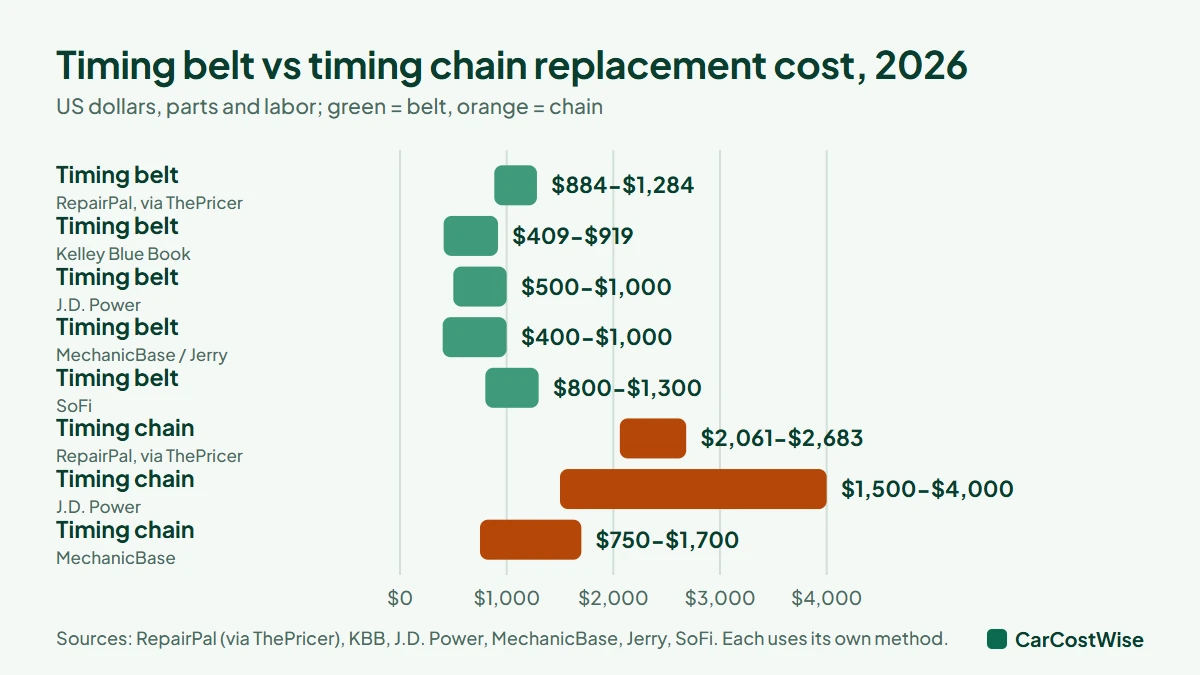
Direct answer: Timing belt vs timing chain: a belt is rubber and needs replacing about every 60,000 to 105,000 miles, while a metal chain usually has no set interval. A belt job costs about $884 to $1,284 (RepairPal), plus roughly $100 for the water pump. A chain job runs about $2,061 to $2,683. Honda V6s and older Subarus use belts.
Timing belt vs timing chain: what is the difference?
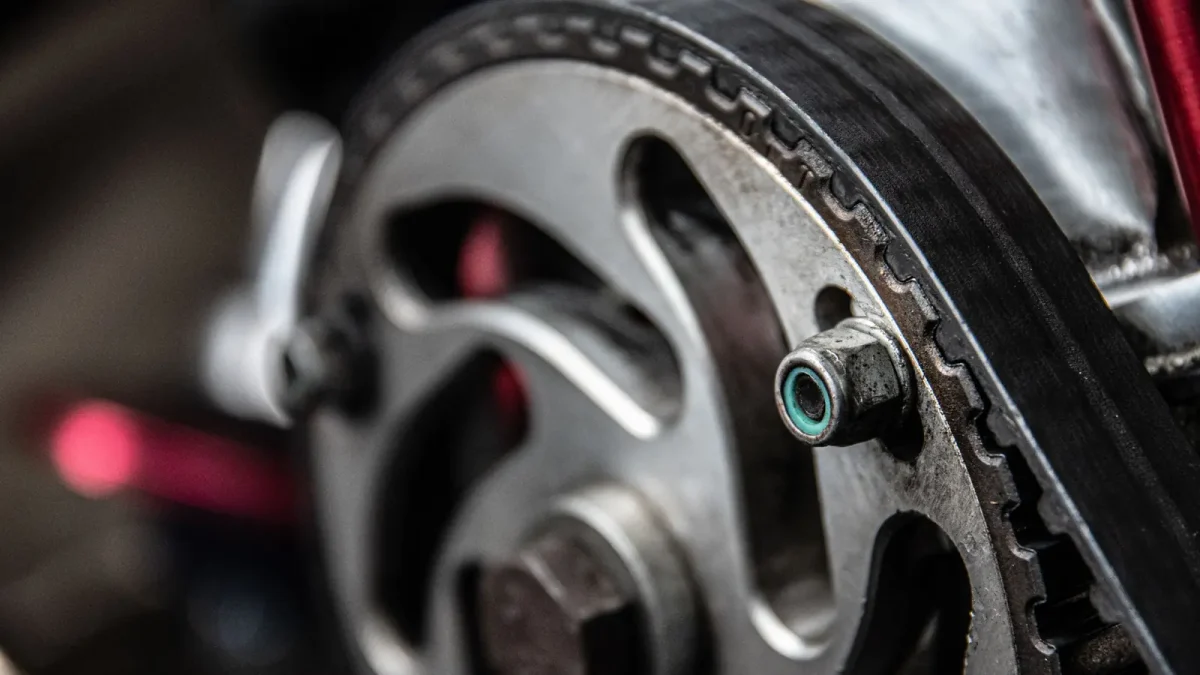
A timing belt is a toothed rubber belt, and a timing chain is a metal roller chain, but both parts do the same job. They link the crankshaft to the camshaft or camshafts, so the engine’s valves open and close at the right moment as the pistons move. If that timing slips, the engine runs badly or not at all.
The difference is the material and the upkeep:
| Timing belt | Timing chain | |
|---|---|---|
| Material | Reinforced rubber with teeth | Metal links, like a bicycle chain |
| Typical interval | 60,000 to 105,000 miles (NAPA, MechanicBase) | No routine interval (NAPA); could last 300,000 miles or more with clean oil (MechanicBase) |
| Cost to replace | About $884 to $1,284 with parts and labor (RepairPal) | About $2,061 to $2,683 (RepairPal) |
| Noise and weight | Light and quiet | Heavier; can rattle when worn |
| Main weakness | Rubber ages, even with few miles | Stretches, or the guides and tensioner wear out |
NAPA Know How says most automakers recommend replacing a belt every 60,000 to 105,000 miles, and that “unless there’s a problem, timing chains don’t have a replacement interval.” It also notes that regular oil changes help prevent chain wear and stretch. MechanicBase says a belt job usually takes two to five hours, and that a chain is much harder to reach because of the cover over it, which is why it costs more when it does fail.
Chains are not free of trouble. MechanicBase notes that some newer cars have chains that fail early, usually because the chain stretches or its tensioner and guides wear, which shows up as a rattle from the timing cover and a check engine light. Still, a chain that is never asked to be replaced is cheaper over the life of most cars than a belt replaced two or three times.
Which cars have a timing belt and which have a timing chain?
There is no single trustworthy list, because automakers switch between belts and chains by engine, trim and model year. The same car can have a belt in one year and a chain in the next. The table below only includes models where we could open a source that confirms the engine’s timing drive. Treat it as a starting point, then confirm with your VIN, owner’s manual or a dealer.
| Model (engine) | Belt or chain | Source |
|---|---|---|
| Honda Accord V6, Odyssey, Pilot (J-series V6) | Belt | Wikipedia: Honda J engine says all J-series engines use a single timing belt; Dickerson Auto lists the Accord V6, Odyssey and Pilot as belt-driven |
| Honda Civic (2006-2016), CR-V (2003-2016) | Chain | Car Buying Support Honda belt-or-chain guide, confirmed via its search listing |
| Toyota Camry and RAV4 (2.5L 2AR-FE) | Chain | Wikipedia: Toyota AR engine; a parts retailer also lists the 2024 Camry as chain-driven |
| Toyota Tacoma and 4Runner (4.0L 1GR-FE), Camry, Highlander, RAV4 (3.5L V6) | Chain | Wikipedia: Toyota GR engine |
| Subaru Forester (2011 and newer), Outback (2013 and newer), Impreza (2012 and newer), Crosstrek (2012 and newer) | Chain (FB engines) | Wikipedia: Subaru FB engine says the FB uses a timing chain that replaced the timing belt of the older EJ engine |
| Older Subaru models with the EJ engine, including the EJ25 | Belt | Wikipedia: Subaru EJ engine |
| Jeep Wrangler and Grand Cherokee, Ram 1500, Dodge Charger (3.6L Pentastar) | Chain | Wikipedia: Pentastar engine |
| Ford 2.0L and 3.5L EcoBoost | Chain | Wikipedia: Ford EcoBoost engine |
| Ford Fiesta (2014-2017), Focus (2015-2018), EcoSport (2018-2021) with the 1.0L EcoBoost | Belt that runs in oil (“wet belt”) | AutoGuide, August 2026, on the NHTSA probe |
| VW Jetta GLI, Golf GTI, Passat, Tiguan and Audi A3, A4, Q5 (EA888 2.0L and 1.8L) | Chain | Wikipedia: Volkswagen EA888 engine |
| Older VW and Audi 1.8T and 2.0 TFSI (EA113), such as the Audi TT and early A4 | Belt | Same Wikipedia article |
| Nissan Rogue (1.5L VC-Turbo) and Kicks (1.6L), 2025 | Chain | Garden Nissan (a dealer blog) |
| Mitsubishi Lancer 2.0L and 2.4L, some Outlander engines | Chain | Wikipedia: Mitsubishi 4B1 engine |
| Hyundai Sonata and Kia Optima 2.0L (2004-2007) | Chain | Wikipedia: Hyundai Theta engine |
What we left out. We found nothing we could trust for the current Chevrolet Silverado, Equinox and Malibu, Mazda, or most current Hyundai and Kia engines. The only sources were parts-store listings, forum posts or pages that contradict each other, so we have not guessed. One example of how bad the free lists are: one popular list says the Camry and Corolla have belts, which contradicts the engine documentation above. Another shop blog says the Mitsubishi Outlander “continues to use timing belts”, but we could not find a second source for that.
The trend. NAPA says automakers have recently moved back toward timing chains to prevent early belt failure and valve damage. That matches the table: the belt-driven names are mostly older engines and a few specific designs, such as Honda’s V6.
How do I know if my car has a timing belt or a chain?
- Check the owner’s manual maintenance schedule. A “replace timing belt” line at a set mileage means you have a belt. A chain is rarely listed.
- Look at the engine. A belt sits behind a plastic cover on the side of the engine, and a chain lives behind a metal cover bolted to the block and wet with oil. SKF, a major timing-kit maker, says a quick look at the engine is the easiest way to tell.
- Search your VIN with a dealer parts desk or an online parts catalog. A parts listing for a “timing belt kit” for your engine code is a good sign you have a belt.
- Ask when a shop quotes the job. Use the engine code, not just the model name, because one model can offer both.
Electric-motor vehicles, including the Toyota Mirai, have neither a timing belt nor a chain.
How much does timing belt replacement cost with the water pump?
Prices below are US estimates from several sources and include parts and labor unless noted. They differ because each source uses its own method and region.
| Job | Low | High | Source |
|---|---|---|---|
| Timing belt (RepairPal: parts $290-$426 plus labor $584-$858) | $884 | $1,284 | RepairPal, via ConsumerAffairs and ThePricer (January 2026) |
| Simple four-cylinder at an independent shop | $310 | $700 | ThePricer |
| Mainstream vehicle, average labor rates | $800 | $1,300 | ThePricer |
| Tight engine bay, V6 or V8, or dealer pricing | $1,400 | $2,000+ | ThePricer |
| Timing belt, general estimate | $409 | $919 | Kelley Blue Book |
| Timing belt kit ($100-$350) plus 3-5 hours of labor | $400 | $1,000 | Jerry |
| Timing belt, professional job | $500 | $1,000 | J.D. Power |
| Timing belt, professional job | $400 | $1,000 | MechanicBase |
| Timing belt, replaced before it breaks | $800 | $1,300 | SoFi |
| Older Subaru EJ belt job (1998-2006 Forester), kit and pump | $700 | $1,600+ | Go-Parts |
| Timing chain | $2,061 | $2,683 | RepairPal, via ThePricer |
| Timing chain | $1,500 | $4,000 | J.D. Power |
| Timing chain | $750 | $1,700 | MechanicBase |
Our reading: the middle of the pack for a belt job on a mainstream car is about $800 to $1,300, plus about $100 if the water pump is done at the same time. That is also where ThePricer lands. Use $884 to $1,284 as the planning range, and expect $1,400 to $2,000 or more if the engine is a V6 with the belt buried deep, as in many SUVs and minivans. A New York City shop could quote $700 to $1,400 for the same job that costs $580 to $1,150 in Jacksonville, per ThePricer’s city examples.
Real examples. Owner reports on TrueDelta for a 2015 Honda Pilot list $850 for a timing belt, water pump, tensioner and drive belt at about 104,000 miles, and $1,180 for a belt, serpentine belt and water pump at about 101,000 miles. These are owner entries, not quotes, but they show real jobs land near the middle of the range.
Why replace the water pump with the timing belt?
On many engines the belt drives the water pump, so both sit behind the same cover. Changing the pump at the same time means you pay the labor once. Jerry says adding the pump to the belt job costs about $100 more. ConsumerAffairs puts a stand-alone water pump job at about $600 to $1,000 on most cars, because the same labor is repeated, and says doing both together can save around $400 in labor.
A pump can wait if it is young. Rick’s Free Auto Repair Advice says pumps often start to leak between 125,000 and 150,000 miles, so it may not need replacing at the first belt change. Our arithmetic: if your car is already at 100,000 miles and the pump is original, paying about $100 now is cheaper than paying $600 to $1,000 for a second teardown later. Ask for a full kit that includes the belt, tensioner, idler pulleys and water pump, and ask the shop whether the pump is part of it.
How often should a timing belt be replaced?
Most automakers call for 60,000 to 105,000 miles. NAPA gives that range, and MechanicBase says 60,000 to 100,000. ThePricer, citing AAA, gives a rule of thumb of about five years or 60,000 miles. At the other end, SKF says intervals on some modern belt engines now reach 240,000 to 300,000 km, about 149,000 to 186,000 miles (our arithmetic). Your manual wins over any rule of thumb. Some interval examples from the sources:
- Subaru EJ22 (1999 models): the belt change interval is 105,000 miles for most versions and 60,000 miles for one variant, Wikipedia reports.
- Ford 1.0L wet belt: the original interval was 150,000 miles. Ford shortened it to 100,000 miles or six years after the failures, AutoGuide reports.
Time matters as well as miles. Rubber ages, and oil and coolant leaks make it age faster, so a car that is ten years old with 40,000 miles can still be overdue. If you buy a used car with no proof the belt was done, treat the belt as due, which also gives you a bargaining point on the price.
What about timing chains?
Most chains have no scheduled replacement. MechanicBase says a chain could last 300,000 miles with clean, well-lubricated oil, and ConsumerAffairs puts the range at 100,000 to 250,000 miles. Nissan’s dealer blog says chains can last the life of the engine with proper maintenance. The practical advice is to keep up oil changes, because worn or dirty oil is the main thing that stretches a chain and its tensioner.
Common warning signs of a stretched chain are a rattle from the front of the engine, often right after a cold start, a check engine light and trouble starting. If you notice one, get it checked early. A chain that jumps a tooth or snaps can cause the same damage as a broken belt.
Is my engine an interference engine?
An interference engine is one where the open valves and the pistons share space at different moments. It works as long as the timing is exact. If the belt or chain breaks or slips, a piston can hit a valve. Wikipedia says that can bend the valves, damage the cylinder and, in the worst case, force a rebuild or engine replacement.
In a non-interference engine the piston never reaches the open valve, so a broken belt just leaves you stranded. You still need a tow, but not a new engine.
Some points that people get wrong:
- Belt or chain does not tell you interference status. Rick’s Free Auto Repair Advice lists chain-driven engines as interference too, including Ford’s 5.0L Coyote and Chrysler’s Pentastar. Chain engines are not automatically safe from valve damage.
- Many popular engines are interference. Wikipedia says “all DOHC and 1998-up SOHC EJ engines” on older Subarus are interference engines. Go-Parts says the 1998 to 2006 Forester is an interference design. Rick’s lists Toyota’s 2AZ-FE four-cylinder and 3MZ-FE V6 as interference engines.
- The lists are not perfect. AA1Car’s list, which is based on data from the Automotive Engine Rebuilders Association and Gates, says it is not exhaustive. A forum poster pointed out errors in a popular Gates-based list. Confirm your engine with a dealer or your service manual.
The cost of getting this wrong is large. A belt job is about $884 to $1,284. A bent-valve repair means a new cylinder head or a rebuild, and on a ten-year-old car that can pass the car’s value. If your engine is on the interference list, do the belt on time or before.
What are the warning signs of a failing timing belt or chain?
- Ticking or whining from the front of the engine.
- Oil or coolant leaking near the timing cover. Leaks soften rubber.
- Check engine light, or a rough idle and misfires. A belt or chain that is a tooth off shows up as poor timing. See our P0300 random misfire guide for what a misfire code means and what to do.
- Trouble starting, or the engine turning over but not catching. This can mean the belt has already broken.
- Visible cracks, fraying or missing teeth on a belt that a shop can see during a service.
- Overdue by miles or years. Most belts give little warning before failing.
If a belt breaks while driving, the engine shuts off at once. Do not try to restart it. On an interference engine, cranking can do more damage.
Should I fix an old car that needs a timing belt?
For most cars, yes. The belt is routine upkeep and a belt job is far cheaper than an engine. Where it gets harder is when the belt is one of several big bills at once, for example a belt, a water pump and a leaking head gasket on an 18-year-old minivan. Our repair vs replace guide explains the 50% rule, and the calculator below lets you test your own numbers.
You can also compare other common repairs in our brake pads and rotors cost guide, wheel bearing replacement cost guide, catalytic converter replacement cost guide and new tire cost guide, or browse all repair cost guides. If the check engine light starts flashing, read our flashing check engine light guide before you drive further.
How can I save on a timing belt or chain job?
- Get three itemized quotes. Ask each shop to list the belt kit, tensioner, pulleys, water pump, coolant and labor separately.
- Ask for the manufacturer’s interval for your VIN. Do not pay for an early job because a shop’s reminder card says so.
- Do the water pump at the same time, unless it is recent. This is the single biggest saving on the job.
- Compare an independent shop and the dealer. ThePricer’s tiers show dealer or tight-engine-bay pricing at $1,400 to $2,000 or more.
- Buy a complete kit. MechanicBase prices kits at $75 to $400 and says to replace tensioners and pulleys with the belt.
- Keep up oil changes on a chain engine. Clean oil is the cheapest way to avoid a $2,000 chain job.
- Do not defer the belt on an interference engine. The savings are small compared with the risk.
What should I ask the shop?
- Does my engine have a belt or a chain, and what is the engine code?
- Is this an interference engine?
- Does the quote include the water pump, tensioner, idlers, seals and coolant?
- Is the part OEM or a name-brand kit, and what is the warranty on parts and labor?
- What will you recheck after the job, and how long will it take?
FAQ
Which is better, a timing belt or a timing chain?
A chain lasts longer and usually has no replacement interval, but it costs more if it fails, about $2,061 to $2,683 per RepairPal. A belt is cheaper, quieter and lighter, but needs replacing about every 60,000 to 105,000 miles. Neither is better for every car.
Which cars have timing belts?
Honda’s J-series V6 in the Accord V6, Odyssey and Pilot, older Subarus with the EJ engine, Ford’s 1.0L EcoBoost in the Fiesta, Focus and EcoSport, and older VW and Audi 1.8T engines. Check your engine code, because automakers switch between belts and chains.
How much does it cost to replace a timing belt and water pump?
About $884 to $1,284 per RepairPal, with $800 to $1,300 at SoFi and ThePricer for a mainstream car. V6 engines, tight engine bays and dealers can run $1,400 to $2,000 or more. Doing the water pump at the same time adds about $100, per Jerry, and ConsumerAffairs puts the combined job at about $1,200 on average.
What happens if a timing belt breaks?
The engine stops at once. On a non-interference engine you need a tow and a new belt. On an interference engine the pistons can hit the valves, bending them and possibly damaging the cylinder, which can mean a repair that costs far more than the belt.
How do I know if my car has a timing belt or timing chain?
Look for a timing belt line in the owner’s manual maintenance schedule, check the engine for a plastic belt cover or a metal chain cover, or have a dealer parts desk look up your VIN. A parts listing for a timing belt kit for your engine code also confirms a belt.
Sources
- NAPA Know How, Timing Chain vs. Timing Belt: Why Do Cars Use One or the Other (60,000-105,000 mile belt interval, no chain interval, return to chains)
- MechanicBase, Timing Chain vs. Timing Belt: Which Is Better? (belt $400-$1,000, chain $750-$1,700, 300,000-mile chain life)
- ThePricer, How Much Does Timing Belt Replacement Cost? (RepairPal $884-$1,284, cost tiers, city ranges, chain $2,061-$2,683; updated January 6, 2026)
- ConsumerAffairs, Timing Belt Replacement Cost (RepairPal-based $884-$1,284 total, chain about $2,100-$2,700, chain life 100,000-250,000 miles; confirmed via search listing)
- J.D. Power, Timing Chain vs. Timing Belt (belt $500-$1,000, chain $1,500-$4,000; confirmed via search listing)
- Kelley Blue Book, Timing Belt Replacement ($409-$919 including parts and labor; confirmed via search listing)
- SoFi, How Much Does a Timing Belt Replacement Cost? ($800-$1,300 if replaced before it breaks; confirmed via search listing)
- Jerry, Timing Belt Replacement Cost Estimate (kit $100-$350 plus 3-5 hours labor, $400-$1,000 total, water pump about $100 more; confirmed via search listing)
- ConsumerAffairs, Water Pump Replacement Cost (pump alone $600-$1,000, belt and pump together about $1,200, about $400 labor saving; confirmed via search listing)
- SKF, Timing belt vs timing chain: which is better? (visual check, modern belt intervals 240,000-300,000 km; confirmed via search listing)
- Rick’s Free Auto Repair Advice, Timing Belt Replacement Cost (water pumps leak at 125,000-150,000 miles; confirmed via search listing)
- TrueDelta, Honda Pilot Expensive Problems (owner-reported timing belt jobs $850 and $1,180)
- Go-Parts, 1998-2006 Subaru Forester timing belt kit with water pump ($700-$1,600, interference design; confirmed via search listing)
- Wikipedia, Honda J engine, Toyota AR engine, Toyota GR engine, Subaru FB engine, Subaru EJ engine, Chrysler Pentastar engine, Ford EcoBoost engine, Volkswagen EA888 engine, Mitsubishi 4B1 engine, Hyundai Theta engine, Interference engine
- AutoGuide, NHTSA Upgrades Probe Into Ford 1.0L EcoBoost Engine Failures (Fiesta, Focus, EcoSport; 135,551 vehicles; interval cut to 100,000 miles or six years; August 4, 2026)
- Dickerson Auto, Timing Belts and the Vehicle Brands That Still Use Them (Accord V6, Odyssey, Pilot)
- Garden Nissan, Which 2025 Nissan Models Have Timing Belts or Chains? (Rogue and Kicks chains)
- Car Buying Support, Honda Timing Belt or Timing Chain (Civic and CR-V chain years; confirmed via search listing)
- Rick’s Free Auto Repair Advice, interference engine lists for Toyota, Ford and Chrysler (confirmed via search listing)
- AA1Car, Timing Belts and Interference Engines (list based on AERA and Gates data; confirmed via search listing)
Several of these are shop or parts-seller pages, and some pages block automated access, so we confirmed their figures through search listings and a second source where we could. Wikipedia engine pages are family-level; they do not guarantee every trim or year. Sources differ, so we show the full spread.
Updated October 2026. By Rasel Hakkani.
This article is general information, not financial or mechanical advice. Have a qualified mechanic confirm what your engine has and when it is due.