
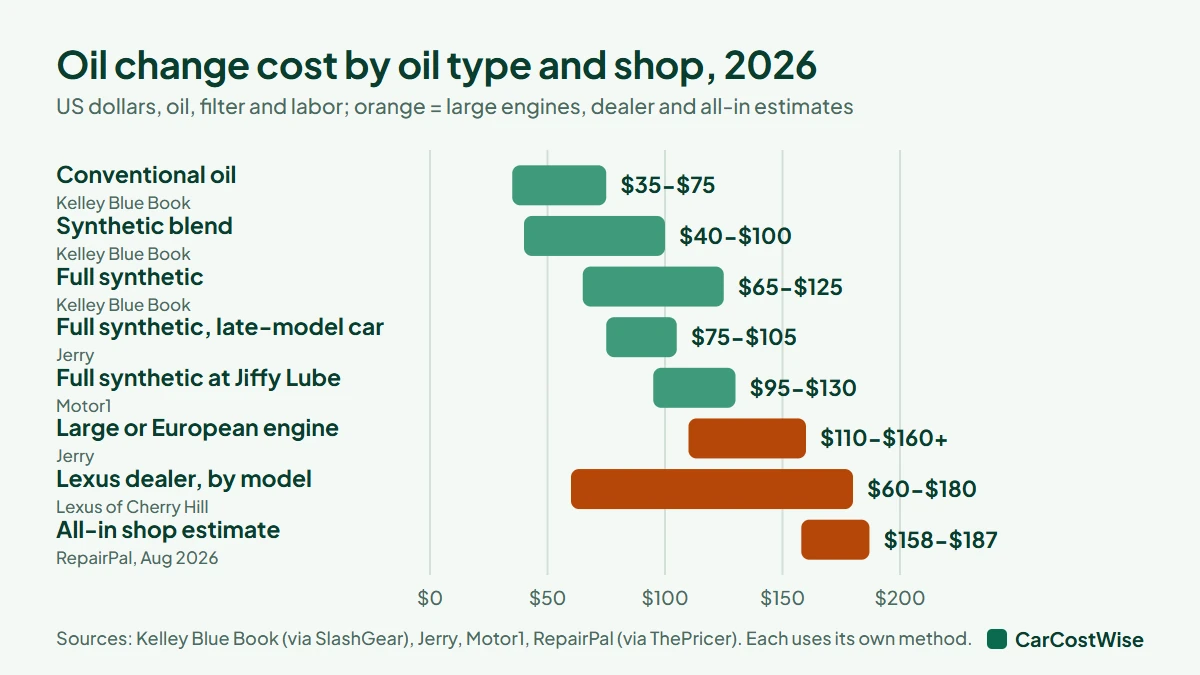
Direct answer: A full synthetic oil change costs about $65 to $125 at a typical US shop, according to Kelley Blue Book, compared with $35 to $75 for conventional oil and $40 to $100 for a synthetic blend. Late-model cars usually land at $75 to $105 (Jerry), while large or European engines can pass $160.
How much does an oil change cost in 2026 by oil type?
Most of the price is the oil itself, so the type of oil decides the bill. Sources disagree on the exact numbers because they measure different things: advertised chain prices, average customer invoices, or a model of parts plus labor. We show the spread instead of picking one number.
| Oil change (oil, filter, labor) | Low | High | Source |
|---|---|---|---|
| Conventional oil | $35 | $75 | Kelley Blue Book |
| Synthetic blend | $40 | $100 | Kelley Blue Book |
| Full synthetic | $65 | $125 | Kelley Blue Book |
| Full synthetic, late-model car | $75 | $105 | Jerry, October 2026 |
| Full synthetic, high-capacity or European engine | $110 | $160+ | Jerry, October 2026 |
| Full synthetic at Jiffy Lube | $95 | $130 | Motor1 |
| Lexus dealer, by model and oil | $60 | $180 | Lexus of Cherry Hill, via Motor1 |
| National all-in shop estimate | $158 | $187 | RepairPal, August 2026, via ThePricer |
| DIY parts, synthetic oil and filter | about $45 | AAA (2017) and KBB, via ThePricer |
How we built this table: in October 2026 we compared the price guides that rank for oil change costs, kept only figures we could trace to a named source, and dropped pages that copy numbers without a source. The RepairPal figure is the outlier. It is a modeled estimate with $58 to $85 of labor and $100 to $102 of parts, so read it as the upper end of what a shop can charge, not what most drivers pay at a quick lube with a coupon.
Jerry also breaks out the step-ups: moving from conventional to a synthetic blend adds about $10 to $20, and moving from a blend to full synthetic adds another $20 to $35. Extra oil beyond the five quarts most prices include costs $7 to $12 a quart, so a truck or SUV that holds seven or eight quarts can add $15 to $50 on its own.
What is the difference between conventional, synthetic blend and full synthetic?
Conventional oil is refined from crude oil. It is the cheapest and works in older engines designed around it, but it breaks down faster under heat.
Synthetic blend mixes conventional and synthetic base oils. It costs a little more and resists heat better than conventional, which is why many quick lubes push it as the middle option.
Full synthetic uses highly refined or chemically built base oils. In AAA’s independent testing, synthetic oils performed an average of 47 percent better than conventional oils across industry-standard tests. Synthetic is also what many newer engines require. If your owner’s manual specifies a full synthetic grade such as 0W-20 or 0W-16, using a cheaper oil can lead to warranty disputes if the engine fails, so keep your receipts.
The practical rule: use the oil type and viscosity printed in your owner’s manual or on the oil filler cap. If the manual allows conventional, synthetic is an upgrade you can choose. If it requires synthetic, the cheaper oil is not an option.
Why are oil changes so expensive in 2026?
Oil changes cost more in 2026 mainly because the base oil used to make synthetic motor oil has risen about 175 percent in price since the war with Iran began, per a trade group cited by NPR. Synthetic motor oil is made from a refined product called Group III base oil, and its supply was hit hard by the war with Iran.
NPR reported in June 2026 that Group III base oil costs had risen 175 percent since the war began, according to a trade group, and that more than 45 percent of US imports of that base oil come from the Middle East. Shell’s Pearl GTL plant in Qatar, a major producer, was damaged in March and half its output is expected to stay offline for at least a year. A Maryland mechanic told NPR that the regular motor oil he buys had gone up about 60 percent, and new US base oil plants are not expected before 2027 or 2028.
SlashGear’s August 2026 explainer adds two slower pressures: a shortage of qualified technicians, which pushes up labor rates, and newer vehicles that are harder to service. Labor is a real part of the bill. Jerry’s customer invoices show labor of about $34 to $57 on oil changes that totaled $43.74 to $69.05.
What this means for you: expect advertised prices to creep up and coupons to shrink while the base oil squeeze lasts. Shops may also be quicker to substitute brands, so ask which oil goes into your engine and confirm it meets the specification in your manual.
Is a full synthetic oil change cheaper at a quick lube or a dealer?
Usually a quick lube is cheaper, but not always by much. Jerry says quick-lube shops are typically $15 to $50 cheaper than dealers for the same basic service. A big chain’s full synthetic price can still match a dealer: Motor1 found Jiffy Lube full synthetic changes typically run $95 to $130, while a Lexus dealer quoted $60 to $180 depending on model and oil.
| Where you go | What to expect | Watch out for |
|---|---|---|
| Discount chain or big-box store (Walmart, Costco, Midas coupons) | The lowest advertised prices; ThePricer found a Walmart full synthetic menu price of $58.88 and Midas offers from $59.99 in July 2026 | Prices assume five quarts; disposal fees and extra quarts are added at the register |
| Quick lube (Jiffy Lube, Valvoline, Take 5) | Fast, no appointment; full synthetic about $95-$130 at Jiffy Lube (Motor1) | Air filter, wiper and flush upsells |
| Independent shop | Often between quick lube and dealer; brings a mechanic who can spot other problems | Ask for the oil brand and grade on the invoice |
| Dealer | Factory-spec oil and filter, recall checks, records in the brand’s system | Highest list price; one Toyota dealer charged about $21 a quart for 0W-8 oil |
| DIY | About $45 for synthetic oil and a filter (KBB, via ThePricer) | Tools, a jack stand, and legal oil disposal |
Dealers can be the better deal in three cases. First, if your car is covered by a free maintenance plan: ToyotaCare, for example, covers normal factory scheduled maintenance, including oil and filter changes, for 2 years or 25,000 miles on new Toyotas. Second, when the dealer runs a service special, which can undercut a quick lube’s posted price. Third, when your engine needs a rare grade the quick lube does not stock.
The high end is real, though. On one Toyota 4Runner owners’ forum, a driver posted a $254.21 dealer bill for a break-in oil change that used six quarts of 0W-8 oil at about $21 a quart plus $103 of labor. Other owners in the same thread said their dealers charged about $95. Ask for a quote before you hand over the keys.
How often should you change full synthetic oil?
Follow your owner’s manual or your car’s oil-life monitor. For most modern cars that means far fewer changes than the old 3,000-mile rule. The Drive puts conventional oil at roughly every 3,000 to 5,000 miles and synthetic at roughly every 7,500 to 15,000 miles, and its brand list shows many mainstream makers, including Ford, Honda, Chevrolet, Hyundai and Kia, at about 7,500 miles. Jerry’s general guidance is every 5,000 to 7,500 miles or every 6 to 12 months.
Use the “severe service” schedule in your manual if you mostly drive short trips, tow, sit in stop-and-go traffic, drive on dusty roads or live where it is very hot or cold. That schedule can cut the interval roughly in half. And change the oil at least once a year even if you barely drive, because oil ages with time as well as miles.
How much do oil changes cost per year?
A driver covering 15,000 miles a year spends roughly $100 to $300 a year on shop oil changes, or about $90 doing synthetic changes at home (our arithmetic). The interval matters as much as the price. The table below uses 15,000 miles a year, the same driving distance AAA uses in its driving cost study, and the Kelley Blue Book price ranges.
| Oil and interval | Changes a year | Yearly cost |
|---|---|---|
| Conventional every 5,000 miles | 3 | $105-$225 |
| Synthetic blend every 5,000 miles | 3 | $120-$300 |
| Full synthetic every 7,500 miles | 2 | $130-$250 |
| Full synthetic every 10,000 miles | 1.5 | $98-$188 |
| DIY full synthetic every 7,500 miles | 2 | about $90 in parts |
So the more expensive oil is often not more expensive per year. When your engine is rated for the longer interval, full synthetic every 7,500 miles costs about the same as conventional every 5,000 miles. AAA’s older 2017 study reached a similar conclusion from a different angle: switching from conventional to synthetic cost the average driver about $64 more a year, or $5.33 a month, with a better-protected engine in return.
At 15,000 miles a year, $130 to $250 works out to under 2 cents a mile (our arithmetic). That is a small share of the 11.7 cents a mile AAA counts for maintenance, repairs and tires in our guide to the cost per mile to drive a car.
Free calculator
Run your own numbers with the Car Ownership Cost Calculator calculator.
How can you save on a full synthetic oil change?
- Check your manual before you pay for upgrades. If the manual calls for conventional or a blend, full synthetic is optional. If it calls for full synthetic, do not let a shop sell you a cheaper oil.
- Use the longest interval your manual allows. Skipping one unneeded change a year saves $65 to $125 at Kelley Blue Book’s full synthetic prices.
- Use coupons and chain specials. ThePricer found Midas full synthetic offers from $59.99 and a Walmart menu price of $58.88 in July 2026. Take 5 and Firestone run regular discounts too.
- Say no to the upsell list. Engine flushes add $40 to $120 (Jerry) and are rarely in a manufacturer’s schedule. Air filters are worth replacing on schedule, but you can often do it yourself in five minutes.
- Combine visits. Many shops rotate tires with an oil change for little or nothing extra. Even tire wear is cheaper than a new set, which our guide to how much new tires cost prices in the hundreds.
- Ask about a free maintenance plan. Check whether your new or certified pre-owned car came with one before paying for oil changes out of pocket.
- Do it yourself if you have the space. Parts for a synthetic change cost about $45, roughly half a shop price. Take the old oil to an auto parts store or recycling center.
What happens if you skip oil changes?
Old oil thickens and leaves sludge, which wears bearings, cam lobes and the timing chain. Jerry describes a 2013 GMC Terrain that went about 9,000 miles on oil meant for about 6,000. Regular oil changes are the cheapest way to keep a timing chain healthy, and our timing belt vs timing chain guide shows what that job costs when a chain stretches. A low-oil or worn engine is also one reason an older car stops being worth fixing, a decision our is it worth fixing my car guide walks through.
While the car is in the shop, ask the technician to look at the other wear items that add up over a year, such as the brakes. Our guide to brake pads and rotors replacement cost puts that job at $322 to $586 per axle. If you are shopping for a cheap car to run, our cheapest used cars to maintain list shows which models keep routine bills low, and you can find more repair cost guides in our hub.
FAQ
How much should a full synthetic oil change cost?
About $65 to $125 at a typical US shop, per Kelley Blue Book, and $75 to $105 for most late-model cars, per Jerry. Large engines, European cars and dealer service can run $110 to $180. Coupons at big chains start near $60 for five quarts.
Is synthetic oil worth the extra cost?
Usually yes when your manual allows longer intervals. Full synthetic every 7,500 miles costs about the same per year as conventional every 5,000 miles (our arithmetic), and AAA found synthetic performed 47 percent better in its tests. If your manual requires synthetic, it is not optional.
How often should you change full synthetic oil?
Follow the manual or the oil-life monitor. Many mainstream brands list about 7,500 miles, some go to 10,000 miles or more, and most say at least once a year. Use the shorter severe-service schedule for towing, short trips, heat or dust.
Is it cheaper to get an oil change at the dealership?
Usually not. Quick lubes are typically $15 to $50 cheaper than dealers (Jerry). But dealer specials, free maintenance plans such as ToyotaCare, and engines that need rare oils can make the dealer the cheaper or only option.
Why are oil changes so expensive now?
The base oil used for synthetic motor oil rose about 175 percent after the war with Iran began, per a trade group cited by NPR in June 2026. Higher labor rates and harder-to-service engines add to it. Relief is not expected before 2027.
Is it cheaper to change your own oil?
Yes. Synthetic oil and a filter cost about $45 (KBB, via ThePricer), versus $65 to $125 at a shop. You need a drain pan, a filter wrench, safe jack stands or ramps, and a place to recycle the used oil.
Sources
- SlashGear, The Average Cost Of An Oil Change, citing Kelley Blue Book (conventional $35-$75, synthetic blend $40-$100, full synthetic $65-$125, including labor; February 2024)
- Jerry, How Much Does an Oil Change Cost? (full synthetic $75-$105 late-model, $110-$160+ high-capacity or European, step-up costs, $7-$12 extra quart, quick lubes $15-$50 cheaper than dealers, engine flush $40-$120, intervals; updated October 23, 2026)
- ThePricer, How Much Does a Synthetic Oil Change Cost? (Midas $59.99 offers, Walmart $58.88 full synthetic menu price, KBB DIY about $45; July 2026 checks)
- ThePricer, How Much Does a Pep Boys Oil Change Cost? (RepairPal August 2026 national estimate $158-$187, labor $58-$85, parts $100-$102)
- AAA Newsroom, AAA Spills the Truth on Oil Changes (synthetic 47 percent better in tests, $38 conventional vs $70 synthetic at shops, DIY $28 vs $45, $64 more a year; 2017)
- Motor1, Lexus oil change article (Lexus of Cherry Hill $60-$180, Jiffy Lube full synthetic $95-$130)
- NPR via WLRN, The war with Iran is making oil changes pricier (Group III base oil up 175 percent, over 45 percent of imports from the Middle East, Pearl GTL damage, mechanic’s 60 percent oil price rise; June 16, 2026)
- SlashGear, Why Are Oil Changes $100 (Or More) Now? (technician shortage, base oil supply, harder-to-service vehicles; August 28, 2026)
- The Drive, How Often To Change Synthetic Oil (conventional 3,000-5,000 miles, synthetic 7,500-15,000 miles, brand intervals; updated May 2023)
- Toyota, ToyotaCare (2 years or 25,000 miles of factory scheduled maintenance, including oil and filter changes; confirmed via search listing)
- 4Runner6G forum, Oil change at 1,000 miles cost $254 (owner reports of dealer bills; confirmed via search listing)
- AAA, Your Driving Costs 2026 fact sheet, as used in our cost per mile guide (15,000 miles a year, maintenance, repair and tires 11.7 cents a mile)
This page is general information, not financial or mechanical advice. Follow your owner’s manual and have a qualified technician check your vehicle before you make maintenance decisions.
Updated October 2026 | By Rasel Hakkani