
Direct answer: Fixing your car is usually worth it when the repair costs less than half the car’s value, the monthly cost of the repair is far below a replacement payment, and the car is otherwise reliable. AAA says to consider replacing once a repair exceeds 50 percent of the car’s value. Consumer Reports adds a second test: divide the repair cost by the months you plan to keep driving.
What is the 50% rule for repairing a car?
The 50% rule is a screen, not a verdict. AAA’s advice is to ask how long a repair will add to the life of the car, and if “your car repair costs exceed 50 percent of your car’s value, consider a trade-in.” If your car is worth $8,000, that line is $4,000 for a single repair. If it is worth $3,000, the line is $1,500.
The rule works because it compares one number you can get in ten minutes (the quote) with another you can look up in five (the car’s value). Check the value in Kelley Blue Book, Edmunds or an instant offer from a dealer, and use the trade-in figure rather than the retail price, because that is what you would actually get.
It also has limits. A repair under 50 percent of value can still be a bad deal if the car has three more big repairs coming. A repair over 50 percent can still be right if the car is paid off, reliable and cheap to insure. Use the rule to decide how hard to look at the other tests below, not to end the conversation.
How do you compare the repair to a replacement payment?
This is the test that most often favors fixing. Consumer Reports (updated January 2026) recommends a personal cost-benefit analysis: divide the repair cost by the number of additional months you plan to keep the vehicle. A minor repair is likely to cost less than a monthly payment on a newer car. Its example is that a $3,000 repair bill is probably a better financial move than committing to a $500 monthly car payment for several years, before counting sales tax, registration fees and higher insurance on a newer car.
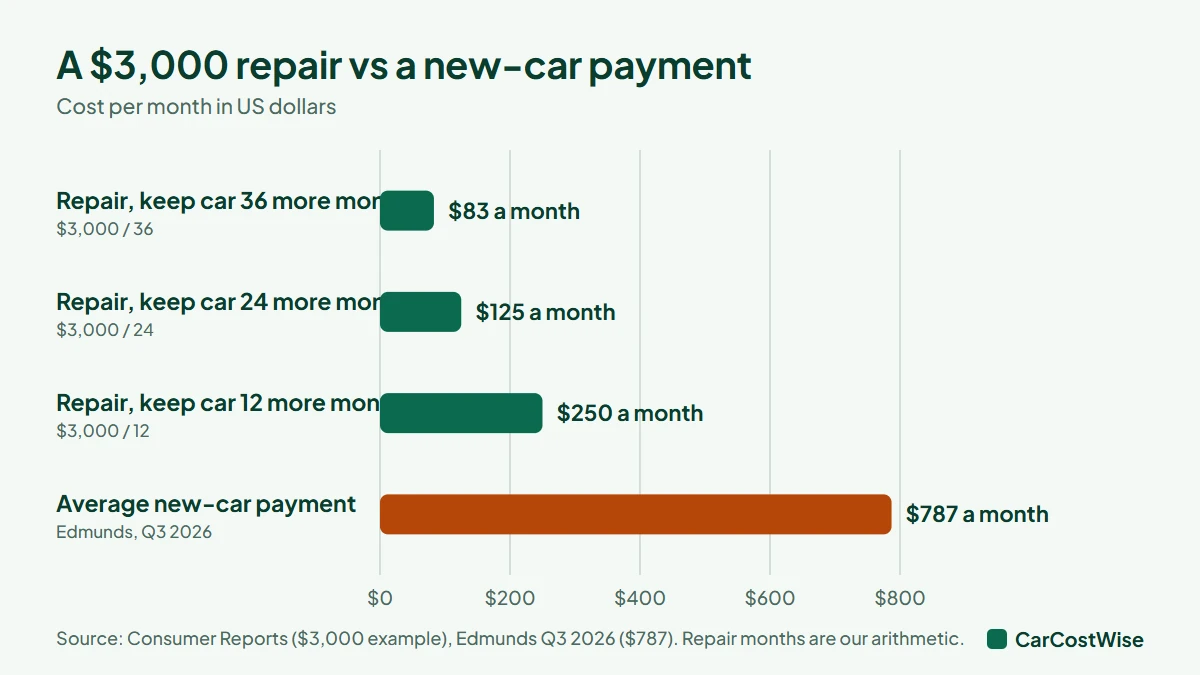
Today’s replacement payments are higher than that $500 example. Edmunds reported in its Q3 2026 data, as covered by Auto Remarketing, that the average monthly payment on a financed new vehicle reached a record $787, with an average of $44,664 financed. Here is what a $3,000 repair looks like against that figure:
| Months you keep the car after the repair | Repair cost per month ($3,000) | Average new-car payment (Q3 2026) |
|---|---|---|
| 12 | $250 | $787 |
| 24 | $125 | $787 |
| 36 | $83 | $787 |
The repair column is simple division, and the payment is the Edmunds average. It leaves out insurance, tax and registration on the replacement, and it leaves out the chance that your old car needs another repair. It also assumes the repair actually buys the time you expect, which is why the next test matters.
How much does it cost to own a new car instead?
A payment is only part of the bill. AAA’s 2025 Your Driving Costs study puts the average cost to own and operate a new car at $11,577 a year. That figure is averaged over five years and 75,000 miles and includes:
- Depreciation: $4,334 a year
- Finance: $1,131 a year
- Insurance: $1,694 a year
- License, registration and taxes: $813 a year
- Fuel: 13 cents a mile
- Maintenance, repair and tires: 11.04 cents a mile
The last line is worth noticing. At 15,000 miles a year, 11.04 cents a mile is about $1,656 a year (our arithmetic) for maintenance, repair and tires on a new car. An older car costs more to keep running, but it avoids most of the depreciation and finance lines. Consumer Reports notes that the average used car costs around $26,000, according to Cox Automotive, so moving to a used replacement is not cheap either.
When should you stop repairing a car?
Money is not the only signal. These are the situations where replacing starts to make more sense:
- The repair is more than half the car’s value and the car has other known problems (AAA’s rule).
- The car is chronically in the shop. Consumer Reports says that if your car is chronically in need of repairs, it might be time to buy a new or used replacement that is more reliable.
- The car is near the end of its life. NerdWallet says a car under 12 years old and within its first 150,000 miles that has been maintained likely still has life left. It adds that most modern gasoline cars start to struggle after about 200,000 miles, and electric cars can usually reach about 300,000 miles before being considered well used.
- The repair is a safety issue you cannot fix cheaply or the car no longer passes inspection or emissions.
- You are not tied to it by a loan. If you owe more than the car is worth, a replacement means financing the old balance as well, so run the full numbers before trading.
When is it worth fixing an old car?
Fixing is usually the better move when most of these are true:
- The quote is well under half the car’s trade-in value.
- The repair, divided over the months you will keep the car, costs far less than a new payment.
- The car has a decent maintenance history and no other big repair on the horizon.
- The car is paid off, or the loan balance is lower than its value.
- You can live without the extra safety and fuel-economy features of a newer car.
Consumer Reports’ chief technician at its Auto Test Center, John Ibbotson, points out that you probably know the problems of the car you have, while buying another could open up a whole new set of them. That is especially true if you are shopping below $15,000, where cars tend to be older, higher-mileage and in need of more work.
Should you sell the car instead of repairing it?
Sometimes selling as-is beats both options. NerdWallet points out that if a shop quotes $2,000 to repair your air conditioning, your car’s value does not automatically drop by $2,000 if you skip the repair. Dealers and online retailers can repair problems more cheaply than you can, so they price the car accordingly. NerdWallet recommends getting a trade-in offer before you invest in repairs, especially if the car already has a low value. If you must have the car to get around and cannot afford a replacement, you will need the repair either way.
A practical order of operations:
- Get a written repair quote, and a second quote if the repair is large.
- Get the car’s trade-in value from a dealer or online buyer.
- Run the 50 percent test and the monthly test.
- Check how much you owe, and whether the replacement payment fits your budget.
- Decide, and keep the quote in case the same problem returns.
How do you run the numbers yourself?
The two tests above take about five minutes. If you want to compare several repairs, mileage and a replacement payment side by side, use our calculator.
How do you avoid the next big repair bill?
The cheapest repair is the one you catch early. Consumer Reports quotes RepairPal’s Kathleen Long saying the key is to stop delaying needed maintenance, especially on an older car, because ignoring small problems leads to larger and slower repairs. Fix oil and coolant leaks, replace worn suspension and driveline parts, and keep up with fluid changes from the owner’s manual.
It also pays to know what common repairs cost before you get a quote. See our guides to car battery replacement cost and wheel bearing replacement cost, read check engine light flashing before you drive a car with an active misfire, and see the P0420 code guide for a typical big-ticket repair. For more on buying and keeping cars, browse more buying guides and more ownership cost guides.
FAQ
Is it worth fixing a car that is worth less than the repair?
Not always, but be cautious. AAA says to consider replacing when a repair passes 50 percent of the car’s value. If the repair costs more than the car is worth, run the monthly test and get a trade-in offer first. Selling as-is can beat paying for repairs on a low-value car.
What is the 50% rule for car repairs?
It is a rule of thumb from AAA: if the cost of a repair exceeds 50 percent of the car’s current value, consider replacing the car. Use it as a first screen, then check the monthly cost and the car’s overall condition.
Is it cheaper to repair or replace a car?
Usually repair, for a single repair on a reliable car. Consumer Reports says a $3,000 repair is probably better than a $500 monthly payment, and Edmunds data put the average new-car payment at $787 in Q3 2026. Replacement wins when repairs keep coming or the car is near the end of its life.
How many miles is too many to keep repairing a car?
There is no single number. NerdWallet says a maintained car under 12 years old and within 150,000 miles likely has life left, and that gasoline cars often struggle after about 200,000 miles. Maintenance history matters more than the odometer alone.
Should I repair my car if I still owe money on it?
Check the loan first. If you owe more than the car is worth, buying a replacement means financing the old balance as well, which can make repairing the cheaper choice. Compare the repair cost with the full cost of the new loan.
Sources
- AAA Club Alliance, “When to Replace or Repair a Car” (50 percent rule)
- Consumer Reports, “Used-Car Prices Are High, So Consider Fixing the Car You Already Own” (updated January 29, 2026; monthly cost test, $3,000 vs $500 example, Cox $26,000 used price)
- NerdWallet, “Should I Sell My Car or Repair It?” (updated November 18, 2025; mileage and trade-in guidance)
- Auto Remarketing, “Edmunds spots 6 new records…” (October 1, 2026; $787 average payment, $44,664 financed)
- AAA, Your Driving Costs 2025 fact sheet ($11,577 a year; category costs)
Values and payments change with your car, loan and local market. Rules of thumb are starting points, not guarantees.
Updated October 2026. By Rasel Hakkani.
This article is general information, not financial or mechanical advice. Get a written quote for your vehicle.