Direct answer: For a new car, December is the best month, according to Edmunds, which has found the largest average discounts off MSRP then, with the deepest cuts in the last week of the month. For a used car, the strongest months are November through January. iSeeCars found January had 41 percent more deals than average, and June had 30 percent fewer. Timing helps, but only if you are ready to buy.
What is the best month to buy a new car?
The widely cited answer is December. Edmunds transaction data, summarized in a December 2025 report distributed by the Associated Press, shows that December has historically had the highest average discounts off MSRP for new and used cars. The deepest discounts of the year come in the final week of December, when dealers face monthly and annual sales deadlines.
There are several reasons, and they explain when the effect is strongest:
- Year-end quotas. Manufacturers and dealers push to meet annual sales targets with cash back, financing offers and price cuts.
- Outgoing inventory. Previous model-year vehicles take up space and lose value as new models arrive. Edmunds said last December that 2025 model-year vehicles were getting the largest discounts.
- Inventory tax. In a handful of states, dealers pay tax on lot inventory as of January 1, which adds pressure to sell vehicles that have been on the lot for 90 days or more by December 31.
- Financing offers. Automakers bundle low rates with clearance deals. Edmunds’ research cited promotional financing of 0 percent, or even 2 percent, compared with a standard rate of 6 to 7 percent at the time.
One caution comes from Edmunds itself. A Santander Consumer USA summary of Edmunds data notes that the December pattern faded for several years during the COVID-19 pandemic, when low inventory kept prices high, and returned in 2023, when December again had the highest discounts. A pattern that has broken once can break again, so treat it as a tendency, not a guarantee.
What is the best time to buy a used car?
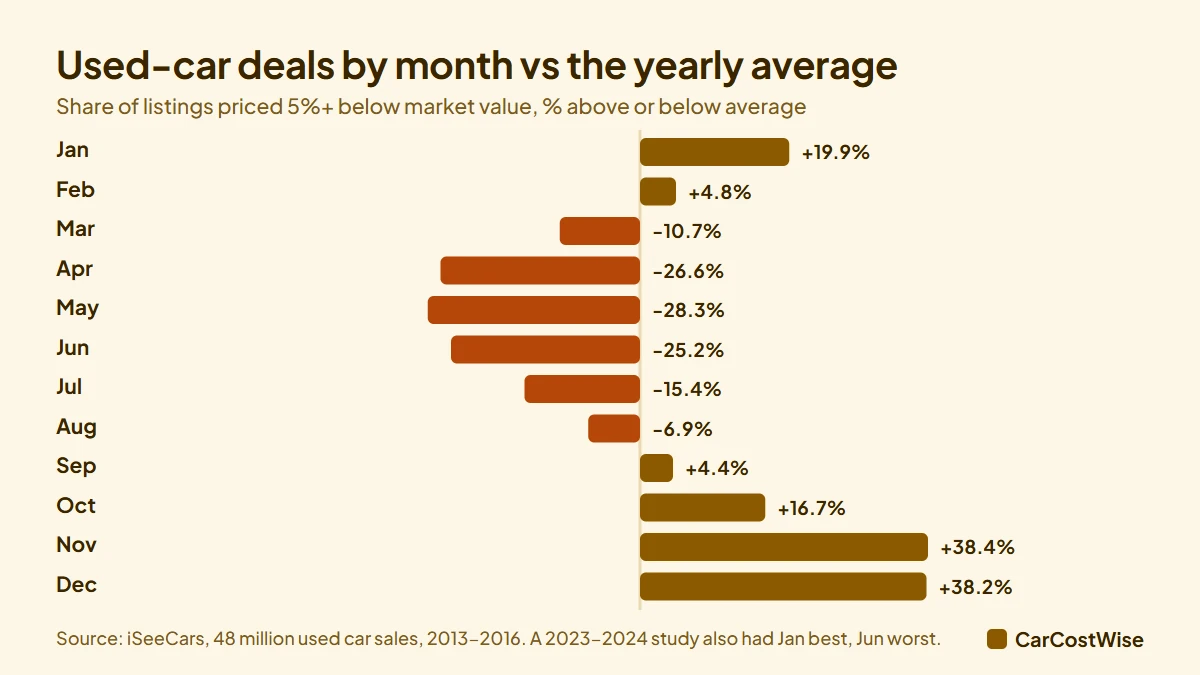
Used cars follow a slightly different calendar because there is no model-year change and no manufacturer quota. The best evidence comes from iSeeCars, which counts a car as a deal when it is listed at least 5 percent below its estimate of fair market value. Two of its studies, a decade apart, point the same way.
| Study | Best months (more deals than average) | Worst months (fewer deals) |
|---|---|---|
| 2013 to 2016, 48 million sales of 1 to 5 year old cars | November +38.4%, December +38.2%, January +19.9%, October +16.7% | May -28.3%, April -26.6%, June -25.2%, July -15.4% |
| 2023 to 2024, nearly 40 million used car sales | January +41.1%, December and February both over +30% | June -30.4%, May -27.8%, July -22.5% |
The older study is on iSeeCars’ own page; the newer one is as reported by SlashGear in August 2025. The ranking has shifted slightly, with January moving ahead of November, but the winter months win and the late spring and summer months lose in both.
Edmunds’ own used-car guide, as shown in its search listing, says the best time to buy a used car should be October and November, and that no seasonal trend has held up consistently since the pandemic. The takeaway is that late fall through January is the sweet spot, and May through July is the time to avoid.
Which days and holidays have the best deals?
iSeeCars also ranked individual holidays. In the 2023 to 2024 data, New Year’s Eve and New Year’s Day tied for the best, with 47.9 percent more deals than average. Martin Luther King Jr. Day and Presidents’ Day also saw notable price drops. The worst were Father’s Day, July 4th and Juneteenth, each with at least 30 percent fewer deals. The 2013 to 2016 study found a different top ten, led by Veterans Day at 43.2 percent more deals and Black Friday at 37.5 percent, followed by Christmas Eve, Thanksgiving Day and Christmas Day. Its worst were Mother’s Day, Memorial Day and Father’s Day.
Two points matter more than the exact order:
- Winter holidays beat summer ones. Memorial Day and July 4th may be heavily advertised, but the data says you are less likely to find a good price.
- End of the month may help. The Santander summary of Edmunds data notes that dealers trying to meet monthly sales goals may be more willing to negotiate near the end of the month. It gives no specific dates.
What does a year-round buying calendar look like?
Here is how the evidence breaks down by month. New-car comments come from Edmunds, and used-car figures are from iSeeCars. Where the sources do not give a number, we say so.
| Month | New cars | Used cars |
|---|---|---|
| January | Prior-year models may still be discounted | Best or near-best month (+41.1% in 2023 to 2024) |
| February | No clear data | Over +30% in 2023 to 2024 |
| March to May | No clear data | Weak; May is 27 to 28% below average in both studies |
| June to July | No clear data | Weakest; June is 25 to 30% below average |
| August to September | New model-year arrivals begin; older stock begins to be cleared | Mixed; September +4.4% in 2013 to 2016 |
| October | Discounts begin to build, per Edmunds | Strong (+16.7% in 2013 to 2016) |
| November | Black Friday through New Year sales events begin | Among the best (+38.4% in 2013 to 2016) |
| December | Highest average discounts; deepest in the last week | Over +30% in both studies |
The pattern is a long off-season from October to February in which buyers have the advantage, and a spring and summer stretch in which they do not.
What is different about the car market in 2026?
The calendar matters less when the market is unusual. Three figures show what buyers face right now.
First, prices are high. The September 2026 Kelley Blue Book report from Cox Automotive put the average new-vehicle transaction price at $50,562, only $52 below the all-time record of $50,614 set in December 2025. Average MSRP was $52,342.
Second, incentives are thinner. They averaged 6.6 percent of the transaction price, or $3,359, in September 2026, down from 7.3 percent a year earlier and 8.8 percent lower in dollar terms. Cox also said next-model-year vehicles arrived more slowly than usual, which may leave more prior-year stock on lots into the winter (that part is our inference, not a Cox forecast).
Third, payments are at records. Edmunds reported in its Q3 2026 data, as covered by Auto Remarketing, that the average monthly payment on a financed new vehicle reached $787, with an average of $44,664 financed.
If prices are this high, a December discount matters more, not less, because every percentage point is worth about $500 on a $50,000 car.
How much can good timing save?
Two things add up: the lower price and a better loan rate. The loan part is easy to calculate. Suppose you finance the average $44,664 over 60 months. This is our arithmetic using the rates Edmunds described.
| Loan rate | Monthly payment | Total interest over 60 months |
|---|---|---|
| 2% (promotional) | about $783 | about $2,300 |
| 7% (standard) | about $884 | about $8,400 |
A year-end 2% promotional rate would save about $100 a month and $6,100 in interest compared with a 7% loan. That is bigger than most price discounts. The catch is that promotional rates are often tied to specific models and to buyers with excellent credit, so confirm the terms before you plan around one.
On the price side, the average incentive in September was $3,359. Dealers sometimes add their own discount on top. Compare the out-the-door price, which includes tax, fees and any add-ons, not just the sticker price or monthly payment.
How much does the best month improve your odds?
It helps to translate the percentages. In iSeeCars’ 2013 to 2016 study, the probability of finding a deal, meaning a car listed 5 percent or more below market value, was 22.2 percent on an average day. A month with 38.4 percent more deals, like November, lifts that to about 31 percent, and a month 28.3 percent below average, like May, cuts it to about 16 percent (our arithmetic). So the best months roughly double your chance of finding a bargain compared with the worst ones, but even in November most listings are not deals.
That is the real lesson for a used-car shopper. Timing raises the odds, and your preparation does the rest. Compare each listing with its market value, watch how long it has been for sale, and be ready to walk away. For a new-car shopper, the same idea applies to incentives: check what the manufacturer is offering on the exact model, because a rebate on one trim does not apply to the next.
Is it better to wait for the best time or buy when you need a car?
Edmunds’ own guide says the best time to buy is when you need a car and are ready to buy, whatever the season. That is good advice, because waiting for December only helps if your current car lasts that long. A car that needs a $4,500 transmission in September should be handled in September. Our guide to transmission replacement cost vs car value shows how to decide, and is it worth fixing my car covers the 50% rule and the monthly test.
If you do have time, you can use the calendar:
- Start in October. Research models, get your trade-in valued and see what incentives are listed.
- Get pre-approved. A rate from your bank or credit union gives you something to compare with the dealer’s offer.
- Shop across dealers. Email several for out-the-door quotes, and use the lowest to negotiate.
- Watch the last week of December. That is when Edmunds says discounts deepen.
- Avoid the holiday rush. Edmunds’ guide, again from its search listing, warns that holiday sales bring busier dealerships, less selection and longer waits, and advises doing your research beforehand and closing the deal soon after the weekend.
What else affects the price besides the month?
Model-year timing, your trade-in and your own preparation matter as much as the calendar. Santander, citing Edmunds, says new model-year vehicles start arriving in August and September, which pushes older stock toward clearance. Your credit score sets your rate, and a trade-in or private sale changes your net cost. A small December discount can still cost more than a car you negotiate well in another month.
To see the whole cost, not only the purchase price, use our calculator.
Free calculator
See what a car really costs per year, including insurance, fuel and repairs.
For more on buying, browse our more buying guides hub, and see hybrid vs gas break even if you are comparing a hybrid with a gas car. Gas is $4.33 a gallon right now, so fuel economy is worth weighing.
FAQ
What is the best month to buy a car?
December is best for new cars, according to Edmunds data, with the deepest discounts in the final week. For used cars, iSeeCars found January had 41 percent more deals than average in 2023 to 2024, with November and December close behind in earlier data.
Is it better to buy a car in December or January?
December is usually better for new cars because of year-end quotas and the January 1 inventory-tax deadline in some states. For used cars, January is as good or better, and New Year’s Eve and New Year’s Day are the top holidays, with 47.9 percent more deals than average.
What is the worst time of year to buy a car?
For used cars, late spring and summer. iSeeCars found June had 30.4 percent fewer deals than average in 2023 to 2024, with May and July also poor. Father’s Day, July 4th and Juneteenth were the worst holidays, with at least 30 percent fewer deals.
Is it cheaper to buy a car at the end of the month?
Often, yes. Dealers trying to meet monthly sales goals may be more willing to negotiate in the last days of the month, according to Edmunds-based summaries. The effect is strongest at the end of December, the end of the year.
Do car prices drop after Christmas?
Not always. iSeeCars found January and New Year’s Day among the best times for used cars, while Edmunds says the deepest new-car discounts come in the final week of December, before the year ends.
Sources
- Edmunds contributor Josh Jacquot via AP (News4Jax), “December is a great time to buy a new car, and this is why” (December 10, 2025)
- Santander Consumer USA, “When is the best time to buy a car?” (November 7, 2024; summarizes Edmunds data)
- iSeeCars, “Best Time to Buy a Used Car” holiday study (48 million sales, 2013-2016)
- SlashGear, “This Is The Worst Time Of Year To Buy A Used Car” (August 16, 2025; iSeeCars data, 2023-2024)
- Cox Automotive, September 2026 Kelley Blue Book Average Transaction Price report
- Auto Remarketing, “Edmunds spots 6 new records…” (October 1, 2026)
- Edmunds, “When Is the Best Time to Buy a New Car?” (as summarized in search results; the page was not retrievable)
Discounts and incentives vary by brand, model, region and month, and past patterns do not guarantee future ones. Compare real quotes from several dealers.
Updated October 2026. By Rasel Hakkani.
This article is general information, not financial advice. Check current offers before you buy.