

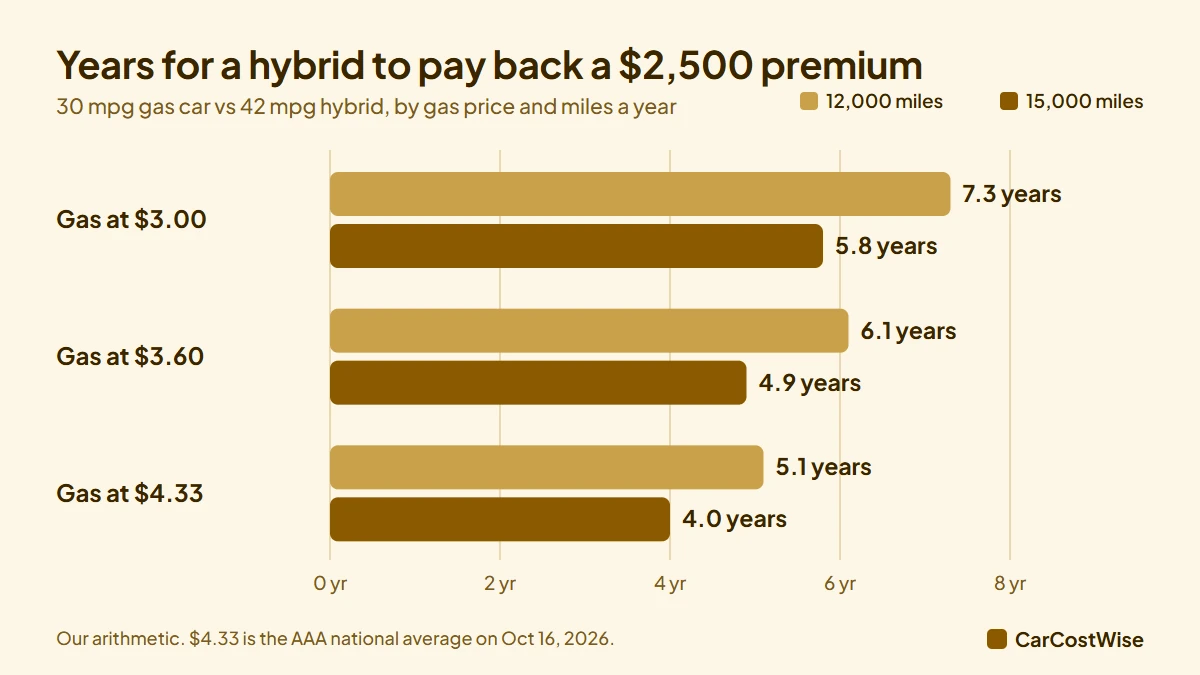
Direct answer: A hybrid pays off when the fuel it saves each year adds up to its extra purchase price. Divide the price premium by your yearly fuel savings. With a $2,500 premium, a 30 mpg gas car against a 42 mpg hybrid and gas at $4.33, break-even takes about 4 years at 15,000 miles a year and 5 years at 12,000. At $3.00 gas it stretches to 6 to 7 years.
How do you calculate hybrid vs gas break-even?
The break-even point is the moment your cumulative fuel savings equal the extra money you paid for the hybrid. The formula has three steps:
- Find the price premium. Compare the hybrid with the closest gas version of the same car, with similar trim and options, after any incentives or discounts.
- Find the yearly fuel savings. Take your annual miles and divide by each car’s combined mpg to get gallons used, subtract the hybrid’s gallons from the gas car’s, and multiply by the price of gas.
- Divide. Premium divided by yearly savings is the break-even time in years.
The U.S. government’s fueleconomy.gov uses the same logic. Its Save Money page shows that a 30 mpg car costs $900 less to fuel each year than a 20 mpg car, based on 15,000 miles and $3.60 a gallon, which is $4,500 over five years. The government’s hybrid comparison calculator at fueleconomy.gov pairs a hybrid with a comparably equipped non-hybrid from the same manufacturer and estimates the savings and payback. It leaves out insurance, maintenance and resale value, so it measures fuel only.
Here is the formula in miles instead of years. Fuel saved per mile is the gas car’s gallons per mile minus the hybrid’s. For a 30 mpg car against a 42 mpg hybrid that is 1/30 minus 1/42, or about 0.0095 gallons per mile. At $4.33 a gallon that saves about 4.1 cents every mile, so a $2,500 premium is recovered after roughly 60,000 miles.
How long does a hybrid take to pay for itself?
It depends mostly on two things you control, your mileage and the premium, and one you do not, the price of gas. The table below holds the car constant (a 30 mpg gas car against a 42 mpg hybrid with a $2,500 premium) and changes only the gas price and miles driven. These are our arithmetic using the formula above, not survey results.
| Gas price | Yearly savings at 12,000 miles | Break-even at 12,000 miles | Yearly savings at 15,000 miles | Break-even at 15,000 miles |
|---|---|---|---|---|
| $3.00 | $343 | 7.3 years | $429 | 5.8 years |
| $3.60 | $411 | 6.1 years | $514 | 4.9 years |
| $4.33 | $495 | 5.1 years | $619 | 4.0 years |
A few lessons come out of the numbers. Every extra 3,000 miles a year cuts the wait by a year or more. Gas at $4.33 instead of $3.00 shortens it by about two years. And with a $2,500 premium, even the best case is four years. A bigger premium hurts quickly: at $4,000 the same car takes about 8 years at 12,000 miles and $4.33 gas (our arithmetic).
What is the gas price now, and where is it heading?
Break-even math was dull when gas averaged about $3. It is more interesting now. AAA put the national average for regular at $4.327 a gallon on October 16, 2026, compared with $3.057 a year earlier. The U.S. Energy Information Administration reported $4.331 for the week of October 12 on its gasoline and diesel page, and its October Short-Term Energy Outlook (released October 6) says September averaged $4.35 and forecasts a 2026 average of $3.91 a gallon, falling to $3.56 in 2027.
That matters for a purchase you will own for years. If you bought a hybrid today and gas drifted back toward the EIA’s 2027 forecast, you would be close to the $3.60 row of the table. If prices stay above $4, the $4.33 row is the better guide. Because nobody knows which way gas goes, run both cases and be skeptical of any break-even number built on a single gas price.
What do real hybrid vs gas examples show?
Real cars rarely match a clean example, because the hybrid often comes with a different trim, more standard equipment and a different price gap. Three published analyses show the range.
Honda CR-V Hybrid (JATO, May 2026). Carscoops reported JATO’s comparison of the CR-V Sport-L Hybrid AWD at $40,225 and the CR-V EX-L AWD at $36,900, a $3,325 premium, with 37 mpg combined for the hybrid and 28 mpg for the gas car. With gas at the January 2026 national average of $2.81, JATO calculated that a buyer would need to drive about 159,000 miles to recover the difference. At $4.51 on May 25 it fell to about 100,000 miles. After incentives shrank the gap to $2,900, break-even was 86,000 miles (6.4 years) with gas at $4.50 and 65,000 miles (4.8 years) at $6.00. If you plug the same mpg figures into our formula you get a somewhat shorter distance, about 85,000 miles at $4.51, so the study evidently used other inputs. Either way the lesson holds: a $3,000-plus premium needs more than five years at a normal pace.
Consumer Reports (2026 sticker prices). Consumer Reports calculates payback with its own real-world mpg, 2026 sticker prices, 12,000 miles a year and gas at $4.47 for regular. It says the Honda Accord Hybrid takes about nine years to pay off against the most similar gas version, and a Subaru Crosstrek Hybrid could take between six and 24 years depending on equipment. It left the Accord Hybrid and Hyundai Tucson Hybrid off its money-saving list because their paybacks exceed five years. It adds that if gas rises further or you drive more, the payback periods will shrink.
Hybrid-only models. Consumer Reports also notes that the Toyota Camry, Prius, RAV4, Sienna and Lexus ES are now sold only as hybrids. For those there is no gas version to compare, so break-even does not apply. The question becomes whether you would pay more for a similar car from another brand.
The common thread is that the price gap, not the fuel savings, drives the answer. A hybrid trim that adds leather seats and a bigger screen is a different car, and some of the premium buys features rather than efficiency.
Is a hybrid cheaper to own over five years?
Fuel is only one line. AAA’s Your Driving Costs 2025 study, which prices new cars over five years and 75,000 miles, found these per-mile ownership costs by vehicle category:
| Category | Cost per mile (all costs) | Yearly cost at 15,000 miles |
|---|---|---|
| Small sedan | 55.87 cents | $8,381 |
| Hybrid | 63.94 cents | $9,591 |
| Subcompact SUV | 66.11 cents | $9,917 |
| Medium sedan | 66.37 cents | $9,956 |
| Compact SUV | 68.53 cents | $10,280 |
The per-mile figures are AAA’s; the yearly column is our arithmetic. AAA describes hybrids as the second-cheapest category for fuel, behind EVs, and third lowest in maintenance and depreciation. That is encouraging, but be careful with the comparison. AAA’s categories are not like-for-like, because a hybrid in its sample is a different size and price from a compact SUV. Use the table to see that hybrids are competitive on total cost, and use the break-even formula to compare one specific hybrid with its own gas twin.
AAA’s fuel assumption is also out of date for this autumn. It priced gas at an average of $3.151 a gallon over the 12 months ending May 2025, so at today’s $4.33 a gallon every category’s fuel line is higher, and the gap between efficient and thirsty cars is wider.
What can make a hybrid worth less than the math says?
Break-even math is clean, and real life adds a few wrinkles.
- Financing the premium. If you borrow the extra $2,500, interest adds to the premium. At a 7 percent rate over 60 months that is about $470 (our arithmetic). Edmunds describes standard financing rates as 6 to 7 percent, according to an AP report it contributed to.
- Lease and incentive swings. Carscoops noted that in April 2026 Honda’s lease incentives roughly equalized the monthly payments on the hybrid and gas CR-V, and in May they tilted back toward the gas model. If the dealer is discounting one more than the other, your premium changes.
- Low mileage. A car driven 6,000 miles a year saves half as much as one driven 12,000, so the same premium takes twice as long to recover.
- Trim mismatches. Compare equal trims. A $3,000 premium that includes $2,000 of added equipment is really a $1,000 premium.
- Keeping the car. Break-even only matters if you keep the hybrid long enough. Ownership for under four or five years leaves you with savings you have not finished collecting, unless resale value makes up the difference.
When does a hybrid clearly pay off?
Hybrids tend to win when several of these line up:
- The premium is small, under about $2,000, or incentives have cut it.
- You drive 12,000 miles a year or more.
- Your gas price is high. It is currently above $4 in much of the country, and AAA lists California at $6.22 and Washington at $5.41 on October 16, against $3.67 in North Carolina.
- The mpg gap is large, at least 10 mpg combined.
- You plan to keep the car for at least five to six years.
It tends to lose when you drive little, the premium is large, or the hybrid is a trim whose extra mpg is only a few points. A small mpg gain on a large premium is the kind of pairing that never pays back.
How do you run the numbers for your own car?
Collect four numbers: the price of the hybrid and gas versions with identical equipment, each car’s combined mpg from the EPA label or fueleconomy.gov, your annual miles, and a local gas price. Then do the division, or let a calculator do it.
Free calculator
Compare gas, hybrid and electric running costs for your own car.
For a simpler look at the fuel side alone, try our fuel cost and mpg tools, and see car ownership cost for the whole picture, including insurance, depreciation and repairs. Our guide to the is it worth fixing my car covers the other big money decision, whether to repair an older car or replace it, and our more fuel cost guides hub collects the rest of our fuel cost guides.
FAQ
How many years does it take for a hybrid to pay for itself?
Usually 3 to 7 years, depending on the premium, your mileage and the price of gas. With a $2,500 premium and a 12 mpg gap, break-even is about 4 years at 15,000 miles and $4.33 gas, and about 7 years at 12,000 miles and $3.00 gas. Larger premiums push it past 9 years.
Is a hybrid worth it if I drive less than 10,000 miles a year?
Often not on fuel savings alone. At 6,000 miles a year the same savings take twice as long to collect as at 12,000 miles. If the premium is under about $1,500, or you value the quieter ride and lower emissions, it can still make sense.
Do hybrids save money when gas is cheap?
Less so. At $3.00 a gallon the $2,500-premium example takes 5.8 to 7.3 years, versus 4 to 5 years at $4.33. JATO calculated that a Honda CR-V Hybrid would need about 159,000 miles to break even with gas at $2.81.
Is a hybrid more expensive to maintain?
AAA’s 2025 study ranked hybrids third lowest in maintenance costs among its vehicle categories, so there is no clear penalty, though the study does not isolate hybrid components. Check the warranty on the battery and hybrid system, which varies by manufacturer.
What is the average price premium for a hybrid?
It varies widely by model. JATO’s Honda CR-V Hybrid example was $3,325 over the EX-L, or $2,900 after incentives. Check the current gap for the exact trims you are considering, and always compare equal trims.
Sources
- AAA, Gas Prices (national and state averages, October 16, 2026)
- U.S. Energy Information Administration, Gasoline and Diesel Fuel Update (week of October 12, 2026)
- U.S. Energy Information Administration, Short-Term Energy Outlook (released October 6, 2026)
- Carscoops, “Hybrid breakeven study” (JATO analysis, May 25, 2026)
- Consumer Reports, “12 Hybrids That Save You the Most Money on Gas” (2026 sticker prices, $4.47 gas, 12,000 miles)
- AAA, Your Driving Costs 2025 fact sheet (cost per mile by category)
- fueleconomy.gov (U.S. DOE and EPA), Save Money page and Hybrid Cost Calculator and second source
- Edmunds contributor Josh Jacquot via AP (News4Jax, December 10, 2025; 6-7% standard financing rates)
Prices, premiums and mpg ratings change with the model year and trim. The table in this article is an illustration built from the formula shown, not a quote for any specific car.
Updated October 2026. By Rasel Hakkani.
This article is general information, not financial advice. Check current prices and incentives before you buy.