
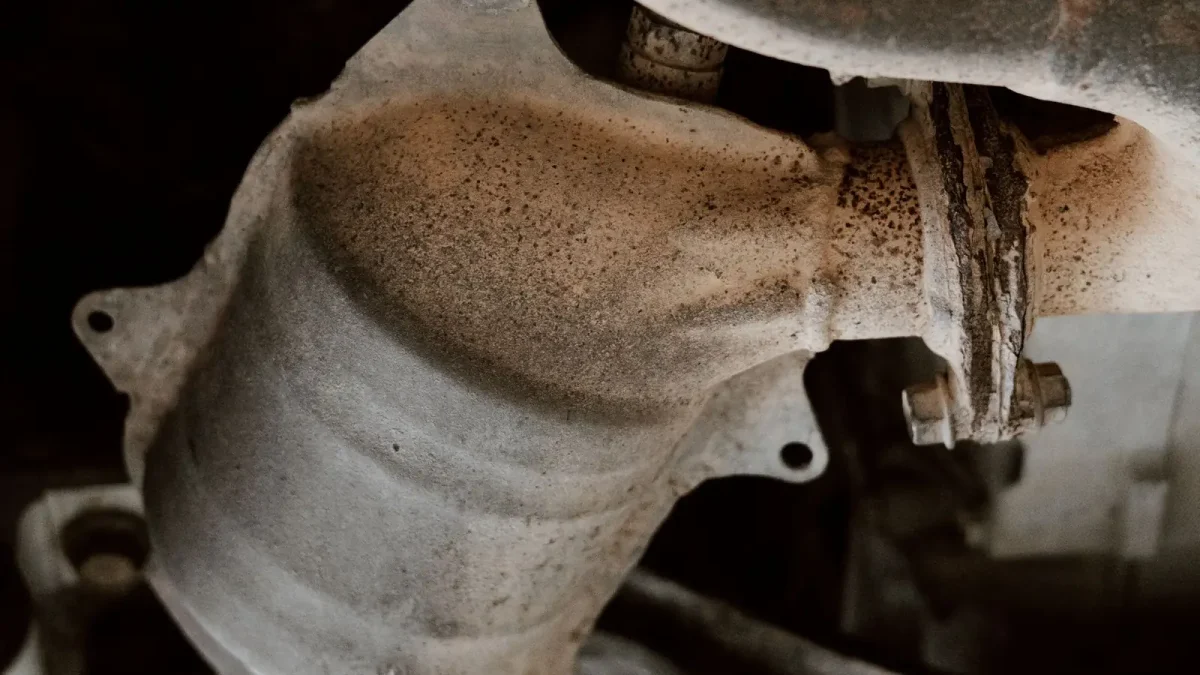
Direct answer: P0420 means your car’s computer thinks the catalytic converter on engine bank 1 is not cleaning exhaust well enough. The cause is often a worn converter, but a bad downstream oxygen sensor or an exhaust leak can set it too. Expect roughly $150-$400 for a sensor fix, or about $400-$2,500 if the converter itself must be replaced.
Quick facts
| Official name | Catalyst System Efficiency Below Threshold (Bank 1) |
| Severity | Moderate. Not an emergency by itself, but do not ignore it for months |
| Can I drive it? | Usually yes for a short time, if the engine runs smoothly and the light is solid (not flashing) |
| DIY difficulty | Easy to read the code; sensor swap is moderate; converter swap is hard (often a welded part) |
| Typical cost | About $150-$400 for a downstream O2 sensor; about $400-$2,500 for a converter (sources disagree, see table) |
| Passes an emissions test? | No. An active P0420 usually means an automatic fail |
What does the P0420 code mean?
Your engine has an oxygen sensor before the catalytic converter (upstream) and one after it (downstream). The upstream sensor reading swings up and down quickly as the engine adjusts fuel. A healthy converter smooths out that exhaust, so the downstream sensor reading stays fairly flat. When the downstream signal starts to look like the upstream one, the computer concludes the converter is no longer doing its job and sets P0420.
“Bank 1” is the side of the engine that holds cylinder number 1. On a four-cylinder engine there is only one bank, so P0420 is the code you will see. On many V6 and V8 engines the matching code for the other side is P0430.
Note what the code does not say. It does not say “replace the converter.” It says the converter test failed. Several cheaper problems can cause the same failure, which is why diagnosis order matters.
What are the symptoms of P0420?
- Check engine light on (solid)
- Often no change in how the car drives, which is why people ignore it
- Slightly lower fuel economy in some cases
- A sulfur or rotten-egg smell from the exhaust in some failing converters
- Rattling from underneath the car if the internal honeycomb has broken up
- Reduced power or a sluggish feel if the converter is partly blocked
- Failing a state emissions inspection
What causes P0420? Ranked from most to least common
Order below reflects how repair guides and shops describe this code in general; exact frequency varies by vehicle and mileage.
| # | Cause | Typical fix | Cost range |
|---|---|---|---|
| 1 | Worn-out catalytic converter (age, mileage, or damage from earlier misfires or oil burning) | Replace converter | $400-$2,500 total (MechanicBase); OEM and luxury parts cost far more (see cost table) |
| 2 | Failing downstream (post-converter) oxygen sensor | Replace sensor | About $150-$400 |
| 3 | Exhaust leak before the downstream sensor (cracked manifold, leaking flange or gasket) | Weld or replace gasket/pipe section | Manifold gasket replacement $382-$547 on RepairPal’s general estimate (labor is most of it); welding or pipe sections need a quote |
| 4 | Engine misfires or rich running that overheated the converter | Fix the misfire first, then replace the converter if damaged | Varies; see P0300 code |
| 5 | Software issue on specific models (reflash fixes a false trigger) | Dealer ECU update | Ask the dealer; the emission control computer is covered by the federal 8-year/80,000-mile emissions warranty (EPA) |
| 6 | Cheap aftermarket converter that cannot pass the test | Replace with a quality or OEM-grade part | Part price difference only |
Why the converter is first but should be last to replace
A converter wears out, so it is the most common true cause. But it is also the most expensive repair, so a good mechanic rules out the cheap items first. Replacing a converter when the real fault was a leaking exhaust gasket means the light returns and you have paid for a part you did not need.
How much does it cost to fix P0420?
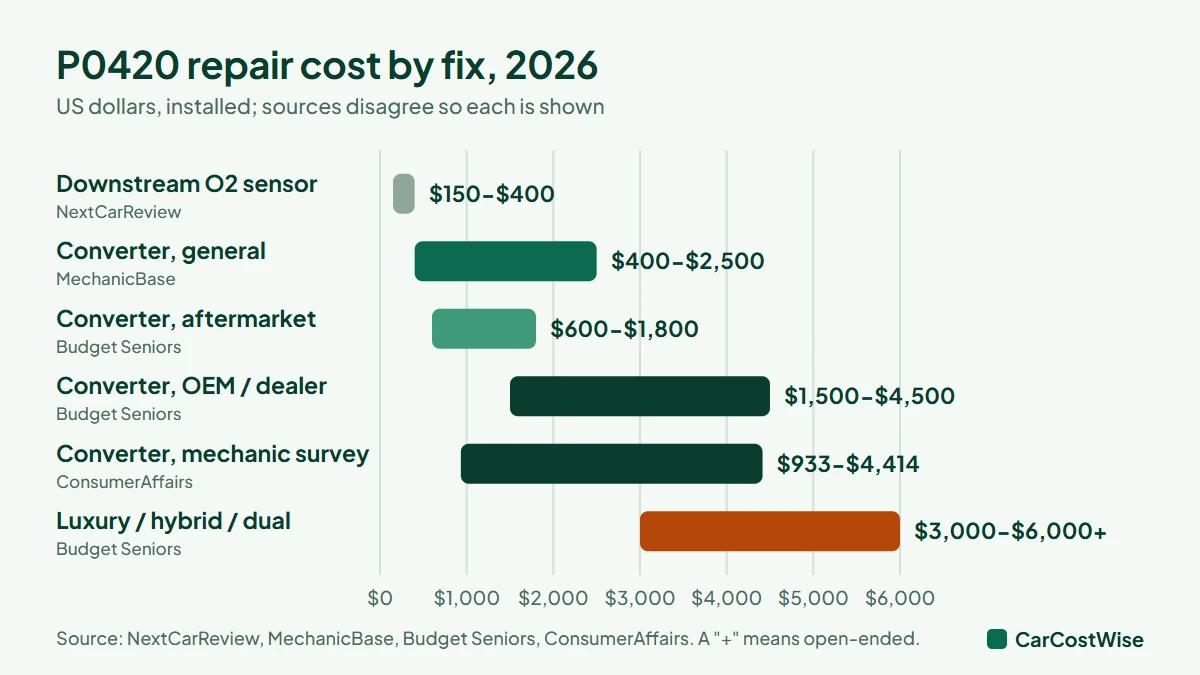
Ranges below come from published guides and parts listings. They disagree with each other, which is normal because vehicle type, one or two converters, and labor rates all change the total.
| Repair | Low | High | Source note |
|---|---|---|---|
| Diagnosis (scan + sensor data review) | $50 | $150 | $50-$100+ for an OBD-II scan in one guide; about an hour of shop labor ($75-$150) in another |
| Downstream O2 sensor, parts + labor | About $150 | About $400 | NextCarReview 2026 table; Budget Seniors cites $150-$300 per sensor. RepairPal model pages run from about $150 on older cars to over $1,000 on some late-model hybrids and luxury cars |
| Converter, aftermarket, installed | $600 | $1,800 | Budget Seniors guide |
| Converter, general range, installed | $400 | $2,500 | MechanicBase guide |
| Converter, OEM / dealer | $1,500 | $4,500 | Budget Seniors guide |
| Converter, survey of mechanics | $933 | $4,414 | ConsumerAffairs (average across sample vehicles) |
| Converter, luxury / hybrid / dual converters | $3,000 | $6,000+ | Budget Seniors guide |
| Converter part alone (direct-fit, aftermarket) | About $200 | $600+ | Spot checks of Walker and Eastern listings on retail sites, $188 to $1,021 depending on vehicle |
A few things worth knowing about these numbers:
- The part is the big cost, not labor. One guide notes the converter makes up most of the bill. AAA says labor rates run from under $100 to over $200 an hour, and that almost half of shops charge $120-$159.
- Some listings are not legal everywhere. Certain cheaper converters are marked as not legal for sale in California, Colorado and New York. If you live in a CARB state, buy a CARB-approved part.
- Anecdote, not a quote: one owner of a late-model Tahoe estimated about $650-$800 for an aftermarket converter installed. Treat forum numbers as one data point.
- Precious metals. The converter’s internal coating contains expensive metals, which is why the part is most of the bill (MechanicBase). Prices move with the metals market, so get a written quote rather than rely on last year’s number.
Is a P0420 repair covered by warranty?
Federal law requires emissions warranty coverage on specified major emission components, which are the catalytic converter, the emission control computer and the onboard diagnostic device, for 8 years or 80,000 miles (whichever comes first) on 1995 and newer light vehicles, according to the EPA. The performance warranty applies after a failed emissions test, and the manufacturer can deny a claim if the failure came from misuse or poor maintenance. California-certified vehicles have their own coverage. If your car is in that window, call a dealer before you buy anything. This single step can save $1,000 or more.
How do you diagnose P0420? Cheapest steps first
- Read all codes, not just P0420. If P0300-series misfire codes or fuel trim codes are present, fix those first. A converter damaged by misfires will fail again if the misfire remains. See P0300 code.
- Look for a known bulletin. Search your year, make and model with “P0420 TSB.” Some makers have issued software updates. For example, Subaru has published bulletins covering P0420 on certain models (09-110-23R for diagnostic procedure; 09-131-25 for a false-detection issue on 2015-2021 WRX/STI manuals). Check your own vehicle; do not assume it applies.
- Inspect the exhaust for leaks. Listen for ticking at cold start, look for black soot around joints, and check the flange gaskets. A leak ahead of the downstream sensor lets extra oxygen in and can trigger the code.
- Check live sensor data. With a scan tool that shows live data, a good converter gives a steady downstream voltage. A downstream sensor that mirrors the upstream one points at the converter. A lazy or flat sensor points at the sensor.
- Check for misfires and fuel problems. Burning oil, a leaking fuel injector, or a rich mixture all kill converters.
- Replace the downstream sensor if it is old or slow. At about $150-$400 it is the cheapest realistic fix. If the light returns, the converter was the problem.
- Replace the converter last, with a part that is legal in your state.
Do not rely on additive “catalytic converter cleaners” as a fix. Mechanic guides such as Rick’s Free Auto Repair Advice say cleaners might reduce light carbon deposits at best, and that they cannot repair a converter that is physically damaged, poisoned by oil or coolant, or melted by misfires. If the cause persists, the code returns.
Can I drive with P0420?
For a short period, usually yes, provided that:
– the check engine light is solid, not flashing,
– the engine runs smoothly with no loss of power,
– there is no strong rotten-egg smell, and
– you are not seeing overheating.
If the light flashes, stop driving as soon as you safely can. That signals an active misfire which can destroy the converter quickly. Read check engine light flashing.
Long term, driving with P0420 means you will fail an emissions inspection in states that test, and a clogged converter can eventually restrict exhaust flow and cut power. Fix it within weeks, not years.
Which cars get P0420? Model notes
We only list what we could verify. Subaru has issued service bulletins that reference P0420 on certain recent models (see step 2 above). We did not find manufacturer bulletins for Toyota, Honda or Nissan in our research, so we are not claiming any model is “known” for this code. If you own a specific car, search the NHTSA technical service bulletin database for your make and the code.
What related codes should you check?
- P0430, the same test on bank 2 (page coming)
- P0300, random misfire, a leading cause of ruined converters: P0300 code
- P0171 / P0174, lean conditions that can also stress the converter (page coming)
- More: more diagnostics guides
Is it worth repairing?
If a converter quote is more than half the value of an older car, the math changes. See our guide to repairing vs replacing a car, then use the calculator below.
FAQ
Is P0420 serious?
It is moderate. The car usually keeps running normally, but it will fail an emissions test and a failing converter can get worse. The urgent case is when the light is flashing, which indicates a misfire rather than P0420 alone.
Can a bad oxygen sensor cause P0420?
Yes. A downstream oxygen sensor that reads slowly or incorrectly can make a healthy converter look bad. Replacing the sensor is the cheapest test, at roughly $150-$400 installed.
How much does a catalytic converter cost to replace?
MechanicBase gives $400-$2,500 on average. Budget Seniors lists $600-$1,800 for an aftermarket converter, $1,500-$4,500 for OEM and $3,000-$6,000+ for luxury, hybrid or dual-converter setups, and a ConsumerAffairs survey found $933-$4,414. Get a written quote for your exact car.
Will clearing the code fix it?
No. The computer will re-run its test and, if the fault is real, the light returns, typically after a few drive cycles. Clearing the code before an emissions test also resets the readiness monitors, which can cause a not-ready fail.
Is my catalytic converter covered by warranty?
Possibly. Federal rules cover the converter for 8 years or 80,000 miles on 1995 and newer light vehicles, and the manufacturer can deny claims caused by misuse. Check with a dealer before you pay.
Sources
- MechanicBase, catalytic converter replacement cost ($400-$2,500)
- Budget Seniors, catalytic converter replacement cost guide (June 2026)
- NextCarReview, P0420 code explained (page no longer online as of October 2026; no archived copy) (2026 cost table, downstream O2 sensor $150-$400; cross-checked against Budget Seniors, $150-$300 per sensor)
- RepairPal, exhaust manifold gasket replacement cost ($382-$547)
- ConsumerAffairs, cost to replace a catalytic converter ($933-$4,414 survey)
- EPA, emissions warranty consumer guide (8 years/80,000 miles for specified major components)
- eCFR, 40 CFR Part 85 Subpart V (emission warranty regulations)
- Rick’s Free Auto Repair Advice, does catalytic converter cleaner work
- Tahoe/Yukon forum thread, owner estimate of aftermarket converter
- RepairPal, oxygen sensor replacement model pages (for example Kia Cadenza, Lexus NX450h+, Plymouth Grand Voyager)
- Walker and Eastern direct-fit listings, price spot checks and second source
- AAA, average mechanic labor rates 2026
- ConsumerAffairs, catalytic converter warranty
- NHTSA, Subaru TSB 09-131-25 (P0420 / P2404)
- Subaru TSB 09-110-23R summary
This page is general information, not professional mechanical advice. Have a qualified technician inspect your vehicle before you make repair decisions.
Updated October 2026 | By Rasel Hakkani