Direct answer: Brake pads and rotors replacement cost is about $322 to $586 per axle at a typical shop, according to Jerry‘s April 2026 estimates, and $900 or more on some luxury and performance cars. Pads alone run $148 to $216 per axle. KBB and AutoZone say $250 to $400 and $250 to $500.
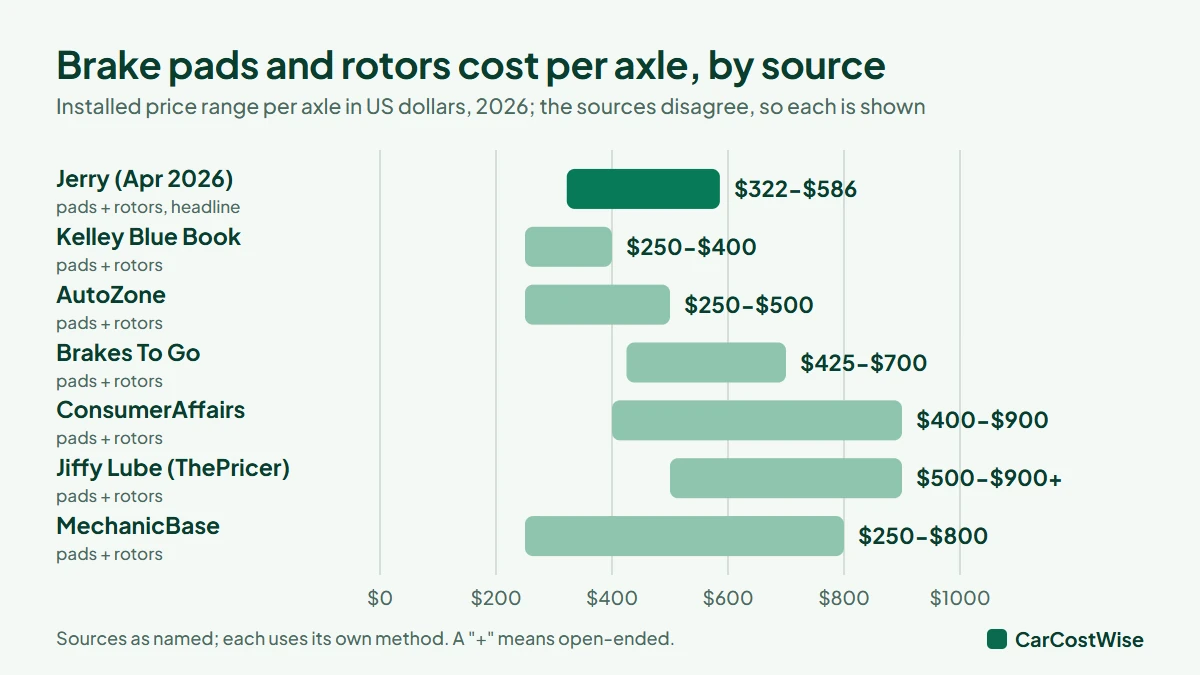
Brake pads and rotors replacement cost table (per axle)
A brake job is priced per axle, meaning the pair of wheels at the front or the pair at the rear. Sources use different methods, so the ranges overlap and we show the spread instead of one number.
| Job (one axle, installed) | Low | High | Source |
|---|---|---|---|
| Pads only | $148 | $216 | Jerry (most drivers) |
| Pads only, wider range | $115 | $270 | AutoZone |
| Pads only, shop average | $330 | $390 | RepairPal (June 2026, via ThePricer) |
| Pads and rotors | $322 | $586 | Jerry |
| Pads and rotors | $250 | $400 | KBB |
| Pads and rotors | $250 | $500 | AutoZone |
| Pads and rotors | $425 | $700 | Brakes To Go |
| Pads and rotors | $400 | $900 | ConsumerAffairs |
| Rotors added to a pad job | $150 | $400 | Jerry |
| Caliper replacement, per caliper | $250 | $600 | Jerry |
| Brake fluid flush | $90 | $160 | Jerry |
| Brake hardware kit | $20 | $80 | Jerry |
Why the spread? Some sources count parts and labor at independent shops, others at chains or dealers. Several are marketing pages written by sellers of brake work. Jerry’s $322 to $586 sits in the middle of the pack and is the most recent dated per-axle estimate we could open, so we use it as the headline range. Treat any single figure as a planning number and get a written quote.
What about all four wheels? Doing both axles roughly doubles the bill. Jerry lists $296 to $429 for pads on all four wheels and $616 to $1,092 with rotors. MechanicBase gives $500 to $1,600 for pads and rotors on four wheels, and says luxury or sports cars can pass $2,000.
How much is a brake job at each type of shop?
Where you go matters as much as what you drive.
| Shop type | Pads (per axle) | Pads and rotors (per axle) | Source |
|---|---|---|---|
| Dealer | $249 to $599 (brake service) | 15% to 40% above independent shops | DirectBrakes via ThePricer; Jerry |
| Independent shop | $200 to $500 (brake service) | $100 to $150 less than Firestone in some cities | DirectBrakes, ThePricer |
| Firestone | $250 to $320 | $350 to $470 | ThePricer (October 2025) |
| Jiffy Lube | $250 to $450 | $500 to $900+ | ThePricer (June 2026) |
Two warnings apply to this table. First, the figures are from one price-tracking site quoting other sources, so they show a pattern rather than a price list. The pattern: dealers charge the most, chains sit in the middle and independent shops are usually cheapest, but a chain coupon can beat a local shop. ThePricer says Firestone ran coupons of $100 to $120 off a brake service. Second, chain prices are set locally, so one franchise can differ from the next.
Labor drives most of the gap. Jerry puts shop labor at $100 to $200 an hour, and says labor is 30% to 50% of a brake bill. The Drive says dealers often charge $150 an hour or more, and that a straightforward job takes about one hour per axle. Jerry gives 0.8 to 1.5 hours per axle.
Is the front or rear brake job more expensive?
Front, usually. Jerry says front pads typically cost 10% to 20% more than rear pads, because the front brakes do most of the stopping, so they have a larger pad area and run hotter. MechanicBase says the front brakes are slightly more expensive than the rear, but gives no separate figures.
Rear brakes can still surprise you. Jerry lists parking brake service at $60 to $150 as an add-on, and it often comes up on the rear axle. Some cars also have drum brakes in the rear, which use shoes instead of pads and rotors, so a quote for “rear brakes” on those cars is a different job. Ask which type your car has, and whether the quote is for the front or the rear axle.
What affects the cost of replacing brake pads and rotors?
Vehicle type
Jerry puts economy sedan pads at $150 to $250 per axle, and says luxury, electric and high-performance vehicles cost 25% to 100% more. RepairPal’s pad-only estimates, as quoted by ThePricer in August 2026, show how model size matters:
| Vehicle | Brake pads, per axle (RepairPal) |
|---|---|
| Ford F-150 | $240 to $297 |
| Honda Civic | $262 to $320 |
| Chevrolet Silverado 1500 | $353 to $410 |
These are pad-only figures, and they vary by location. KBB publishes a vehicle-specific Fair Repair Range on its brake repair pages, so look up your exact model before you shop.
Pad material
Ceramic pads add 10% to 30% to the parts cost versus semi-metallic, roughly $40 to $120 per axle, according to Jerry. Ask the shop which pad material it is quoting, because a low price often means the cheapest pad.
Rotors: replace or resurface
New rotors run $40 to $80 each, and resurfacing (machining the surface flat) about $15 to $45 per rotor before labor, Jalopnik reports. AutoZone lists rotors at $30 to $75 each, with labor adding $150 to $200 per axle. ConsumerAffairs says some owners of American, Japanese and Korean cars can resurface rotors for about half the cost of replacing them. The Drive says new rotors are often the better value anyway, because the savings from machining are small.
Extras that quietly raise the bill
- Hardware: clips and springs should be replaced on every brake job, The Drive says. Jerry puts a hardware kit at $20 to $80 per axle.
- Wear sensors: electronic pad wear sensors add $25 to $80 per axle (Jerry), if your car has them.
- Brake fluid: a flush is $90 to $160 (Jerry). The Drive says brake fluid should be replaced at least every two to three years.
- Calipers: $250 to $600 installed per caliper, and Jerry says a dragging or leaking corner can reach $300 to $600 or more. Seized slide pins are $50 to $300.
- Shop fees and taxes: RepairPal’s estimates exclude taxes, disposal fees and diagnostics.
Your labor rate also depends on where you live. ThePricer, citing AAA’s 2026 labor-rate analysis, says almost half of surveyed shops charge $120 to $159 an hour, with some under $100 and some over $200.
Do you need new rotors with new brake pads?
Not always. Opinions differ, and the honest answer is that thickness and condition decide it, not a rule of thumb.
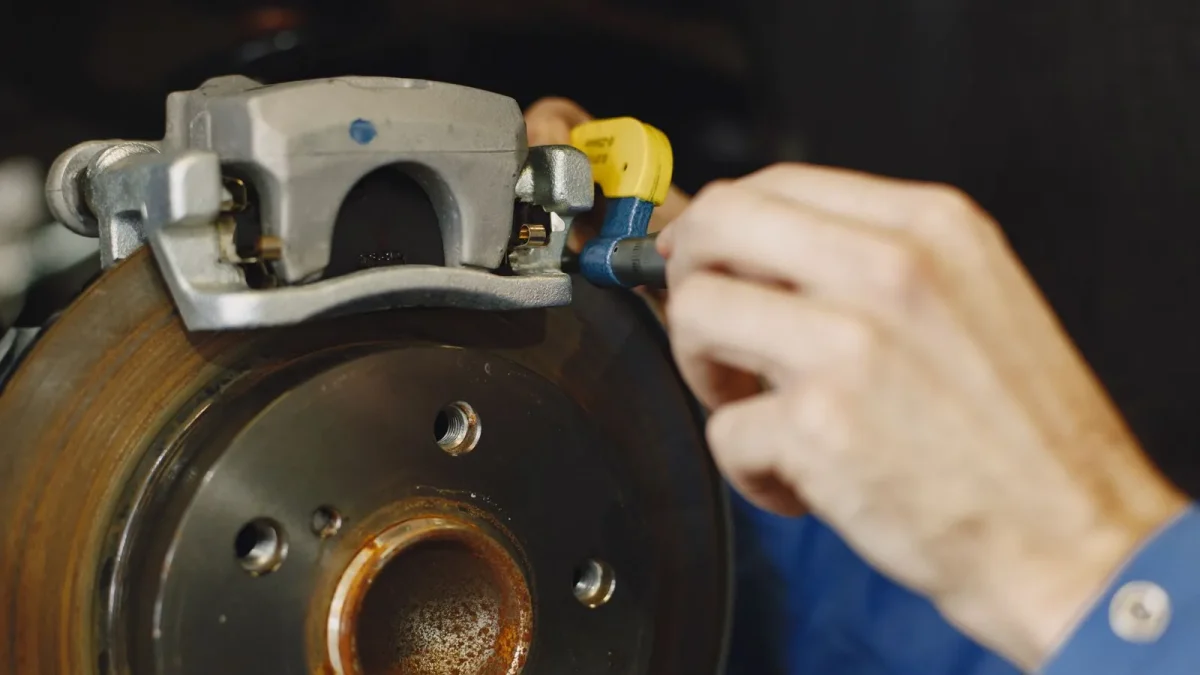
Every rotor has a minimum, or “discard,” thickness, usually stamped on the rotor or hub. Rick’s Free Auto Repair Advice (an auto repair advice site, posted in 2021) says you cannot judge this by eye: a technician measures with a micrometer in at least three places. A rotor that will be resurfaced must stay at least 0.015 inch above the discard thickness afterward.
Replace the rotors with the pads when:
- They are at or under the minimum thickness, or machining would take them under it.
- They are cracked, which makes them unfit for reuse at any thickness.
- Grooves are 0.039 inch deep or more, Rick’s says.
- They show blue or purple heat spots, or rust is clogging the cooling vanes.
- The brake pedal pulses and the rotor is too warped or uneven to be machined flat.
You can often keep them when: the surface is smooth, the thickness is comfortably above the minimum and nothing in the list above applies. Jalopnik says experts generally recommend new rotors with new pads, but that for an average Corolla or CR-V there is no reason to swap rotors that are still in good shape. GM’s service bulletin, which Jalopnik quotes, says to replace the rotors only if they do not meet the minimum thickness specification.
Parts retailers tend to recommend replacing both together, and some enthusiasts say shops push unneeded rotors. The practical move is to ask the shop for the measured rotor thickness and the minimum spec. A shop that will not tell you the numbers is worth a second opinion.
One cost tip follows from this. Jalopnik says neglect and driving on worn pads are the main causes of early rotor damage, so a pad job done at the first warning sign is the surest way to keep the rotors usable and the bill small.
How long do brake pads and rotors last?
Brake pads last roughly 25,000 to 70,000 miles (Jerry), and SlashGear puts it at about 30,000 to 35,000 miles in mostly city driving and up to 80,000 on the highway. Its rule of thumb is to replace pads at or under three millimeters of friction material.
Rotors last longer. SlashGear says 30,000 to 70,000 miles. Jalopnik says highway drivers can expect up to 60,000 miles while hard-braking drivers may need replacements around every 20,000 miles. Driving on worn pads is the main cause of early rotor damage, Jalopnik says, and many newer cars use thinner rotors to save weight, so they have less metal to spare.
If you tow, drive in hills or live where roads are salted, plan for the short end of these ranges.
What are the signs you need new brake pads or rotors?
- Squealing or squeaking when braking, which can mean the pads are low.
- Grinding, which usually means the pad material is gone and metal is touching the rotor. Stop driving more than you need to and get it checked.
- Pulsing in the pedal or a shaking steering wheel when braking, a sign of rotor trouble.
- Visible grooves, scoring, blue heat spots or heavy rust on the rotor surface.
- Longer stopping distances or a soft pedal.
- A dash warning light or a wear-sensor message on cars that have sensors.
Brakes are a safety system, so do not wait for a grinding noise to be loud. Waiting is also the expensive option: the pads are cheap, but a damaged rotor, and sometimes a damaged caliper, are not.
How can you save on a brake job?
- Get three itemized quotes. Ask each shop to list pads, rotors, hardware, fluid and labor separately, and to state whether the price is per axle. A “$99 brake special” is often pads only on the cheapest material.
- Ask for the rotor measurement. If the rotors are above the minimum and smooth, you may only need pads.
- Compare independent shops to chains and the dealer. Jerry says dealers cost 15% to 40% more than independent shops.
- Use coupons and price-match offers, which are common at chain shops.
- Decline add-ons you do not need today. A fluid flush can wait if your service schedule says so, but ask the shop why it recommends one.
- Replace pads early. A pad job at the first squeal is cheaper than a pad-and-rotor job after grinding.
- Consider DIY on a simple setup. AutoZone says pads cost $25 to $100 per axle and rotors $50 to $180 each if you do the work yourself.
Can you replace brake pads and rotors yourself?
On many cars, yes, if you have the tools and the patience. Pads are one of the more common DIY repairs and the parts savings are real. Expect to need a jack, jack stands, a torque wrench and a caliper compression tool, and plan extra time the first time. Rust can turn a simple job into a stuck-bolt fight, and a wrongly installed brake is a safety problem. If the car has an electronic parking brake, a rear job may need a scan tool to retract the caliper. If you are not sure, pay for the job and use the savings tips above.
Is it worth fixing the brakes on an older car?
Almost always. Brakes are a basic safety item, and pads and rotors are routine wear parts, not signs that a car is finished. A $400 to $600 axle job on a car worth $4,000 is normal upkeep. Trouble comes when brakes are one of several large bills at once, such as calipers plus rotors plus a wheel bearing. Our repair vs replace guide explains the 50% rule, and you can run your own numbers below. If a wheel is also humming, see the wheel bearing replacement cost guide, and ask the shop to check the bearing while the wheel is off.
To see how brakes fit into the yearly cost of owning your car, try the car ownership cost calculator, or browse all repair cost guides.
What to ask the shop
- Is the price per axle, and does it include rotors, hardware and fluid?
- What are the measured thickness and the minimum spec of my rotors?
- Are the pads ceramic or semi-metallic, and are the parts OEM, OE-equivalent or aftermarket?
- Do the calipers and slide pins need work, or is this only a recommendation?
- What is the warranty on parts and labor?
FAQ
How much does it cost to replace brake pads and rotors?
Jerry puts it at $322 to $586 per axle, and over $900 on some luxury or performance cars. KBB says $250 to $400 and AutoZone $250 to $500. Doing all four wheels is roughly double, about $616 to $1,092 per Jerry.
Do I have to replace rotors when I replace brake pads?
No. If the rotors are above the minimum thickness stamped on them, smooth and free of cracks, deep grooves and heat spots, they can often stay or be resurfaced. Many shops and parts sellers recommend replacing both together, so ask for the measurements.
Is it cheaper to replace pads and rotors at the same time?
Usually yes. Labor overlaps, so adding rotors costs $150 to $400 per axle (Jerry) rather than the price of a separate rotor job. Rotors also stop uneven wear on new pads.
How long does a brake job take?
About 0.8 to 1.5 hours per axle at a shop (Jerry), and The Drive says about an hour per axle for a straightforward job. Rust, stuck bolts or caliper work add time.
Are front or rear brakes more expensive?
Front, usually. Jerry says front pads cost 10% to 20% more than rear. Rear jobs on cars with electronic parking brakes can cost more in labor, so get a quote for your car.
Sources
- Jerry, How Much Does a Brake Pad Replacement Cost? (pads $148-$216, with rotors $322-$586, labor, add-ons, dealer premium; dated April 29, 2026)
- Kelley Blue Book, Brake Repair Prices and Cost Estimates (pads and rotors $250-$400 per axle; vehicle-specific Fair Repair Range)
- AutoZone, How Much Does It Cost To Replace Brakes? (pads $115-$270, pads and rotors $250-$500 per axle, DIY parts prices)
- ConsumerAffairs, Cost to Replace Brake Pads and Rotors ($400-$900 per axle, resurfacing at half the cost on some cars)
- MechanicBase, How Much Does a Brake Pad and Rotor Replacement Cost? ($250-$800 per axle, $500-$1,600 for four wheels)
- Brakes To Go, How Much Should a Brake Job Really Cost (pads $195-$300, pads and rotors $425-$700 per axle)
- ThePricer, How Much Does Brake Pad Replacement Cost? (RepairPal pad estimates, rotor and caliper estimates, AAA labor rates; updated August 2026)
- ThePricer, How Much Does Firestone Brake Service Cost? (pads $250-$320, pads and rotors $350-$470; October 2025)
- ThePricer, Jiffy Lube Brake Pad Replacement Cost (pads $250-$450, pads and rotors $500-$900+; June 2026)
- The Drive, How Much Should It Cost To Replace Brake Pads and Rotors? (labor time, dealer rates, hardware, brake fluid; November 2023)
- Jalopnik, How Long Do Brake Rotors Usually Last? (rotor life, replace vs keep, rotor and resurfacing prices; September 2025)
- Jalopnik, When To Resurface Brake Rotors, and When You Should Just Replace Them (minimum thickness, cracks, GM bulletin)
- SlashGear, How Often Your Brake Rotors Need Replacing (rotor and pad lifespan, warning signs, 3 mm rule of thumb; July 2025)
- Rick’s Free Auto Repair Advice, Should You Replace Brake Rotors When Installing Brake Pads? (groove depth, heat spots, discard thickness; page dated 2021)
Several of these are shop or parts-seller pages and some pages block automated access, so we confirmed their figures through search listings and a second source. Sources differ, so we show the full spread.
Updated October 2026. By Rasel Hakkani.
This article is general information, not financial or mechanical advice. Have a qualified mechanic inspect your brakes.