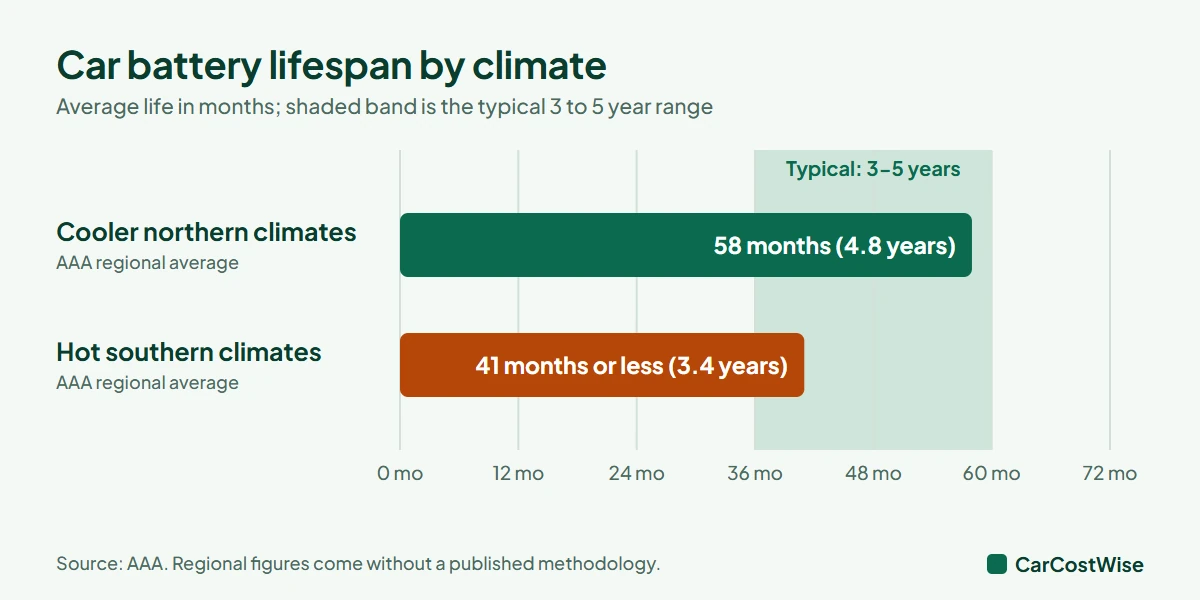
Direct answer: How long does a car battery last? Most last three to five years, and climate moves that number more than anything else. AAA reports about 58 months (4.8 years) in the North versus 41 months or less (3.4 years) in hot Southern regions. A standard replacement costs roughly $120 to $370 installed.
How long does a car battery last on average?
| Situation | Typical life | Source |
|---|---|---|
| General average, all climates | 3-5 years | AAA, Interstate, Walser, Jerry |
| Cooler northern climates | about 58 months (4.8 years); can reach 5+ years | AAA |
| Hot southern climates | 41 months or less (3.4 years or less); about 3 years | AAA |
| Standard flooded battery | shorter life than EFB or AGM | AAA |
| EFB and AGM batteries | longer life than flooded | AAA |
| EV or hybrid 12-volt battery | no verified lifespan figure; Jerry notes it is often an AGM battery | n/a |
AAA does not give a specific year range for AGM versus flooded, only that AGM and EFB last longer. Walser says the same about AGM in start-stop cars: it costs more but tends to last longer. We found no published year figure we could verify, so we do not give one.
How much does a car battery cost per year?
Because batteries wear out on a schedule, the real cost is per year. A standard battery installed runs about $120 to $300 (Walser) or $268 to $368 (Jerry). An AGM battery costs $230 to $450 or more for the part (AutoZone). Spread over 3 to 5 years, that is roughly $25 to $120 a year, depending on the battery and how long it survives. Full prices are in our guide to car battery replacement cost.
How does climate affect car battery life?
Hot climates: the bigger problem
AAA says heat speeds up the chemical reaction that makes power, but it also increases the rate of battery degradation. Under-hood temperatures “can easily exceed 200 degrees Fahrenheit in hot weather,” AAA says. Extreme heat causes evaporation and oxidation inside the battery, and AAA states that heat has a greater impact on a battery than cold. Interstate Batteries adds that the warmer the weather, the faster a battery corrodes.
AAA’s regional numbers: about 41 months or less in hot Southern regions, and “approximately three years” in the South in its other guide. For drivers in Arizona, Texas, Florida or similar states, plan on replacement at around year three.
Cold climates: cold exposes weak batteries
Cold does not usually kill a healthy battery, but it reveals a weak one. AAA says that at 32 degrees F a battery has only about 65% of its normal strength, and at 0 degrees F about 40%. Interstate Batteries puts the loss at about 35% at 32 F and up to 60% at 0 F, and says the engine needs nearly twice the power to start. This is why batteries tend to fail on the first cold morning, even though heat did the damage over the summer.
The good news is that the North still wins on lifespan. AAA’s 58 months is 17 months longer than the hot South number.
Mixed climates
AAA’s published split is only north versus south. For everywhere in between, the general 3 to 5 year range is the best verified guide. In practice that means a driver in a region with hot summers and cold winters should lean toward the shorter end, because summer heat does the damage and winter exposes it. Start testing earlier than the calendar says if your summers are hot.
What else shortens car battery life?
Short trips
A battery needs time to recharge after starting. AAA says batteries in cars driven mostly on short trips may not fully recharge, and it recommends a maintenance charger to keep them topped up. We found no authoritative figure for how much life short trips cost you, so we do not give one. If most of your driving is a few minutes at a time, treat the battery as a wear item and test it earlier.
Sitting unused
Interstate Batteries says a car left unused for more than two months can drain the battery, especially if the battery is three years old or older.
Electronics and loads
Newer cars carry more electronics. AAA notes some newer cars with AGM batteries “require careful control of charging rates for maximum battery life,” so a failing alternator can also kill a battery fast. Check the charging system if a new battery fails early.
Loose or corroded connections
AAA recommends checking at every oil change that cable connections are clean and tight and that the hold-down hardware is secure. A loose battery vibrates and ages faster.
Does battery type change how long a car battery lasts?
AAA lists three common types:
- Flooded lead-acid (FLA): cheapest, shorter life than the other types.
- EFB: costs more than FLA, less than AGM, longer life than FLA.
- AGM: the most expensive, longer life, and more durable. AGM handles repeated discharging and recharging better, which is why start-stop cars use it.
If your car came with a start-stop system, AAA says it likely needs AGM. Do not swap it for a cheaper flooded battery.
How long do batteries last by vehicle type?
We found no verified battery-life statistics by make or model, so we do not publish them. What does vary by vehicle:
- Gas cars: 3 to 5 years as above.
- Start-stop cars: AGM or EFB, a longer service life than flooded but a higher price.
- Electric vehicles: AAA says the EV’s main battery can last up to ten years. That is the traction battery, not the 12-volt starter battery.
How does a car battery test work, and when should you ask for one?
A battery can start the car on Monday and fail on Tuesday. The only reliable way to know its condition is a load test, which parts stores and many shops run for free or as part of a battery service. Walser, for example, says its battery replacement price includes a battery or charging-system test.
Ask for the result on paper, or at least the reading and the verdict (good, weak or replace). Then use the result:
- Good: leave it alone and retest in a year.
- Weak or marginal: budget for a replacement now rather than waiting for a no-start. A marginal battery usually fails at the worst time, on the first cold morning or after a hot summer.
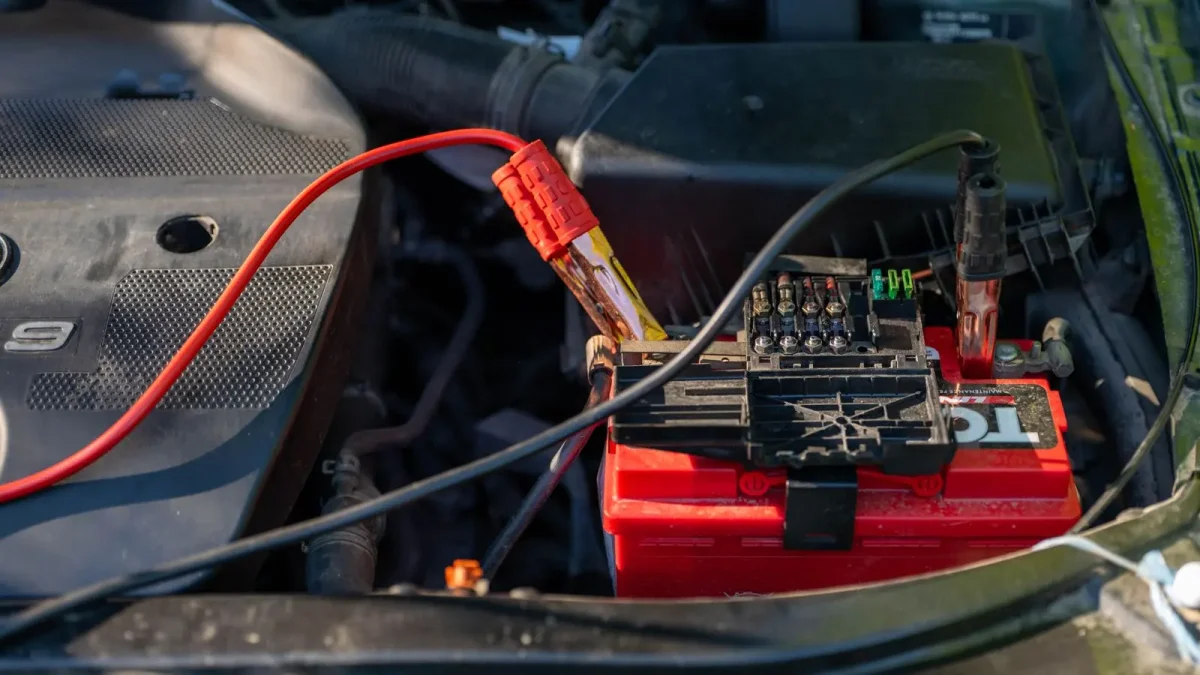
- Replace: buy one the same week. Jump-starting it repeatedly masks the problem and strains the alternator.
- Good battery but the car still will not start: ask for the charging system and starter to be checked. See alternator replacement cost (guide coming soon).
AAA suggests testing every year once the battery is past its third birthday in general, and starting earlier in the South (after year two) and a little later in the North (after year four).
Planning for the next replacement
Because a battery is a predictable expense, it is worth planning the swap instead of reacting to it. Write the purchase date on the battery or in your phone, along with the warranty length, so you know whether a failure is covered. Note the Group size and whether it is flooded, EFB or AGM, so you can compare prices without lifting the hood again. If the car is a hybrid or EV, remember that the 12-volt battery is a separate part from the traction battery, and a dead 12-volt can leave the car unable to start even when the large battery is fine.
When the time comes, shop on the exact Group size and type, and keep the old battery for the core refund. A free-installation offer can save the labor line, but check that your battery’s location is not one the store will decline. The cost side of that decision is covered in car battery replacement cost.
How can you make a car battery last longer?
- Test it annually once it is old enough. AAA says test every year after the third year in general, and its heat-and-cold guide says to begin after year two in the South and year four in the North.
- Park in shade or a garage in hot weather. Under-hood heat is the main killer.
- Keep terminals clean and the battery secure. Look at every oil change.
- Drive longer than a few minutes now and then. Give it time to recharge.
- Do not leave the car unused for months. Use a battery maintainer for storage.
- Fix charging problems early. A bad alternator will drain even a new battery.
- Turn off lights and accessories when the engine is off.
What are the signs your car battery is dying?
- Engine cranks slowly
- Headlights dim when starting
- Clicking noise, no start
- Battery warning light
- Corroded terminals or a swollen case
- Start-stop system stops working
- Battery is past year three and has never been tested
A jump start works once, but if the battery needs a second one within a week, replace it. If the new battery still dies, have the alternator tested. See alternator replacement cost (guide coming soon) and starter replacement cost (guide coming soon).
Should you replace the battery or the car?
A battery is a cheap fix next to most repairs. If your car has several repairs piling up, compare the full cost with a replacement vehicle.
Related: car battery replacement cost, wheel bearing replacement cost, more repair cost guides
FAQ
How long does a car battery last on average?
Three to five years, according to AAA, Interstate Batteries, Walser and Jerry. Climate, driving habits and the car’s electronics move the number up or down.
How long do car batteries last in hot weather?
AAA says about 41 months or less in hot Southern regions, and approximately three years in its other guidance, compared with about 58 months in the North. Heat increases evaporation and oxidation inside the battery.
How can I tell if my car battery is dying?
Slow cranking, dim lights, clicking when you turn the key, a warning light, and corrosion on the terminals are the main signs. A free test at a parts store confirms it. AAA recommends annual testing after year three.
Can a car battery last 10 years?
For a gas car, we found no reliable source that says 10 years is realistic. AAA gives 3 to 5 years, with 5 or more in cool northern climates. The “up to ten years” figure in AAA’s article applies to EV traction batteries.
Does cold weather kill car batteries?
Cold weakens them: AAA says a battery has about 65% of its strength at 32 F and about 40% at 0 F. But heat does more lasting damage, and a battery that fails in winter often wore out over the summer.
Sources
- AAA, How Long Do Car Batteries Last (3-5 years, North 5+ years, South about 3 years, under-hood heat, annual testing after year 3)
- AAA, How Temperatures Affect Your Gas, Electric or Plug-in Hybrid Vehicle (58 vs 41 months, 65% and 40% strength, testing by region, EV up to ten years)
- AAA, Car Battery Types: Which One Is Best for Your Vehicle?
- Interstate Batteries, Is your car’s battery ready for the summer? (35% and 60% cold loss, corrosion in heat, two-month idle drain)
- Walser, How Much Should a Car Battery Replacement Cost? ($120-$300, 3-5 years)
- Jerry, How Much Does a Car Battery Replacement Cost? ($268-$368, 3-5 years)
- AutoZone, How Much Is a Car Battery? ($230-$450+ for AGM)
AAA’s regional figures are not accompanied by a published methodology, so treat them as averages, not guarantees.
Updated October 2026. By Rasel Hakkani.
This article is general information, not financial or mechanical advice. Have a technician test your battery.