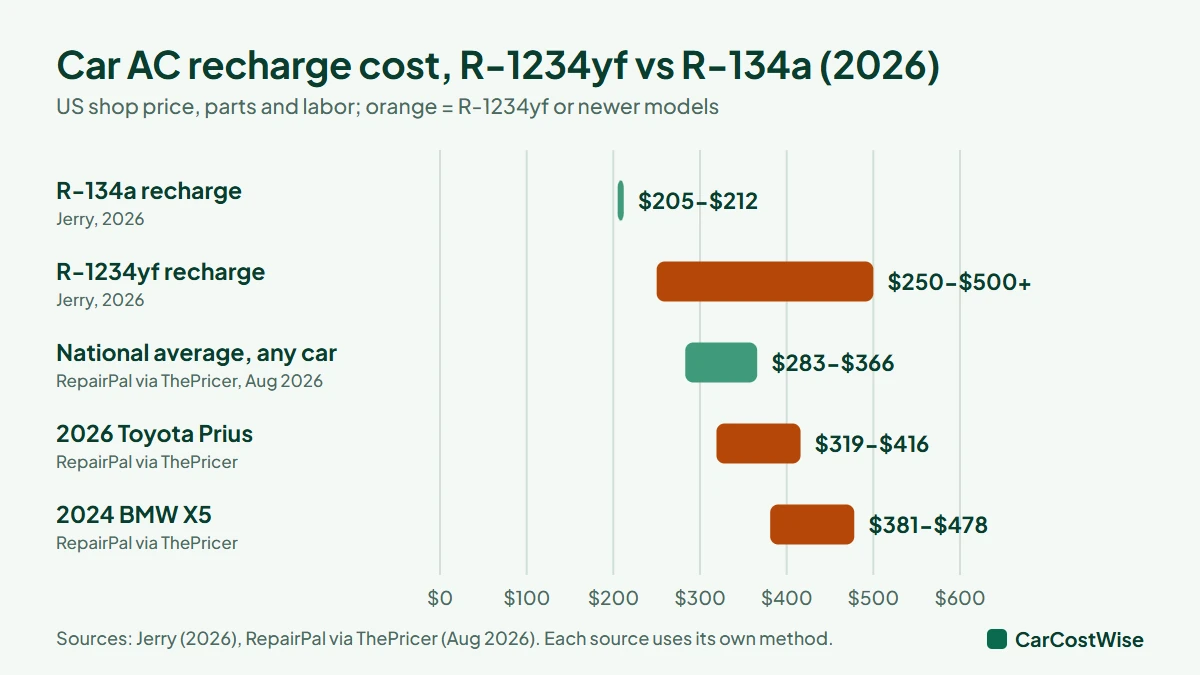
Direct answer: The R-1234yf recharge cost is about $250 to $500 or more at a shop, versus about $205 to $212 for an older car that uses R-134a, according to Jerry‘s 2026 estimates. The newer refrigerant costs roughly 4.7 times as much per pound, and the service takes longer and needs more expensive equipment.
R-1234yf (also written HFO-1234yf or just “yf”) is the low-global-warming refrigerant that replaced R-134a in new car air conditioners. Most cars built since about 2019 use it. Most cars from the mid-1990s through the mid-2010s use R-134a. If your car is new enough to have yf, the same “AC recharge” you remember paying under $200 for can now cost twice that. This guide shows the numbers, explains why, and tells you how to avoid paying for a recharge that will leak out again in a month.
How much does an AC recharge cost in 2026?
The national average for a professional car AC recharge is about $283 to $366, from RepairPal data quoted by ThePricer in September 2026. That average mixes both refrigerants. RepairPal splits it into about $178 to $261 for labor and about $104 for parts, before taxes and any leak repair.
| AC service (installed, shop price) | Low | High | Source |
|---|---|---|---|
| Recharge, R-134a car | $205 | $212 | Jerry |
| Recharge, R-1234yf car | $250 | $500+ | Jerry |
| Extra cost of yf over the same 134a service | $100 | $250 | Jerry |
| Recharge, national average (both types) | $283 | $366 | RepairPal via ThePricer |
| Rear or dual-zone system, extra materials | $25 | $150 | Jerry |
| Dealer or high-cost metro area, extra | $50 | $150 | Jerry |
| Service port or Schrader valve repair | $80 | $200 | Jerry |
| Condenser replacement | $833 | $978 | RepairPal via ThePricer |
| Compressor replacement | $1,058 | $1,447 | RepairPal via ThePricer |
| Evaporator replacement | $1,345 | $1,887 | RepairPal via ThePricer |
The first three rows are the ones that matter for most readers. If your car takes R-1234yf, plan on the upper half of every recharge quote you see online, because many published “AC recharge” prices were written when most cars on the road used R-134a.
How much does an R-1234yf recharge cost by vehicle?
Model matters because system size, access and labor time differ. ThePricer lists these RepairPal ranges, current as of August 2026:
| Vehicle | AC recharge estimate |
|---|---|
| Honda CR-V | $250 to $333 |
| Honda Civic | $255 to $342 |
| Toyota Camry | $272 to $354 |
| Ford F-150 | $316 to $399 |
| 2026 Toyota Prius | $319 to $416 |
| Honda Passport | $343 to $437 |
| 2024 BMW X5 | $381 to $478 |
ThePricer says many vehicles fall between about $250 and $440, and some pass $500. The listing does not say which refrigerant each model year uses, so check your own car (see below) before comparing.
Why is R-1234yf so expensive?
R-1234yf is so expensive because four costs stack up: the refrigerant costs about 4.7 times as much per pound as R-134a, shops need a separate and pricier service machine, the full service takes longer, and only certified technicians can do the work for pay.
The refrigerant costs about 4.7 times as much per pound
ThePricer priced retail cans in 2026: R-134a at about $19.99 a pound (a 12-ounce can at $14.99) and R-1234yf at about $93.98 a pound (a Honeywell 8-ounce can at $46.99). That is roughly 4.7 times the price. Shops buy in bulk and pay less per pound, but the gap follows into the shop bill.
How much refrigerant does a car hold? Less than many people think. One current Kia owner’s manual lists its R-1234yf charge at 15.87 ounces, plus or minus 0.88 ounce (450 grams), or about one pound. The exact amount for your car is printed on the under-hood AC label. At retail can prices, one pound of refrigerant is about $20 for R-134a and about $94 for R-1234yf (our arithmetic). So the refrigerant alone explains part of the gap, not all of it.
Supply is the older part of the story. A 2018 article from Refrigerant HQ, a refrigerant trade site, said the yf market was controlled by two companies, Honeywell and Chemours, and put wholesale prices at around $70 a pound at the time. AA1Car reported $660 to $675 for a 10-pound container in 2016. Prices have moved since, so treat those as history, not today’s quotes.
Shops need separate, more expensive machines
R-1234yf is slightly flammable, while R-134a is not. EPA’s 2011 approval of yf for new cars requires those systems to meet the SAE J639 safety standard, which includes a flammable refrigerant warning label, a high-pressure cutoff switch, pressure relief devices and unique service fittings (Federal Register, 2011). Service machines must meet SAE J2843 and include a built-in leak check and a refrigerant identifier, AA1Car notes. A shop cannot use its old 134a machine on a yf car, so it buys a second machine and passes that cost on.
The job takes longer
At a 2023 meeting of the Society of Collision Repair Specialists, shop owner Barry Dorn said a full recover-and-recharge “takes over an hour longer” with yf, as reported by Repairer Driven News. He described about 8 to 10 minutes to recover R-134a, against about 5 minutes of machine self-checks, about 5 minutes of refrigerant analysis and 15 to 20 minutes of recovery for yf. On the recharge side, yf needed at least 15 minutes of vacuum and at least 5 minutes of leak testing, versus about 10 minutes of vacuum for 134a. That was a collision shop’s full procedure, so a simple top-off at a quick-lube shop will not add a full hour, but more steps still mean more billed time.
Only certified technicians can do it for pay
Anyone who services a car AC system for payment must be trained and certified under EPA’s Section 609 program (EPA). That applies to both refrigerants, but it limits who can legally quote you, especially for yf work that needs the newer machines.
Why did carmakers switch from R-134a to R-1234yf?
The short answer is climate rules. R-134a has a global warming potential (GWP) of 1,430, meaning one pound traps about 1,430 times as much heat as a pound of carbon dioxide over 100 years. R-1234yf has a GWP of 4, per EPA’s 2011 rule. Leaking car AC systems release refrigerant every year, so regulators pushed for the low-GWP option.
| Year | Rule or event | What it means for drivers |
|---|---|---|
| 2011 | EPA lists HFO-1234yf as acceptable for new cars and light trucks, with use conditions | yf allowed in new cars, with unique fittings and labels |
| 2013 | Cadillac XTS is the first US car with R-1234yf (AA1Car) | First yf cars reach owners |
| 2015 | EPA rule lists R-134a as unacceptable in new light-duty cars from model year 2021 | Carmakers plan the switch |
| 2017 | Federal appeals court (Mexichem v. EPA) rules EPA cannot use this program to force users off HFCs | The 2021 deadline loses its force, but most carmakers keep switching |
| 2019 | AA1Car: most automakers use yf in almost all cars and trucks | yf becomes the norm |
| 2020 | Congress passes the AIM Act | EPA gets direct power to cut HFC supply |
| 2023-2024 | EPA Technology Transitions rule: GWP limit of 150 for new light-duty cars from model year 2025 | R-134a (GWP 1,430) is effectively out of new cars |
| 2024-2028 | AIM Act phasedown at 40% below baseline | Less new R-134a supply over time |
The 2015 change-of-status rule is in the Federal Register. The court ruling that followed in 2017 was covered by Aftermarket News.
The rule that now locks in the switch comes from the AIM Act of 2020. EPA’s HFC restrictions by sector page lists a GWP limit of 150 for light-duty passenger vehicle AC, starting with model year 2025 and no earlier than October 24, 2024. Medium-duty passenger vehicles, heavy-duty pickups and complete heavy-duty vans follow at model year 2028. R-134a’s GWP of 1,430 is far over the 150 limit, so it cannot go into new light-duty cars (our reading of the two figures).
EPA loosened some of these rules in May 2026, but mainly for home air conditioning, supermarket refrigeration and a few other sectors, according to a summary by law firm Holland and Knight. EPA’s sector page still shows the model year 2025 limit for light-duty car AC.
Will R-134a get more expensive too?
Probably, slowly. The AIM Act also caps how much HFC refrigerant can be produced and imported. A June 2026 Congressional Research Service report says the cuts run 10% below the 2011-2013 baseline for 2020-2023, 40% for 2024-2028, 70% for 2029-2033, 80% for 2034-2035 and 85% from 2036. The United States is now in the 40% step.
Older cars are not banned from the road. EPA’s 2023 Technology Transitions fact sheet says the rule does not restrict the continued use of existing products, so an R-134a car can still be serviced with R-134a. What changes over time is supply. We have not found a reliable published forecast of R-134a prices, so we will not guess a number. Expect the gap between the two refrigerants to narrow from the bottom up rather than yf getting cheap.
Does my car use R-1234yf or R-134a?
Look under the hood. Every car has an AC label, usually on the radiator support, the hood underside or near the front of the engine bay, that names the refrigerant and the charge amount. Kia’s manual, for example, says its refrigerant label is on the front body trim.
As a rough guide by year:
- 2012 and older: R-134a, or R-12 (old “Freon”) on very old cars. The first US car with yf was a 2013 model.
- 2013 to 2018: mixed. The 2013 Cadillac XTS and 2014 Jeep Cherokee, Ram 1500 and Dodge Charger used yf early, and AA1Car’s 2017 list adds the Ford F-150 and Honda Civic, while other models stayed on 134a.
- 2019 and newer: almost always R-1234yf, per AA1Car.
The service ports also differ in size, so a 134a hose will not connect to a yf port. If the label is missing, a shop with a refrigerant identifier can test it.
Can you put R-134a in an R-1234yf system?
You should not. AA1Car says R-134a should not be used to top off a yf system, and yf should not go into older 134a or R-12 systems because of material and lubricant differences. EPA’s 2011 approval of yf did not cover retrofits, and the system is built with fittings that deliberately prevent mixing.
There is also a cost trap. Mixed refrigerant contaminates the system, and a shop’s identifier will flag it before connecting its machine. The shop may then need to recover and dispose of the contaminated charge before it can do a proper recharge, which costs more than doing it right the first time. Some forum posters say they have run 134a in yf cars, but that is anecdote, may break emissions-tampering rules and can create a problem for the next owner.
Can you recharge R-1234yf yourself?
You can buy yf in small cans at parts stores, and EPA’s 2022 rule requires unique fittings on small cans of two pounds or less. The savings are smaller than with 134a, though. At $46.99 for 8 ounces, a single can of yf costs about three times as much as a 12-ounce can of R-134a at $14.99 (prices per ThePricer, ratio is our arithmetic), and you may need compatible yf hardware on top.
The bigger risk is the diagnosis. A car AC is a sealed system. If it is low, it is leaking. A can of refrigerant without dye or a leak test often buys a few weeks of cold air, and at yf prices that is an expensive few weeks. Overcharging is also easy with a gauge-on-a-can kit, and too much refrigerant can cool worse and strain the compressor.
When is a recharge a waste of money?
A recharge alone only makes sense if the system lost a small amount slowly over years. ThePricer says a compressor, condenser or evaporator failure can turn a roughly $300 recharge into a repair of $800 to $1,900 or more. Before you pay for the refrigerant, ask for:
- A leak test with UV dye or an electronic sniffer. Dye lets the shop find the leak on a return visit instead of guessing.
- The pressures and the amount recovered. If the shop recovered half the label charge, you have a leak.
- A check that the compressor clutch engages. No clutch, no cold air, no matter how much refrigerant goes in.
- A written quote that names the refrigerant type. A low price that assumes R-134a will rise when the tech sees a yf label.
How can you save on an R-1234yf recharge?
- Find the leak first. Paying $300 or more twice in one summer is the most common way to overspend on yf.
- Get two or three quotes from independent shops. Jerry says dealers and high-cost metro areas add $50 to $150.
- Ask whether the price includes the refrigerant at your car’s full label charge, or quotes refrigerant per ounce on top. Some shops quote the labor and then bill yf separately.
- Time it before summer. Shops get busy in the first hot weeks, and a booked shop has no reason to discount.
- On an older car, weigh the big repairs against the car’s value. A $1,058 to $1,447 compressor job on a car worth $3,000 is a real decision, not routine upkeep.
Free calculator
Is a big AC repair worth it on your car? Run the repair vs replace numbers.
If the AC repair is one of several bills at once, our is it worth fixing my car guide walks through the 50% rule. The same logic applies to the biggest repair of all in our transmission replacement cost vs car value guide. AAA counts repairs like this inside the maintenance part of the cost per mile to drive a car, and summer heat is also hard on starting batteries, so see our car battery replacement cost guide or browse all repair cost guides.
FAQ
How much does it cost to recharge R-1234yf?
About $250 to $500 or more at a shop, according to Jerry’s 2026 estimates, which is $100 to $250 more than the same service on an R-134a car. The national average for any car AC recharge is about $283 to $366, per RepairPal data quoted by ThePricer.
Why is R-1234yf so expensive?
The refrigerant costs about 4.7 times as much per pound at retail ($93.98 vs $19.99, per ThePricer), shops need separate service machines with refrigerant identifiers, and the full recovery and recharge takes longer. Only EPA Section 609 certified technicians can service car AC for pay.
Can I use R-134a instead of R-1234yf?
No. R-134a should not be used in an R-1234yf system, the service ports are different, and mixing contaminates the system so a shop must recover it before a proper recharge. EPA’s approval of R-1234yf did not cover retrofits.
What year did cars switch to R-1234yf?
The first US car with R-1234yf was the 2013 Cadillac XTS. Many brands switched between 2014 and 2018, and by 2019 most automakers used it in almost all cars and trucks. EPA rules now cap new light-duty car refrigerant at a GWP of 150 from model year 2025, which R-134a cannot meet.
How much R-1234yf does a car take?
Usually around a pound, but it varies by model. One current Kia manual lists 15.87 ounces (450 grams). The exact charge amount is printed on the AC label under your hood, and a shop should fill to that figure.
Sources
- Jerry, How Much Does an A/C Recharge Cost? (R-134a about $205-$212, R-1234yf $250-$500+, yf adds $100-$250, add-ons and leak repairs; updated October 2026)
- ThePricer, How Much Does Car AC Freon Recharge Cost? (RepairPal national average $283-$366, labor and parts split, prices by vehicle, retail refrigerant prices per pound, compressor, condenser and evaporator costs; updated September 2026)
- Repairer Driven News, SCRS presentation lays out how 1234yf is more time-consuming to recover, recharge (service steps and times; August 2023)
- US EPA, Federal Register, HFO-1234yf SNAP rule for motor vehicle air conditioning (GWP 4 vs 1,430, SAE J639 use conditions; March 2011)
- US EPA, Federal Register, Change of Listing Status for Certain Substitutes under the SNAP Program (HFC-134a unacceptable in new light-duty vehicles from model year 2021; July 2015)
- Aftermarket News, Court Overturns R-134a Substitutes Rule (2017 Mexichem v. EPA decision)
- US EPA, Federal Register, SNAP listing for nonroad vehicles and small-can fittings for HFO-1234yf (May 2022)
- US EPA, Technology Transitions HFC Restrictions by Sector (light-duty vehicle AC GWP limit 150 from model year 2025)
- US EPA, Technology Transitions Final Rule Fact Sheet (existing products not restricted; October 2023)
- US EPA, Section 609 Technician Training and Certification Programs
- Congressional Research Service, Hydrofluorocarbon Phasedown: Background and Issues Facing Congress (AIM Act phasedown schedule; June 2026)
- Holland and Knight, EPA Finalizes Changes to Technology Transitions Provisions of the AIM Act (May 2026 reconsideration rule)
- AA1Car, HFO-1234yf refrigerant (first yf cars, J2843 equipment, no mixing with R-134a, 2016 container prices)
- Refrigerant HQ, The Pricing Struggles of 1234yf (two suppliers, 2018 wholesale price)
- Kia owner’s manual, Air conditioning system (R-1234yf charge 450 g and label location)
Shop-price sites use their own models, and some figures come through a second site quoting RepairPal, so we show ranges rather than a single number. Older trade figures are labeled with their year.
Updated October 2026. By Rasel Hakkani.
This article is general information, not financial or mechanical advice. Have a certified technician diagnose your AC before paying for a recharge.