Direct answer: Car sales tax by state runs from no state tax in Alaska, Montana, New Hampshire and Oregon to 7.25% in California, the highest state rate on cars in 2026. Most states charge 4% to 7%, about two dozen add city or county tax, and all but a handful let a dealer trade-in lower the taxable price.
How does car sales tax work?
When you buy a car, your state charges a one-time tax on the price. Most states call it sales tax or use tax. Others give it a different name, such as a motor vehicle excise tax (New Mexico, North Dakota, South Dakota), a highway use tax (North Carolina), a titling tax (Maryland) or a title ad valorem tax (Georgia). The name does not change much for you: it is a percentage of the price, paid once, when the car is titled.
Four rules decide what you pay:
- You pay the rate where you register the car, not where you buy it. If you live in Ohio and buy in Indiana, you pay Ohio tax when you title the car at home. Dealers in many states collect your home state’s tax for you. The Florida Department of Revenue, for example, charges out-of-state buyers their home state’s rate, up to Florida’s 6%.
- Local tax may stack on top. In about two dozen states (our count), cities and counties add their own tax to car purchases. In Colorado, the average local add-on (4.99%) is larger than the 2.9% state rate, according to the Tax Foundation.
- A trade-in usually lowers the taxable price. In most states you pay tax only on the difference between the new car’s price and what the dealer gives you for your old one.
- Used cars are taxed like new ones. The same rate applies, but some states tax a private sale on a book value instead of the price you wrote on the bill of sale.
Our car ownership cost calculator lets you add the tax to your first-year cost, next to insurance, fuel and depreciation.
What is the car sales tax rate in each state?
This table covers all 50 states and the District of Columbia. “State tax on cars” is the statewide rate that applies to a passenger car in 2026, which is not always the same as the state’s general sales tax. “Local tax” says whether cities or counties can add their own rate to a car purchase. “Trade-in credit” says whether the value of a vehicle you trade in comes off the taxable price. We started from the Florida Department of Revenue’s state-by-state chart, then checked every state that changed its car tax in 2025 or 2026 against that state’s own revenue or DMV page in October 2026.
| State | State tax on cars | Local tax added? | Trade-in credit | Notes |
|---|---|---|---|---|
| Alabama | 2% | Yes, county and city | Yes, dealer sales | Half the 4% general rate (Alabama DOR) |
| Alaska | None | Yes, some cities and boroughs | Depends on the city | No state tax; local rates and caps vary |
| Arizona | 5.6% | Yes | Yes | Average combined general rate 8.54% (Tax Foundation) |
| Arkansas | 6.5% | Yes | Yes | Used cars under $4,000 untaxed; $4,000 to $9,999 taxed at 3.5% (Arkansas DFA) |
| California | 7.25% | Yes, district taxes | No | Full price taxed even with a trade-in (CDTFA) |
| Colorado | 2.9% | Yes, often larger than the state rate | Yes | Average local add-on 4.99% (Tax Foundation) |
| Connecticut | 6.35% | No | Yes, dealer sales | 7.75% on cars over $50,000, based on the price before the trade-in |
| Delaware | None, but a 5.25% document fee | No | Yes, dealer sales | Fee rose from 4.25% on October 1, 2025 (Delaware DMV) |
| District of Columbia | 1% to 11% excise | No | No | Rate set by weight and city mpg on fair market value; EVs 1% to 3% (DC DMV) |
| Florida | 6% | Yes, county surtax | Yes | Out-of-state buyers pay their home rate, up to 6% |
| Georgia | 7% title ad valorem tax | Included in the 7% | Yes, dealer sales only | One-time tax replaces sales tax and the yearly car tax (Georgia DOR) |
| Hawaii | 4% general excise tax | Yes, 0.5% county surcharge | Unclear, ask the dealer | Sources disagree on trade-ins; see the note below the table |
| Idaho | 6% | Rare, resort cities only | Yes, dealer sales | |
| Illinois | 6.25% | Yes | Yes, dealer sales, no cap since 2022 | Private sales pay a flat tax from a state table instead |
| Indiana | 7% | No | Yes | |
| Iowa | 5% fee for new registration | No | Yes | Trade-in counts only if the same people are on both titles (Iowa Code 321.105A) |
| Kansas | 6.5% | Yes | Yes | |
| Kentucky | 6% usage tax | No | Used cars only | No trade-in allowance on a new car (Kentucky budget office) |
| Louisiana | 5% | Yes | Yes | Highest average combined general rate, 10.13% (Tax Foundation) |
| Maine | 5.5% | No | Yes | |
| Maryland | 6.5% excise titling tax | No | Yes | Up from 6% (Maryland MVA) |
| Massachusetts | 6.25% | No | Yes, dealer sales | Private sales: price or clean trade-in book value, whichever is higher |
| Michigan | 6% | No | Capped | Cap was $11,000 in 2025 and rises $1,000 a year |
| Minnesota | 6.875% | No | Yes | $10 flat tax on cars 10+ years old worth under $3,000 |
| Mississippi | 5% | In some cities | Yes | General rate is 7%; heavy trucks 3% (Mississippi DOR) |
| Missouri | 4.225% | Yes, by home address | Yes | Also credits a car you sell privately within 180 days |
| Montana | None | No | Not needed | No sales tax on cars |
| Nebraska | 5.5% | Yes | Yes | 2.75% inside “Good Life” districts |
| Nevada | 6.85% | Yes | Yes | |
| New Hampshire | None | No | Not needed | No sales tax on cars |
| New Jersey | 6.625% | No | Yes | |
| New Mexico | 4% motor vehicle excise tax | No | Yes | Replaces the gross receipts tax on cars |
| New York | 4% | Yes, county and city | Yes | Average combined general rate 8.54% (Tax Foundation) |
| North Carolina | 3% highway use tax | No | Yes, dealer sales | Private sales taxed on the car’s computed value (NCDMV) |
| North Dakota | 5% motor vehicle excise tax | No | Yes | Replaces sales tax on cars |
| Ohio | 5.75% | Yes, county | New cars only | No trade-in credit on a used car |
| Oklahoma | 3.25% excise plus 1.25% sales tax | No | Yes | Used cars: $20 on the first $1,500, then 3.25% excise |
| Oregon | None, but a 0.5% privilege tax on new cars | No | Not needed | Charged on new cars sold by Oregon dealers |
| Pennsylvania | 6% | Yes, 1% Allegheny County, 2% Philadelphia | Yes | |
| Rhode Island | 7% | No | Yes | |
| South Carolina | 5% fee, capped at $500 | No | Yes | Infrastructure maintenance fee replaces sales tax |
| South Dakota | 4% motor vehicle excise tax | No | Yes | No sales tax on car sales |
| Tennessee | 7% | Yes, on the first $1,600 only | Yes | Plus 2.75% state single-article tax on $1,600 to $3,200 |
| Texas | 6.25% | No | Yes | Private sales taxed on at least 80% of standard presumptive value (Texas Comptroller) |
| Utah | 4.85% | Yes | Yes | Total of state, statewide local and local rates averages 7.42% (Tax Foundation) |
| Vermont | 6% purchase and use tax | No | Yes | Taxed on price or average trade-in value, whichever is higher |
| Virginia | 4.15%, $75 minimum | No | No | Trade-in not deducted (Virginia DMV) |
| Washington | 7% (6.5% plus 0.5% motor vehicle tax) | Yes | Yes | Extra 8% luxury tax on the part of the price over $100,000 since 2026 |
| West Virginia | 6% | No | Yes, dealer sales | Traded car must be titled in West Virginia in your name |
| Wisconsin | 5% | Yes, county | Yes | |
| Wyoming | 4% | Yes | Yes |
Sources: Florida Department of Revenue TIP 25A01-01R, “Motor Vehicle Sales Tax Rates by State” (rates and trade-in rules for every state), updated with the 2025 and 2026 changes from the state agency pages named in the notes and listed under Sources. Local-tax status and average local rates come from the Tax Foundation’s midyear 2026 sales tax table and the state revenue pages. The “about two dozen” count of local-tax states and the Washington 7% total are our arithmetic.
Hawaii note: Hawaii charges its 4% general excise tax (4.5% with the county surcharge) on the dealer, and dealers usually pass it on to you as a line on the bill. The Florida Department of Revenue’s chart lists a trade-in credit for Hawaii, but several consumer guides say the full price is taxed. Ask the dealer to show the tax line on the buyer’s order before you sign.
Which states have no sales tax on cars?
Four states charge no state sales tax on a car: Alaska, Montana, New Hampshire and Oregon. Delaware is often added to that list. Three of these five still charge something:
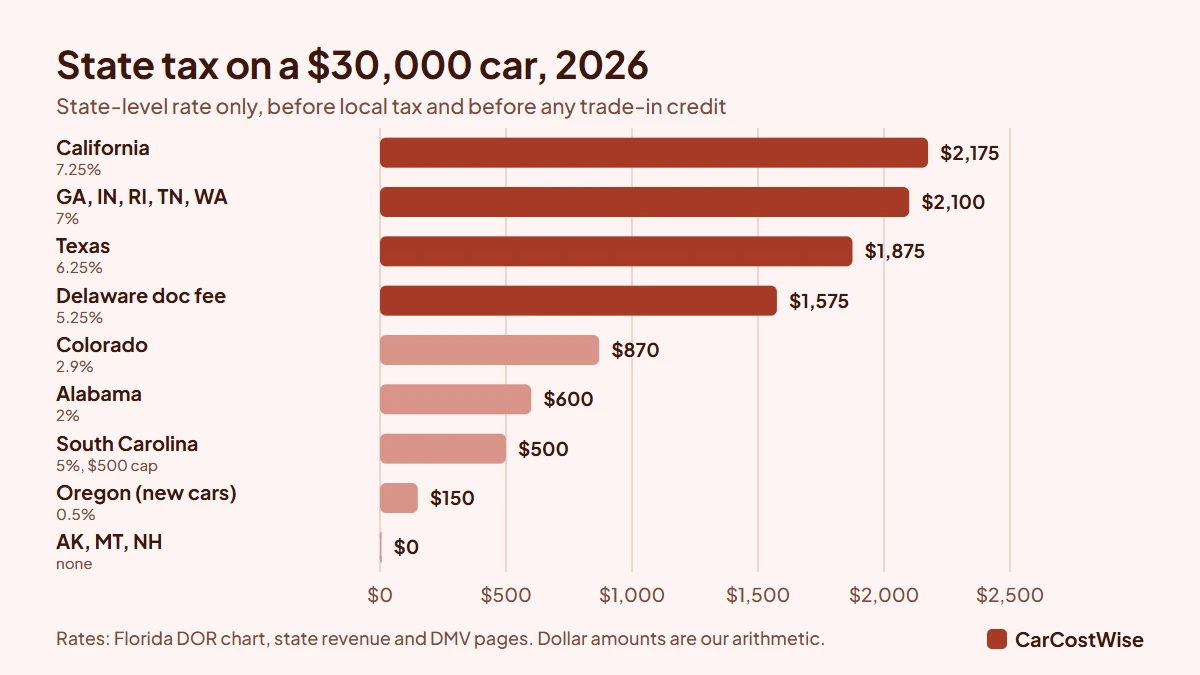
- Oregon has no sales tax, but it charges a 0.5% vehicle privilege tax on new cars sold by Oregon dealers, and a matching use tax on new cars bought out of state. On a $30,000 new car that is $150 (our arithmetic).
- Alaska has no state tax, but some cities and boroughs charge their own sales tax, and the Tax Foundation lists local rates as high as 7.85%. Check the rate for your city.
- Delaware is often listed as tax-free, but it is not cheap. It charges a 5.25% document fee on the price when you title a car, up from 4.25% on October 1, 2025. On a $30,000 car that is $1,575 (our arithmetic), more than the sales tax in Alabama or Colorado at the state rate.
Montana and New Hampshire are the only two with no tax or percentage fee on the price at all. Registration and title fees still apply everywhere. If you drive an EV, check our EV registration fees by state guide too, because 41 states add a yearly fee on top.
Buying in a no-tax state rarely saves you money if you live somewhere else. You owe your home state’s tax when you register the car there.
Which state has the highest car sales tax?
At the state level, California has the highest rate on cars at 7.25%. Georgia (7% title tax), Indiana, Rhode Island and Tennessee (7%), and Washington (7% once you add the 0.5% motor vehicle tax that took effect January 1, 2026) are close behind.
Local tax changes the ranking. These states have the highest average combined general sales tax rates in the Tax Foundation’s midyear 2026 table, and all of them apply local tax to car purchases:
- Louisiana, 10.13%
- Tennessee, 9.61% (but local tax on a car stops after the first $1,600 of the price)
- Washington, 9.57%, plus the extra 0.5% motor vehicle tax
- Arkansas, 9.48%
- Alabama, 9.46% (but the state rate on cars is 2%, not the general 4%)
In practice, a car buyer in Washington is likely to pay one of the highest totals in the country. The state’s 6.5% rate plus the 0.5% motor vehicle tax plus the 3.07% average local rate comes to about 10.07% (our arithmetic). Washington also added an 8% luxury tax in 2026 on the part of a vehicle’s price above $100,000.
How much is the sales tax on a $30,000 car?
At the state rate alone, the tax on a $30,000 car ranges from $0 to $2,175 (our arithmetic for every figure in this section):
- California, 7.25%: $2,175 before district taxes
- Indiana, Rhode Island, Tennessee or Georgia, 7%: $2,100
- Texas, 6.25%: $1,875
- Florida, 6%: $1,800 before the county surtax
- North Carolina, 3%: $900
- Alabama, 2%: $600 before local tax
- South Carolina: $500, because the 5% fee is capped there
To estimate your own bill, add your state and local rates, then multiply by the taxable price: the sale price, minus the trade-in where your state allows it, plus any taxable dealer fees. In most states the dealer’s documentation fee is taxable too. Our guide to dealer fees you can refuse covers which fees you can push back on; here, just count the doc fee in the taxable price when you check the math.
How does a trade-in lower your sales tax?
In most states, the trade-in value comes off the price before the tax is figured. Take a $30,000 car and a $10,000 trade-in in Texas: you pay 6.25% on $20,000, or $1,250, instead of $1,875 on the full price. The trade-in saved $625 in tax (our arithmetic).
The exceptions matter, because the savings can be large:
- No trade-in credit: California, Virginia and the District of Columbia tax the full price. In California, a $10,000 trade-in saves you nothing on tax.
- New cars only: Ohio gives the credit only when you trade in toward a new car at a new-car dealer.
- Used cars only: Kentucky allows a trade-in allowance on used cars but not on new ones.
- Capped: Michigan limits the credit. The cap was $10,000 in 2024 and $11,000 in 2025, per the Florida Department of Revenue chart. If it keeps rising by $1,000 a year, the 2026 cap is $12,000 (our arithmetic; confirm with the dealer).
- Same-owner rules: Iowa counts a trade-in only when the same people are on both titles. West Virginia requires the traded car to be titled in West Virginia in your name.
A few states also give you the tax benefit if you sell your old car yourself. Missouri credits a car you sell within 180 days before or after the purchase, and Arkansas gives a credit for a used vehicle you sell privately within 60 days before or after you buy the new one.
The trade-in credit is one reason a dealer trade can beat a private sale even when the private offer is higher. In a 7% state, a $10,000 trade-in is worth $700 in tax savings (our arithmetic), so a private buyer has to pay at least $700 more to come out ahead.
Do you pay sales tax on a used car from a private seller?
Yes, in every state that taxes car sales. You pay it to the DMV or tax office when you title the car, not to the seller. Several states also guard against a low price on the bill of sale:
- Texas taxes a private sale on the higher of the price or 80% of the car’s standard presumptive value.
- Massachusetts and Vermont use the higher of the price or a book value.
- Illinois replaces the percentage with a flat tax table for private sales, from $100 for an old, cheap car to $1,600 for a car priced at $30,000 to $49,999.99.
- North Carolina taxes private sales at 3% of the car’s computed value.
Private sales usually get no trade-in credit, because there is no dealer to take the old car. If you are shopping used, our list of the cheapest used cars to maintain under $10,000 can help you find a car where the tax bill stays small too. In Arkansas, a used car under $4,000 pays no state sales tax at all.
How can you lower the sales tax on a car?
You cannot avoid the tax, but you can keep it from growing:
- Use the trade-in credit. In most states, trading in at the dealer is the simplest way to cut the tax.
- Negotiate the price, not the payment. Every $1,000 off the price saves $20 to $72.50 in state tax at the rates in our table (our arithmetic). Timing helps: see the best time of year to buy a car.
- Check how rebates are taxed. In Mississippi and many other states, a manufacturer rebate does not reduce the taxable price, but a dealer discount does.
- Know your local rate. In Colorado, Louisiana, Alabama and New York, the local add-on can be as big as the state tax, and the rate follows your home address.
- Budget for it. If you finance, rolling the tax into the loan means paying interest on it. Paying the tax in cash avoids that.
Free calculator
Add the sales tax to insurance, fuel, repairs and depreciation to see your real first-year cost.
Rates in this guide are for 2026 and change often. Confirm the rate with your state’s revenue department or DMV before you sign. More buying guides are in more buying guides.
FAQ
Which state has the highest car sales tax?
California has the highest state rate on cars at 7.25%. With local taxes, Washington and Louisiana are among the most expensive: Washington’s state rate, motor vehicle tax and average local rate add up to about 10.07% (our arithmetic), and Louisiana has the highest average combined sales tax rate, 10.13%.
Which states have no sales tax on cars?
Montana and New Hampshire charge no sales tax on cars. Alaska has no state tax, but some cities charge one. Oregon charges a 0.5% privilege tax on new cars, and Delaware charges a 5.25% document fee instead of a sales tax.
Do you pay sales tax where you buy the car or where you register it?
Where you register it. Your home state collects its own rate when you title the car. Many dealers collect your home state’s tax at the sale, and most states give credit for tax you already paid to another state.
Does a trade-in reduce sales tax on a car?
In most states, yes. You pay tax only on the price minus the trade-in value. California, Virginia and DC give no credit, Ohio allows it only on new cars, Kentucky only on used cars, and Michigan caps it.
Do you pay sales tax on a used car from a private seller?
Yes. You pay it when you title the car at the DMV or tax office. Some states, including Texas, Massachusetts and Vermont, tax a private sale on a book value if it is higher than the price you paid.
Sources
- Florida Department of Revenue, TIP 25A01-01R, “Motor Vehicle Sales Tax Rates by State” (rates and trade-in rules for each state, revised January 31, 2025)
- Tax Foundation, “State and Local Sales Tax Rates, Midyear 2026” (July 6, 2026)
- California Department of Tax and Fee Administration, “Applying Tax to Your Sales and Purchases” (trade-ins not deductible)
- Virginia DMV, Sales and Use Tax (4.15%, $75 minimum, no trade-in credit)
- DC DMV, Vehicle Title (excise tax by weight and fuel economy, effective February 17, 2025)
- Delaware News, “DMV Fees Increase in October 2025” (document fee 4.25% to 5.25%)
- Georgia Department of Revenue, Vehicle Taxes: Title Ad Valorem Tax (7% rate)
- Georgia Department of Revenue, TAVT FAQ (trade-in reduction for dealer sales only)
- Alabama Department of Revenue, “What are the state sales tax rates?” (2% on automotive vehicles)
- Arkansas DFA, Sales Tax Credit for Sale of a Used Vehicle
- Maryland MVA, Excise Tax (6.5% of total purchase price, less a trade-in allowance)
- Minnesota Department of Revenue, Motor Vehicle Sales (6.875% rate, trade-in allowance)
- Mississippi Department of Revenue, Motor Vehicle Licensing FAQs (5% on net price after trade-in; rebates not deducted)
- North Carolina DMV, Vehicle Taxes (3% highway use tax)
- Texas Comptroller, Motor Vehicle Sales and Use Tax (6.25%, standard presumptive value)
- Tennessee Department of Revenue, Automotive Dealership Manual (single-article tax and the $1,600 local cap)
- Washington Department of Revenue, Motor Vehicle Sales/Use Tax (0.5% from January 1, 2026)
- Washington Department of Revenue, Luxury Motor Vehicle Tax (8% over $100,000 from 2026)
- Kentucky Office of State Budget Director, Motor Vehicle Usage Tax report (no trade-in allowance on new vehicles)
- Iowa Code 321.105A (fee for new registration and the same-owner trade-in rule)
- Chicago Auto Show, “New Illinois Law Removes Trade-In Tax Credit Cap” (effective January 1, 2022)
- Oklahoma Policy Institute, Motor Vehicle Taxes (3.25% excise and 1.25% sales tax)
Tax rates change, and several states adjusted their car taxes in 2025 and 2026. All figures marked “our arithmetic” are our own calculations from the sources above.
Updated October 2026. By Rasel Hakkani.
This article is general information, not tax, legal or financial advice. Confirm your rate with your state revenue department or DMV before you buy.