
Direct answer: The dealer fees you don’t have to pay are the ones the dealer invents: prep or delivery fees, advertising fees, market adjustments and add-ons you never asked for, like VIN etching, nitrogen and paint protection. Tax, title and registration are set by the government. The doc fee is a dealer charge, capped in some states and often negotiable.
Which dealer fees are required and which are optional?
Every line on a buyer’s order falls into one of three groups. Government charges are fixed by law. The dealer’s own paperwork fee is legal but negotiable in most states. Everything else is optional, and you can say no to it.
| Fee | Who sets it | Required? | What to do |
|---|---|---|---|
| Sales tax | State and local government | Yes, where your state charges it | Pay it; a lower price lowers it |
| Title and registration fees | State DMV | Yes | Pay it; ask to see the state fee schedule |
| Destination charge (new cars) | Manufacturer, printed on the window sticker | Yes, on new cars | Pay it once; refuse any second “delivery” charge |
| Documentation (doc) fee | Dealer, capped in some states | Usually charged to every buyer | Negotiate it, or ask for the same amount off the price |
| Dealer prep or delivery fee | Dealer | No | Refuse it |
| Advertising fee | Dealer | No | Refuse it, or count it in the price you negotiate |
| Market adjustment (ADM) | Dealer | No | Ask to remove it, or shop another dealer |
| VIN etching, nitrogen, paint and fabric protection | Dealer | No | Refuse it unless you asked for it |
| Extended warranty, gap, tire and wheel plans | Dealer or a third party | No | Decline, or buy later and elsewhere |
The FTC states the core rule plainly: dealers may never charge you for options you did not agree to. In its pricing FAQ for dealers (September 2026), the agency says a dealer cannot imply an optional add-on is required, misstate its cost, or include charges for options the buyer did not agree to.
Which dealer fees are legally required?
Only three kinds of charges are truly required, and none of them goes to the dealer as profit.
- Sales tax. Your state and local rate, collected by the dealer and sent to the state. The dealer cannot change the rate, but a lower negotiated price and, in most states, a trade-in credit reduce the amount taxed. We cover state rates in a separate guide.
- Title and registration fees. These are the state’s charges for a title, plates and registration. The dealer usually collects them and files the paperwork. Ask for the state fee schedule if the number looks high, because some dealers blend a “title processing” charge into this line.
- The destination charge on a new car. The manufacturer sets this to ship the car to the dealer, and it is printed on the window sticker. Consumer Reports calls it a legitimate charge. What it covers matters: CR’s Jon Linkov says a separate “vehicle prep” or “delivery prep” fee on top of it is double billing, and you should never pay that (NBC DFW, citing Consumer Reports).
Georgia’s Attorney General draws the same line. Its consumer office says tax, tag and title are government fees, while dealer charges such as document, freight and prep fees must be included in any advertised price (Georgia Consumer Protection Division).
Which dealer fees and add-ons can you refuse?
Anything the dealer adds after you agree on a price is optional unless it is already in the advertised price. These are the most common, with what the data says about each.
Dealer prep, delivery and advertising fees
Prep is the dealer washing the car, removing the plastic and checking fluids. On a new car, that work is already paid for through the destination charge and the price of the car. An advertising fee is the dealer’s own marketing cost, which is a cost of running the business, like rent. If a dealer agrees to a price and then adds one, refuse it or insist that it comes out of the agreed price. Georgia requires dealer-added charges like these to be included in any advertised price.
Market adjustments
An “additional dealer markup” or market adjustment is extra profit added when a model is in short supply. CR says you can ask the dealer to remove it, but many will not. Your real leverage is a written quote from another dealer without one.
Dealer-installed add-ons
These are the expensive lines. CarWhere studied 5,211 buyer-submitted new-car quotes (updated June 12, 2026) and found that 34.1% included dealer-installed add-ons, at an average of $1,454 on each of those quotes (CarWhere dealer add-on study). The most frequent items and their average prices:
- Accessories packages: $1,386
- Window tint: $504
- Door edge guards: $224
- Wheel locks: $188
Florida had the highest rate in the study, with add-ons on 59.3% of quotes. CarWhere’s numbers come from deal sheets that buyers chose to submit, not a random sample, so treat them as a guide to what you may see rather than a national average.
Other add-ons that Consumer Reports calls unnecessary: VIN etching (your VIN is already on several parts of a newer car), nitrogen-filled tires, rustproofing, paint sealant and fabric protection. Credit Karma notes that DIY VIN etching kits sell online for less than $20 (Credit Karma).
Extended warranties and gap coverage
These are sold in the finance office, after the price is settled. Most new cars come with a factory warranty, so CR says you probably do not need an extended one on day one. Gap coverage can be worth having if you owe more than the car is worth, but the dealer is rarely the cheapest place to buy it. Dealer gap runs about $400 to $700, versus about $84 a year as an add-on from your insurer; see our gap insurance from the dealer vs your insurance company guide for the full comparison.
What if the add-on is already on the car?
A pre-installed item, such as tint or wheel locks, is harder to remove, but it should not appear as a surprise charge. Georgia’s Attorney General says an add-on that is already on the car, or that is required to buy or lease it, must be included in the advertised price, and the FTC’s March 2026 letters call it illegal to require buyers to purchase extra items that are not in the advertised price. Georgia also says that you have the right to decline any or all add-on services (Georgia Consumer Protection Division, August 2025). If the dealer will not drop the charge, ask for the same amount off the price, or walk away.
Is the dealer doc fee negotiable?
Usually yes, though dealers often say no. The doc fee pays for the paperwork: preparing the sale contract, submitting the title and registration, and filing lien documents. It is a dealer charge, not a government fee, and dealers set the amount up to any state cap.
Two facts help you negotiate:
- Prices vary a lot between dealers. Consumer Reports found one dealer charging $399 and another $699 for the same vehicle. Credit Karma puts the range at less than $100 to several hundred dollars, depending on the dealer and the state.
- Some states put it in writing. Washington requires the dealer to tell you in writing, in bold or capital letters, that the doc fee is negotiable, and bars dealers from saying the state requires it (RCW 46.70.180). Oregon’s DMV says dealers may negotiate the fee (Oregon DMV). Rhode Island’s Attorney General calls both its permitted fees “entirely negotiable.”
Many dealers charge the same doc fee to every buyer and treat it as fixed. If the fee will not move, ask for the same dollar amount off the price of the car. The result is the same.
What is the maximum dealer doc fee in each state?
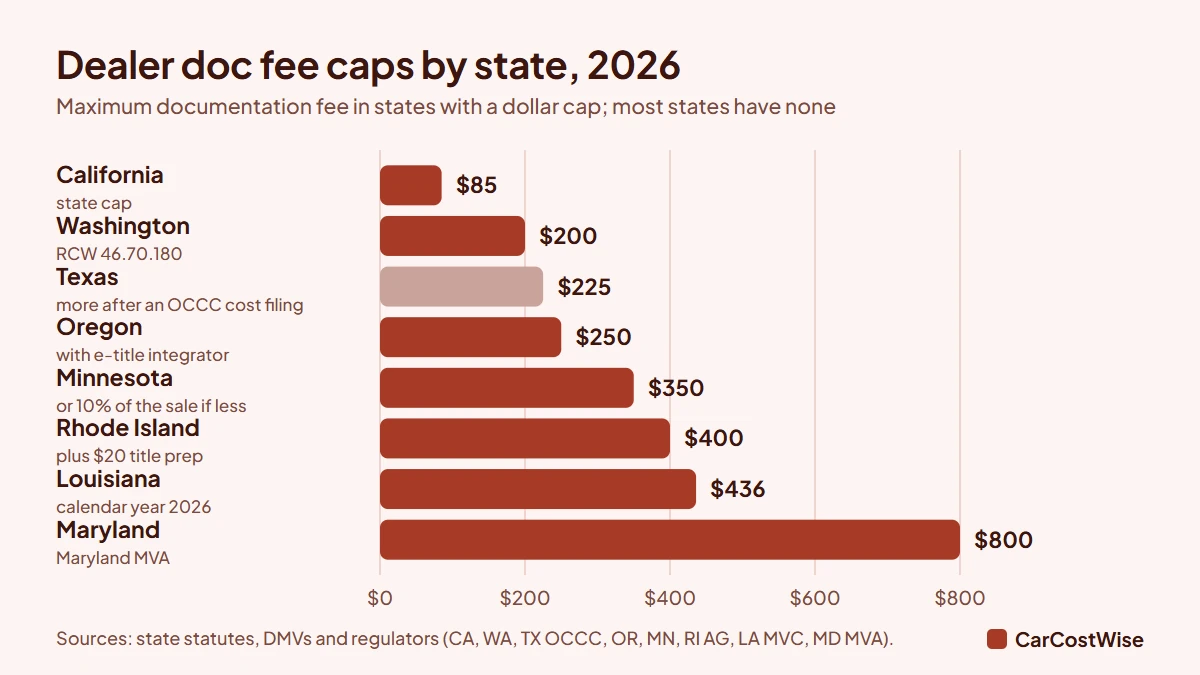
Most states have no dollar cap. Among the states we could verify, 2026 caps range from $85 in California to $800 in Maryland. The table lists the states where we could confirm a 2026 limit from a statute, DMV or state regulator, plus two large uncapped states for comparison. We checked each one against the state’s own page in October 2026 and left out states where we found only third-party figures, such as New York and Illinois. It does not cover all 50 states; if yours is missing, check your state DMV or Attorney General’s site.
| State | Doc fee limit in 2026 | Rule and source |
|---|---|---|
| California | $85 | Unchanged after the governor vetoed SB 791, which would have raised it to as much as $260, in October 2025 (CalMatters) |
| Washington | $200 | Must be disclosed in writing as negotiable (RCW 46.70.180) |
| Texas | $225 without a filing | A dealer must file a cost analysis with the OCCC before charging more than $225 (Texas OCCC bulletin) |
| Oregon | $250 ($200 without an electronic title integrator) | Negotiable, per the Oregon DMV (ODOT) |
| Minnesota | $350 or 10% of the sale, whichever is less | Since July 1, 2025 (Minn. Stat. 168.27, subd. 31) |
| Ohio | The lesser of an inflation-adjusted amount (base $250) or 10% of the contract amount | Adjusted by the Registrar each year (Ohio Rev. Code 4517.261) |
| Rhode Island | $400, plus up to $20 for title preparation | Both negotiable (Rhode Island Attorney General) |
| Louisiana | $436 | Calendar year 2026, inflation-adjusted (Louisiana Motor Vehicle Commission) |
| Maryland | $800 | Counts toward the taxable price (Maryland MVA) |
| Georgia | No cap | Must be included in any advertised price (Georgia Consumer Protection Division) |
| Florida | No cap | Dealer must print a notice that the charge is “costs and profit to the dealer” (Fla. Stat. 501.976) |
The chart above shows the eight dollar caps side by side. The gap between the lowest and highest is $715, our arithmetic ($800 minus $85). A cap is a ceiling, not a price you must pay, so you can still ask for less.
Is the FTC CARS Rule still in effect?
No. The FTC’s Combating Auto Retail Scams (CARS) Rule was finalized in December 2023 and was due to take effect on July 30, 2024, but the FTC postponed it while dealer groups challenged it in court. On January 27, 2025, the U.S. Court of Appeals for the Fifth Circuit vacated the rule in a 2-1 decision, holding that the FTC skipped a required advance notice of proposed rulemaking (Holland and Knight). The rule would have required dealers to disclose that add-ons are optional and to get express consent for every charge. Some fee guides online still describe it as current law; it is not.
Buyers are not left without protection, though:
- The FTC Act still applies. Section 5 bans unfair and deceptive practices. On March 13, 2026, the FTC sent warning letters to 97 dealership groups, saying advertised prices must be the total price including all mandatory fees, and that requiring buyers to purchase extra items not in the advertised price is illegal (FTC press release).
- The FTC still brings cases. In August 2024 it sued three Texas dealerships owned by Asbury Automotive, saying as many as 75% of buyers reported add-ons were put on their contracts secretly or with false claims that they were required (FTC consumer alert).
- States are writing their own rules. California’s SB 766 takes effect October 1, 2026. It requires dealers to disclose full costs up front, bars charging for add-ons that give the buyer no benefit, and lets used-car buyers return a car under $50,000 within three days for a refund, less a restocking fee (CalMatters).
How do you get dealer add-ons and junk fees removed?
The cheapest fee to remove is the one that never reaches the contract. A simple process:
- Get the out-the-door price in writing first. Email two or three dealers for the total, including tax, title, registration and every dealer fee, before you visit. The FTC advises getting the total price before you talk about financing.
- Say no in writing. Reply that you do not want any dealer-installed add-ons or optional products. A short email gives you a record if they show up later.
- Negotiate the total, not the lines. If the dealer will not remove a fee, ask for the same amount off the price. A $699 doc fee with $300 off the car costs you the same as a $399 doc fee.
- Read every line before you sign. The FTC’s Asbury case involved buyers signing on screens that showed only where to sign. Ask for a printed copy and compare it with your quote.
- Decline the finance-office menu. Warranties, gap and protection plans can be bought later, often for less. Saying “not today” costs nothing.
- Time your purchase. Dealers are more flexible on fees when they are chasing a sales target; see our guide to the best time of year to buy a car.
Free calculator
See what your next car costs per year, including the loan, insurance and fuel.
What can you do if a dealer charged fees you refused?
Act quickly. Many add-on products, such as service contracts and gap, can be cancelled for a prorated refund, and the Georgia Attorney General notes that a refund on a financed add-on often goes toward the loan balance rather than to you. Read the cancellation terms in the contract.
If the dealer added items you declined, or told you an optional product was required, complain in writing to the dealer first. If that fails, file a complaint with your state Attorney General’s consumer protection office and report it to the FTC at ReportFraud.ftc.gov. Keep your written quote and your email declining add-ons; they are your best evidence.
More guides on getting a fair price are in more buying guides.
FAQ
Can a dealer refuse to sell you a car if you decline add-ons?
A dealer can choose not to make a deal, but it cannot tell you an optional add-on is required. The FTC’s March 2026 warning letters say requiring buyers to purchase extra items not in the advertised price is illegal. If a dealer insists, get a written quote from another dealer.
Is the doc fee mandatory?
It is the dealer’s fee, not the government’s. Most dealers charge it to every buyer, but the amount is often negotiable, and Washington, Oregon and Rhode Island say so directly. If the dealer will not lower it, ask for the same amount off the car’s price.
Which dealer fees are negotiable?
The doc fee, market adjustments, advertising and prep fees, and every add-on or protection plan are negotiable. Sales tax, title and registration fees are set by your state, and the destination charge on a new car is set by the manufacturer, so those are not.
Is the destination fee a junk fee?
No. On a new car, the destination charge is set by the manufacturer and printed on the window sticker, and Consumer Reports calls it legitimate. A second “delivery” or “prep” fee added by the dealer on top of it is the one to refuse.
Can I get money back for add-ons after I sign?
Often yes. Many service contracts, gap policies and protection plans can be cancelled for a prorated refund, though on a financed car it usually goes to the loan. In California, SB 766 adds a three-day return right on used cars under $50,000 from October 1, 2026.
Sources
- Federal Trade Commission, Automobile Industry Pricing Transparency: FAQs (September 2026)
- Federal Trade Commission, “FTC Warns 97 Auto Dealership Groups About Deceptive Pricing” (March 13, 2026)
- Federal Trade Commission, “Car dealerships can’t charge you for add-ons you don’t want” (August 16, 2024)
- Holland and Knight, “Fifth Circuit Strikes Down FTC’s Auto Retail Scam Rule” (February 2025)
- Georgia Attorney General Consumer Protection Division, “Can I decline add-on products and services when purchasing a new vehicle?” (August 20, 2025)
- Georgia Attorney General Consumer Protection Division, “Is it legal for a car dealer to charge a fee for dealer services?”
- Rhode Island Attorney General, Auto Dealers
- Washington State Legislature, RCW 46.70.180 (documentary service fee)
- Oregon DMV, Electronic Vehicle Registration (dealer processing fees)
- Minnesota Statutes 168.27, subdivision 31 (documentary fee)
- Ohio Revised Code 4517.261 (documentary service charge)
- Texas Office of Consumer Credit Commissioner, Documentary Fee Filing Instructions
- Louisiana Motor Vehicle Commission, Bulletin B-2026-001, Maximum Documentary Fee for 2026 (January 16, 2026)
- Maryland MVA, Taxable Price bulletin (dealer processing fee up to $800)
- Florida Statutes 501.976 (dealer predelivery service charge disclosure)
- CalMatters, “Newsom vetoes car dealer fee hike, signs SB 766” (October 2025)
- CarWhere, Dealer Add-On Statistics 2026 (5,211 quotes, updated June 12, 2026)
- NBC 5 Dallas-Fort Worth, citing Consumer Reports, “Car dealer fees: yes, no and never” (July 13, 2023)
- Credit Karma, “Dealer fees you should know when buying a car” (updated November 8, 2024)
Fee caps and rules change, and several states adjust them every year. Figures marked “our arithmetic” are our own calculations from the sources above.
Updated October 2026. By Rasel Hakkani.
This article is general information, not legal or financial advice. Confirm current fees and your rights with your state DMV or Attorney General before you sign.