
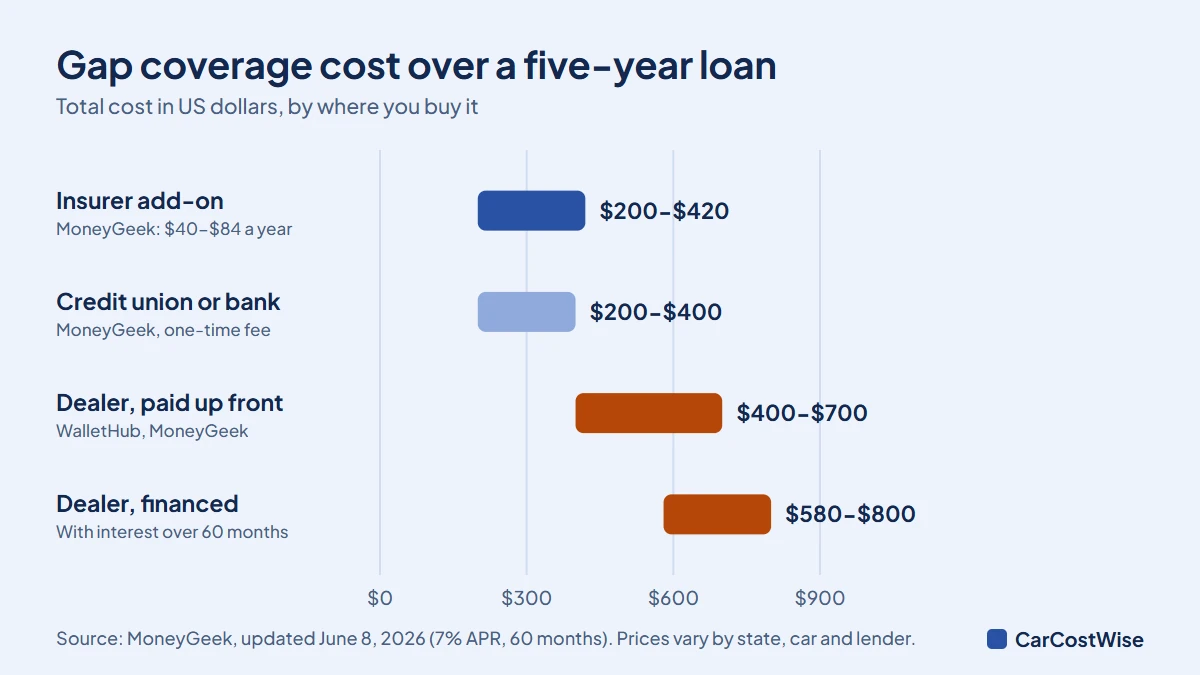
Direct answer: Gap insurance from the dealer vs your insurance company is rarely close: your insurer is almost always cheaper. MoneyGeek puts the insurer add-on at about $7 a month ($84 a year), while dealer gap runs about $400 to $700 up front and is often rolled into the loan with interest. You only need it if you owe more than the car is worth.
What is the difference between dealer gap and insurer gap?
Both products pay the same kind of bill. If your car is totaled or stolen, your collision or comprehensive coverage pays the car’s actual cash value, not your loan balance. Gap covers the shortfall between the two. Progressive notes that you can buy gap coverage “from the dealer or your auto insurance company,” and that standard collision and comprehensive coverage is required before an insurer will add it to your policy.
The two versions are built differently, and that matters for price and refunds:
- Dealer or lender gap is usually a “waiver” tied to your loan contract. Caribou explains that a waiver is usually offered by a lender, dealer or finance company, is often financed into the loan or paid up front, and cancels the eligible remaining balance after your insurer pays.
- Insurer gap is an add-on to your auto policy, usually offered by an insurance company, and is paid as part of your premium.
The practical difference is who you pay and how. A dealer sells the waiver at the finance desk, in the middle of a stack of paperwork, and the price is set by the dealer. Your insurer sells it as a small line on a policy you already have.
How much does gap insurance cost from a dealer vs your insurer?
Published ranges vary a little, so here are the two most recent sources side by side. WalletHub (updated October 7, 2026) says dealerships are “often the most expensive source of gap insurance, typically charging around $400 to $700 upfront.” MoneyGeek (updated June 8, 2026) gives the same $400 to $700 range for a financed dealer policy.
| Where you buy it | Typical cost | How you pay | Source |
|---|---|---|---|
| Auto insurer add-on | About $84 a year ($7 a month) on average; WalletHub says $20 to $40 a year | Added to your premium; you pay no interest | MoneyGeek, WalletHub |
| Bank or credit union | About $200 to $400 one time (MoneyGeek); WalletHub says $200 to $700 | Up front, sometimes added to the loan | MoneyGeek, WalletHub |
| Car dealer | About $400 to $700 | Up front, or rolled into the loan | WalletHub, MoneyGeek |
| Car dealer, financed for 60 months | About $580 to $800 including interest | Monthly, inside your car payment | MoneyGeek |
Two cautions. First, the credit union row in MoneyGeek cites only “industry sources,” and WalletHub gives two different lender figures on the same page, so treat that row as a rough range and get a real quote. Second, individual insurers differ. MoneyGeek lists Progressive at about $4 a month, Allstate at $6 to $8, Nationwide at $5 to $7 and GEICO at $6 to $8 where available.
Here is what those numbers mean over a typical loan. MoneyGeek’s example is a $600 dealer policy financed at 7% APR over 60 months, which totals about $713 (we get the same number: $11.88 a month for 60 months). The insurer add-on at the $84 average costs about $420 over the same five years, and a flat-fee provider at $40 a year costs about $200. The insurer option is also easier to drop. If you cancel it after three years because you owe less than the car is worth, you will have paid about $252 (3 x $84, our arithmetic).
Why is dealer gap so expensive?
The dealer sets the price of add-ons at the finance desk. The National Consumer Law Center’s consumer tip sheet on auto add-ons says dealer add-on products are “very often” overpriced and of low value. It tells buyers who want gap coverage to check with their insurance agent and their bank or credit union first, because “many insurance agents and some banks and credit unions provide GAP insurance directly to consumers, typically at more reasonable prices than dealer pricing.” MoneyGeek, citing the same organization, says the National Consumer Law Center has documented dealer gap markups of up to 300%. We could not open the underlying report, so treat that figure as secondhand.
Financing adds a second cost. Progressive warns that gap from a dealer “can be more expensive if the cost of the coverage is bundled into your loan amount,” because you pay interest on it, while buying from an insurer “may be less expensive, and you won’t pay interest on your coverage.” The Consumer Financial Protection Bureau makes a similar point about negative equity in general: rolling an old balance into a new loan “will increase your total loan costs and the interest you’ll pay over the life of your loan.”
Do you need gap insurance?
Gap insurance is optional in most financed purchases. Progressive says it is usually optional when you finance, though it “might not be optional” when you lease. Whether you need it comes down to one comparison: your loan payoff amount versus the car’s actual cash value. If the loan is bigger, you are exposed.
Progressive lists the situations that tend to put you in that position:
- A small down payment, which it defines as typically 20% or less.
- A long loan, which it defines as 48 months or more.
- A car that loses value fast. Progressive cites the Insurance Information Institute: most cars lose about 20% of their value in the first year.
- Rolled-in negative equity from a trade-in.
These situations are common now. Edmunds reports that the average new-vehicle loan reached a record $44,664 in the third quarter of 2026 at an average 7.0% APR, and that loans of 84 months or longer made up a record 25.5% of financed new-vehicle purchases. In the first quarter of 2026, Edmunds data showed 30.9% of buyers with a trade-in were upside down, owing an average of $7,183 more than the car was worth.
You can probably skip gap in these cases:
- You paid cash or the car is paid off.
- You put down 20% or more and the loan is short.
- You owe less than the car is worth (check a valuation site against your payoff letter).
- The car is older and cheap, so the possible shortfall is small. Progressive notes some insurers will only sell gap on used cars that are less than three years old.
Gap also has limits. A policy can have a payout cap, and it only pays after a covered total loss, so read the contract.
What does a gap shortfall look like in dollars?
Here is a worked example, using Edmunds’ $44,664 average new-car loan and 7.0% APR. We assume a 72-month loan, nothing down, a price equal to the amount financed, and the 20% first-year drop that Progressive attributes to the Insurance Information Institute. This is our arithmetic, not a quote for your car.
| After 12 months | Amount |
|---|---|
| Loan balance | About $38,456 |
| Car value (80% of $44,664) | About $35,731 |
| Gap shortfall if totaled | About $2,725 |
Without gap, you would owe the lender roughly $2,725 for a car you no longer have, before any deductible. With an insurer add-on at $84 a year, that protection costs about $7 a month. With a $600 dealer policy rolled into the loan, you pay about $713 over 60 months for the same protection. By month 24 the balance falls to about $31,799 (our arithmetic), and if the car’s value has kept pace, the gap may already be gone. That is why paying a lump sum up front for a dealer policy can be poor value: the risk is largest early and shrinks every month, but the price stays the same.
When does buying from the dealer make sense?
Dealer gap is not always the wrong choice. Consider it when:
- You lease. Progressive says gap might not be optional on a lease. Check the lease terms before you buy anything separate.
- Your insurer will not sell it for your car. Some insurers limit gap by vehicle age (Progressive notes some only sell it on used cars under three years old), and you need collision and comprehensive coverage to add it.
- The dealer price is competitive in writing. If a dealer quotes a price close to your insurer’s and it is not financed, it can be a reasonable convenience.
- The policy has stronger terms. Some products cover your deductible, and Caribou says to check deductible coverage on any gap contract, dealer or insurer.
Even then, ask for the gap price as a separate line. American Family suggests requesting a quote that excludes gap so you can see its cost on its own.
How do you buy gap from your insurer or credit union?
- Get the payoff and the value. Ask the lender for a payoff letter and look up the car’s market value. If the loan is larger, you need gap.
- Call your insurer before you sign at the dealer. Ask the price, whether you need collision and comprehensive, any vehicle age or mileage limits and whether the policy pays your deductible.
- Price a credit union or bank option. NCLC specifically recommends checking your bank or credit union for gap.
- Say no at the finance desk if it is cheaper elsewhere. Progressive says you can generally buy gap for a new or used car at any time while the loan or lease is open. American Family adds that some gap policies limit how long after purchase you can add coverage, so check your agent’s timeline rather than waiting months.
- Keep the paperwork. You need it if you cancel later or file a claim.
If you are shopping for the car itself, timing helps too. See our guide to best time of year to buy a car for when dealers discount most.
How do you cancel dealer gap insurance and get a refund?
Most dealer gap can be cancelled, and you may be due a pro-rated refund for the unused coverage. The rules depend on your contract and your state, so use this as a general guide.
- Line up replacement coverage first. American Family’s advice is to make sure the new coverage starts before you cancel the old one, so there is no period without protection.
- Find the provider. Contact the insurer or administrator behind the dealer’s policy, not just the salesperson. It may require written notice.
- Gather your documents. Have the purchase agreement and your current address ready. Ask the dealer for copies if you cannot find them.
- Ask how the refund is figured. American Family says the provider will prorate the refund based on how long the policy was active. If you financed the gap, the refund can go to your lender if your loan agreement says so.
- Expect a wait. Refunds can take a few days to several weeks, and timelines vary by provider and state.
As an example of the pro-rata idea, if you cancelled a $600 policy after 24 months of a 60-month term, the unused 36 months would be worth about $360 (our arithmetic). Your contract may use a different method or charge a fee. Caribou’s guide says cancellation and refund rules vary, with a refund possible if you cancel early, refinance or pay off the loan. If the gap benefit has already been paid on a total-loss claim, the coverage has done its job and there is nothing left to refund (our reading).
What fine print should you check on any gap contract?
Before you buy from anyone, check these items in writing:
- The payout cap. American Family mentions policies that cap the benefit at a percentage of the car’s value, such as 125% of actual cash value.
- Your deductible. Caribou lists deductible coverage as an item to review on both waivers and insurance.
- Rolled-in negative equity. Ask whether old debt rolled into the new loan is covered.
- Cancellation and refund terms. Ask whether you get money back if you cancel or pay off early.
- Whether it is a waiver or insurance. A waiver comes through the loan contract, and insurance comes through an insurer.
How does gap fit into the total cost of owning the car?
Gap is a small line, but it sits next to larger ones. Dealer add-ons are one way a car’s real price grows after you agree on the sticker price, and a financed gap policy raises both your amount borrowed and your monthly payment. To see gap alongside your insurance, fuel, maintenance and depreciation, use our calculator. For per-mile numbers, see cost per mile to drive a car, see when to drop collision coverage (remember gap needs collision and comprehensive coverage, so do not drop them while you owe more than the car is worth), and browse more ownership cost guides for more insurance and ownership guides.
Free calculator
See what your car really costs each year, including insurance and loan interest.
FAQ
Is it better to get gap insurance from the dealer or my insurance company?
Usually your insurance company. MoneyGeek puts the average insurer add-on at $84 a year, versus about $400 to $700 up front at a dealer, often with interest if financed. Progressive adds that buying from an insurer may be cheaper and carries no interest. The dealer can win if you lease or your insurer does not offer gap.
How much does gap insurance cost from a dealer?
About $400 to $700 in total, according to WalletHub and MoneyGeek. If you roll it into the loan, MoneyGeek estimates $580 to $800 once interest over 60 months is included. Ask for the gap price as a separate line before you sign.
Can I cancel gap insurance from the dealer and get a refund?
In most cases yes. Contact the insurer behind the dealer’s policy and ask for its cancellation steps. American Family says the provider will prorate the refund by how long the policy was active, and refunds can take a few days to several weeks. Get replacement coverage first if your loan still requires it.
Do I need gap insurance on a used car?
Only if you owe more than the car is worth. Used cars lose value more slowly than new ones, so the risk is lower, but a small down payment or long loan can still leave you upside down. Progressive notes some insurers only sell gap on used cars under three years old.
Is gap insurance worth it?
It is worth it when your loan balance is likely to exceed the car’s value: a down payment of 20% or less, a loan of 48 months or longer, or a fast-depreciating car. It is not worth paying a dealer a premium for if your insurer sells it for about $7 a month, or if you owe less than the car is worth.
Sources
- MoneyGeek, “How Much Does GAP Insurance Cost?” (updated June 8, 2026; $84 a year average, dealer $400-$700, financed example, credit union range, NCLC markup claim)
- WalletHub, “Gap insurance cost” (updated October 7, 2026; dealer $400-$700, insurer $20-$40 a year, lender $200-$700)
- Progressive, “Who offers gap insurance?” (dealer vs insurer, interest on bundled gap, lease, collision and comprehensive requirement)
- Progressive, “Do I need gap insurance on a used car?” (20% first-year depreciation per the Insurance Information Institute, small down payment, long loan, three-year limit)
- National Consumer Law Center, “Auto Add-Ons Add Up: Tips” (2017; check insurer, bank or credit union first)
- American Family Insurance, “Can I cancel gap insurance from a dealership?” (updated February 16, 2026; cancellation steps, proration, payout cap)
- Caribou, “GAP waivers vs. GAP insurance” (June 15, 2026; waiver vs insurance, refund and deductible checks)
- Auto Remarketing, “Edmunds spots 6 new records…” (October 1, 2026; $44,664 average financed, 7.0% APR, 84-month loans 25.5%)
- KOLD News, “Nearly one-third of car shoppers with trade-ins owe more than vehicle is worth” (April 21, 2026; Edmunds Q1 2026 negative equity)
- Consumer Financial Protection Bureau, “Should I trade in my car if it’s not paid off?” (rolling negative equity)
Prices, policy terms and refund rules change with your state, car and provider. Check your own contract.
Updated October 2026. By Rasel Hakkani.
This article is general information, not financial or insurance advice. Ask your lender and insurer for written terms before you buy or cancel.