
Direct answer: Drop collision coverage when your car is paid off, the yearly collision premium is more than 10% of the car’s value, and you could replace the car from savings. On a $4,000 car, a premium above $400 fails the test. Keep collision if you still owe money on the car or a total loss would put you in debt.
What does the 10% rule for collision coverage say?
The 10% rule is a rule of thumb, not an insurance regulation. It compares what you pay each year with what the car is worth. Money expert Clark Howard puts it this way, as Clark.com reports: once the value of your vehicle is less than ten times what its insurance premiums are, it is more economical to drop the coverage than to pay for it. The same page gives the formula: if the annual cost is more than the car’s value divided by ten, consider dropping it. Its example is a $3,000 car, where coverage costing more than $300 a year may no longer be worth keeping.
MoneyGeek (updated October 11, 2026) uses the same test and adds an example: a $6,000 car with a $900 yearly premium is paying 15% of its value, so drop it. Its own FAQ shows the other side. A $5,000 car with a $300 premium sits at 6%, so keep it.
To run the rule on your car, you need two numbers:
- The car’s value today. Not what you paid, and not what you owe. Look it up in Kelley Blue Book and Edmunds and compare it with local listings for the same year, mileage and trim. MoneyGeek notes that Kelley Blue Book tends to be conservative and Edmunds tends to show higher values, so check more than one.
- The collision part of your premium. Your policy’s declarations page or your insurer’s app usually lists each coverage separately. If you only see one total for “full coverage,” ask the insurer for a quote with collision removed so you can see the real difference.
Divide the premium by the value. Above 10%, the rule says drop. Below it, the rule says keep, or at least raise the deductible first.
When should you drop collision coverage?
The ratio is the first test. The conditions below decide whether dropping it is safe. MoneyGeek says all of these should apply before dropping full coverage makes sense:
- The car is paid off. Lenders require collision and comprehensive on financed or leased cars. Progressive says lenders typically require both until the vehicle is paid off, and that you may not be able to drop one at a time while a lender requires both.
- The premium is more than 10% of the car’s value. This is the rule above.
- The car is worth less than about $7,500. MoneyGeek raised its benchmark from $5,000 because repair costs and premiums have climbed. Treat this as a guide, since it is one publisher’s number.
- You have enough savings to absorb a large repair or a replacement. MoneyGeek’s collision-specific advice adds a clean record and low or local mileage. It warns not to drop collision if you are a new driver or a high-mileage driver.
If you meet these, the savings are real. MoneyGeek says dropping full coverage can save up to $1,200 a year on average, and raising a collision deductible from $500 to $1,000 saves $100 to $200 a year. Those are averages across many drivers, so use your own quote.
What does a collision claim actually pay on an old car?
This is the part most “10% rule” pages skip. Collision pays what the car was worth before the accident, minus your deductible. It does not pay what you paid for the car. So the older and cheaper the car, the less there is to collect.
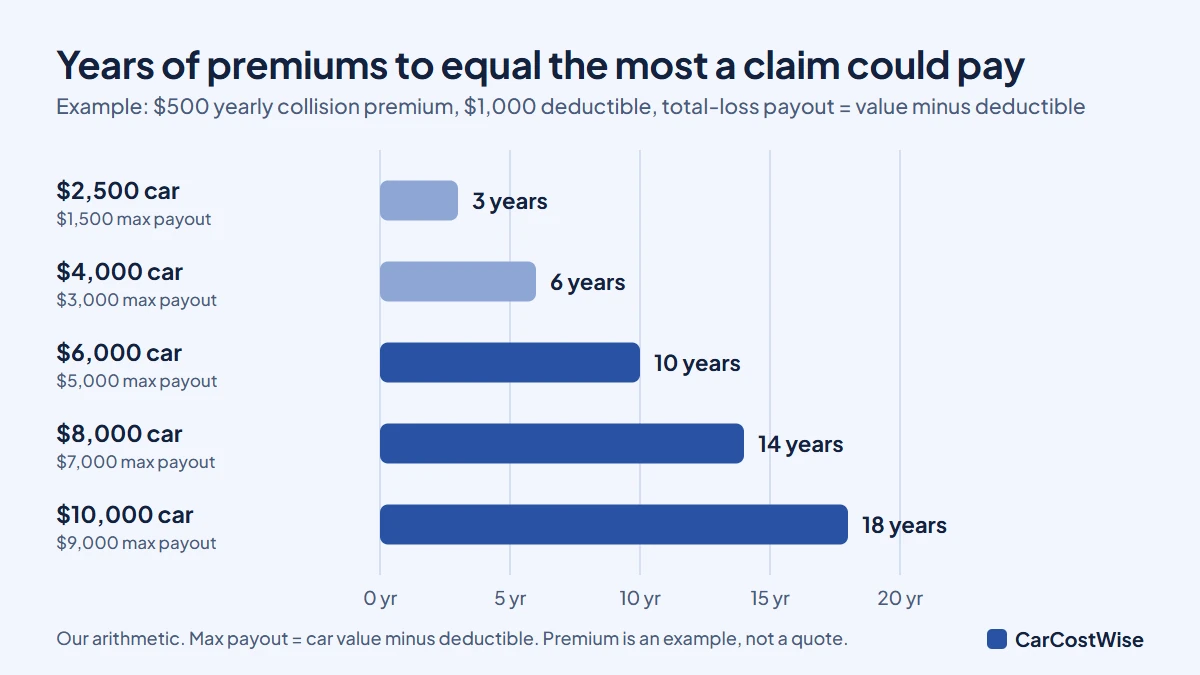
Progressive gives the example: a $2,500 car with a $1,500 deductible could pay out as little as $1,000 on a collision claim. Here is the same math across a range of values, using a $500 deductible and a $1,000 deductible:
| Car value | 10% rule line (most you should pay a year) | Most a total-loss claim pays, $500 deductible | Most a total-loss claim pays, $1,000 deductible |
|---|---|---|---|
| $2,500 | $250 | $2,000 | $1,500 |
| $4,000 | $400 | $3,500 | $3,000 |
| $6,000 | $600 | $5,500 | $5,000 |
| $8,000 | $800 | $7,500 | $7,000 |
| $10,000 | $1,000 | $9,500 | $9,000 |
The first column is the car’s value divided by ten. The payout columns are value minus deductible (our arithmetic). They are ceilings: a smaller repair claim pays less than a total loss, and insurers set the final value with their own valuation method, which can come in below what you expect.
Worked example: should you drop collision on a $4,000 car?
Say you own a paid-off 2013 sedan worth about $4,000 in Kelley Blue Book and local listings. Your insurer charges $480 a year for collision with a $1,000 deductible. These premium and value figures are our example, not a quote.
- Rule test: 10% of $4,000 is $400. At $480, the premium is 12% of the car’s value. It fails the rule.
- Payout ceiling: $4,000 minus a $1,000 deductible is $3,000, the most a total-loss claim could pay.
- Years of premiums: $3,000 divided by $480 is 6.25 years. You would have to total the car about once every six years for collision to break even on your premium alone, and a smaller claim takes longer to pay you back.
- Self-insuring: If you drop collision and set the $480 aside each year, you have $2,400 after five years, which is most of the way to the $3,000 ceiling.
For this driver, dropping collision looks reasonable if there is cash on hand for an at-fault accident. If the same driver had no savings and needed the car for work, the answer flips. The next section explains why.
When should you keep collision coverage?
Run the ratio, then check these before you cancel anything:
- You owe money on the car, or it is leased. Lenders require it, and skipping it can put the loan in default. If the loan is bigger than the car is worth, gap insurance covers the difference, and your insurer usually sells it cheaper than the dealer.
- You could not replace the car from savings. Clark.com’s summary is that this is a risk decision as well as a math decision. If losing the car tomorrow would be a major setback, the savings on premiums may not be worth the exposure.
- Your car is your only way to work. A $3,000 loss is manageable. Missing a month of work is not. Count the cost of a rental car or bus fares while you save for the next one.
- You drive a lot, park on the street, or commute in heavy traffic. More miles and more crowded roads mean more chances to be in a collision, and your risk is higher than the average the rule assumes.
- Your car is valuable for its age. The 10% rule assumes a car losing value. A well-kept truck, a low-mileage import or a classic can be worth far more than its age suggests. MoneyGeek says classic and collector cars follow different rules because they are insured on agreed value.
- Your premium is low relative to the value. If collision costs 5% of the car’s value, you are probably paying a fair price for the protection.
Also remember that dropping collision does not affect the other driver’s side of an accident. Liability coverage, which is required, still pays for damage you cause to others. MoneyGeek notes that liability is required by law in every state, and collision and comprehensive are not.
What do you lose if you drop collision?
You lose coverage for damage to your own car when you hit something. MoneyGeek lists the situations: accidents you cause and single-vehicle crashes, such as hitting another car, a tree or a guardrail, where you pay 100% of the repair cost.
You also give up some protection when someone else causes the accident and has no insurance. Clark.com quotes Clark Howard on this point: if you self-insure and an uninsured driver at fault hits you, it comes out of your pocket. If you drop collision, keep uninsured and underinsured motorist coverage on the policy. Clark.com recommends it as the middle ground.
Collision also pays when your parked car is hit and the other driver leaves. Clark.com lists collisions while parked among covered events.
Should you drop collision but keep comprehensive?
Often yes. Collision and comprehensive cover different risks, and you do not have to drop both. MoneyGeek says driving habits drive collision risk, and where you live drives comprehensive risk. Comprehensive covers fire, theft, vandalism, hail, falling objects and animal strikes, according to Clark.com. MoneyGeek says it costs $200 to $400 a year and is worth keeping if you lack emergency savings or live where hail, flooding or theft is common.
Progressive’s note is that comprehensive may not be worth it either when the car is worth less than a few thousand dollars, especially with a deductible of $1,000 or more. A common order for an older car is:
- Raise the deductible and compare quotes first.
- Drop collision if it fails the 10% rule and you have savings.
- Keep comprehensive while it is cheap and your area has hail, theft or deer.
- Drop comprehensive last, when the car is worth only a few thousand dollars.
What about dropping full coverage on a 10-year-old car?
You will see “drop full coverage at 10 years” often. Age is a shortcut, not the rule. Clark.com notes that older advice to drop at five or six years or 100,000 miles is outdated, and the decision now turns on value and repair costs. Two 10-year-old cars can be worth $3,000 and $12,000. Use the value and premium, then ask whether you could replace the car if it were totaled.
“Full coverage” also is not an official policy type. It usually means liability plus collision plus comprehensive. MoneyGeek says liability coverage cannot be dropped, since it is required by law in every state, so the choice is between “liability only” and adding collision and comprehensive on top.
Is it better to raise your deductible than to drop collision?
Sometimes. A higher deductible lowers the premium and keeps a safety net for the worst case. Progressive recommends considering a higher deductible for older cars instead of dropping coverage, and MoneyGeek puts the saving at $100 to $200 a year for a move from $500 to $1,000. The catch is in the table above: a high deductible shrinks the payout. On a $2,500 car, a $1,000 deductible leaves a $1,500 ceiling. Our rule of thumb: raise the deductible when the car is worth many times the deductible, and consider dropping collision when it is not.
How do you drop collision coverage?
- Confirm the car is paid off. Ask the lender for a payoff letter if you recently finished the loan.
- Get a quote with and without collision from your current insurer and at least one other. Rates differ by insurer.
- Check your savings against the car’s value. If you could not buy a similar car, keep it.
- Call your insurer or use the app to remove collision. Progressive’s steps are to confirm the car is paid off, contact the insurer, and ask for a revised quote.
- Put the saved money into a dedicated account so you are actually self-insuring.
Nothing locks you in. MoneyGeek says you can add collision back later, with no penalty, though the rate will reflect your current risk and the car’s current value. If you want to see what the car costs you all in, our car ownership cost page shows insurance next to fuel, repairs and depreciation.
Free calculator
See what your car costs per year, including insurance, fuel and repairs.
How does dropping collision fit with repair-or-replace decisions?
Insurance cost is one piece of an older-car budget. If you drop collision, you are also betting that you will not face a big repair and a collision at once. Before you cancel, read is it worth fixing my car for the 50% repair rule, and see transmission replacement cost vs car value for how a big repair compares with the car’s value. Our repair vs replace calculator runs both numbers, and cost per mile to drive a car puts the per-mile cost of driving next to the insurance savings. More in more ownership cost guides.
FAQ
When should you drop collision coverage on an older car?
When the car is paid off, the yearly collision premium is more than 10% of the car’s value, and you could replace the car from savings. A $4,000 car with a $480 premium fails the test (12%). If you still owe on the car or lease it, your lender requires collision.
Is collision insurance worth it on a 10-year-old car?
Only if it is worth more than the premium and deductible. Use the 10% rule with the car’s current value. A 10-year-old car worth $6,000 with a $900 premium (15%) is not worth covering. One worth $12,000 with a $500 premium (about 4%) may be.
Can I drop collision and keep comprehensive?
Often yes, if no lender requires both. Comprehensive covers theft, hail, fire and animal strikes, and costs $200 to $400 a year according to MoneyGeek. Many drivers drop collision first and keep comprehensive, especially where hail or theft is common.
What does the 10% rule for collision insurance mean?
It is a rule of thumb: if your annual collision premium is more than 10% of your car’s value, consider dropping it. Clark Howard states it as dropping once the car’s value is less than ten times the premium.
Do I need collision coverage if my car is paid off?
No. Collision and comprehensive are optional once there is no loan or lease. Liability coverage is required by law in every state, so you cannot drop that. Keep collision if you could not afford to repair or replace the car yourself.
Sources
- Clark.com, “When Should I Drop Comprehensive and Collision Coverage?” (May 5, 2026; Clark Howard’s ten rule, $3,000 example, uninsured driver risk)
- MoneyGeek, “When to Drop Collision and Comprehensive (Full Coverage)” (updated October 11, 2026; four conditions, $7,500 value benchmark, $1,200 average saving, deductible saving, what you lose)
- Progressive, “When to Drop Comprehensive and Collision Coverage” (updated September 24, 2026; $2,500 car and $1,500 deductible example, lender requirements, higher deductible)
Premiums, values and rules differ by insurer, state and car. The 10% rule is a starting point, not a guarantee. Check your policy and lender requirements before you change coverage.
Updated October 2026. By Rasel Hakkani.
This article is general information, not insurance or financial advice. Get quotes for your own car and talk to your insurer or lender before you drop coverage.