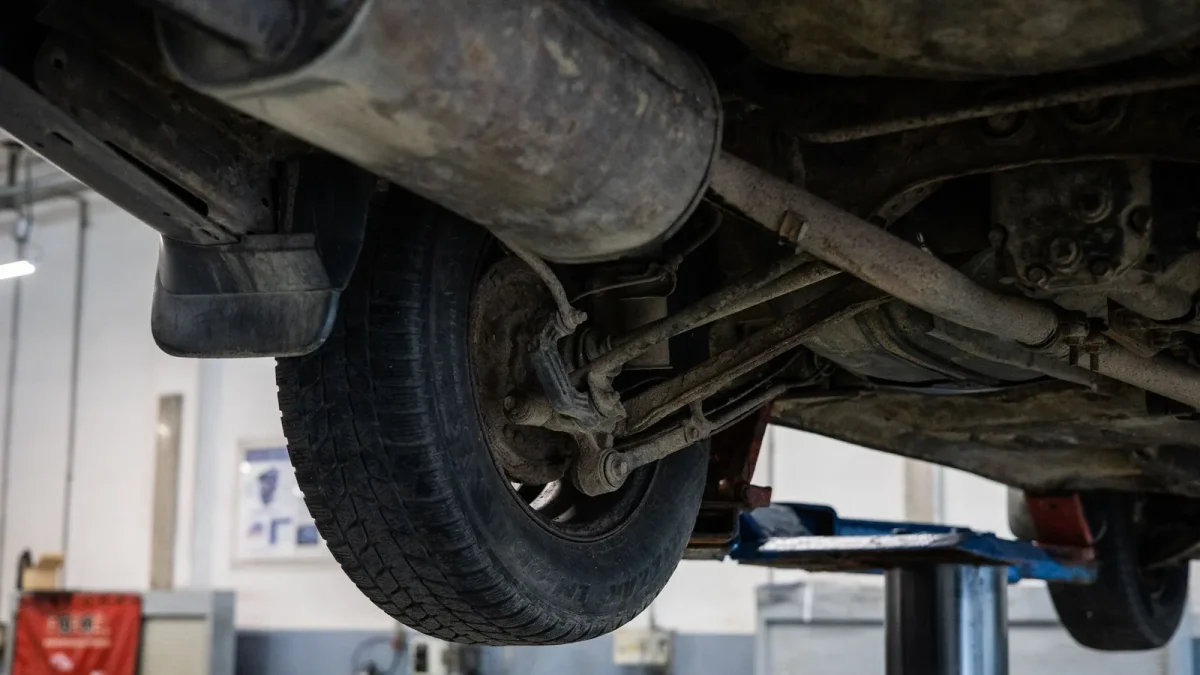
Direct answer: Catalytic converter replacement cost runs about $400 to $2,500 or more, parts and labor, per MechanicBase. A CARB-compliant converter costs more than a federal (EPA) one. California, Colorado, New York and Maine require a CARB-approved or factory (OEM) converter. Most other states accept EPA parts.
How much does catalytic converter replacement cost?
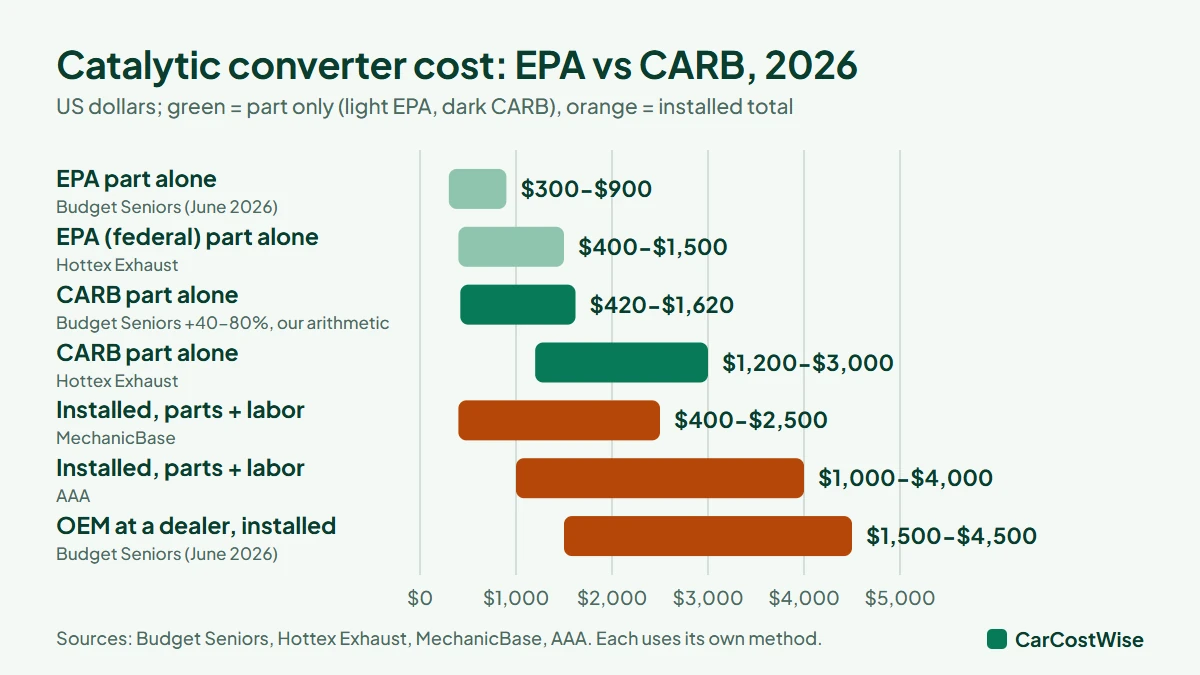
Most drivers pay about $900 to $3,500 installed, according to Budget Seniors (June 2026). AAA puts parts and labor at $1,000 to $4,000, with the part alone at $300 to $2,500 and labor at $160 to $200 an hour. MechanicBase gives $400 to $2,500 including parts and labor, the figure our other guides use, so we keep that headline here. The spread comes from your car, the part type and the shop.
| What you are pricing | Low | High | Source |
|---|---|---|---|
| Replacement, parts and labor | $400 | $2,500 | MechanicBase |
| Converter part alone, any type | $300 | $2,500 | AAA |
| Converter part alone | $400 | $2,500 | Budget Seniors (June 2026) |
| EPA-compliant aftermarket part | $300 | $900 | Budget Seniors |
| Federal (EPA) part, seller range | $400 | $1,500 | Hottex Exhaust |
| CARB-compliant part, seller range | $1,200 | $3,000 | Hottex Exhaust |
| Installed total, aftermarket | $600 | $1,800 | Budget Seniors |
| Installed total, OEM at a dealer | $1,500 | $4,500 | Budget Seniors |
| Installed total, luxury or hybrid | $3,000 | $6,000+ | Budget Seniors |
| Installed total, any type | $1,000 | $4,000 | AAA |
| Labor per hour | $160 | $200 | AAA |
Two of these rows describe the same thing with different numbers, and that is normal. Several sources are parts sellers, so treat each figure as a planning number and get a written quote that lists the part, its brand and its CARB status.
AAA’s estimates by vehicle show how much the car matters:
| Vehicle | Aftermarket part | OEM part | Labor | Total |
|---|---|---|---|---|
| Honda | $200 to $400 | $900 to $2,000 | $100 to $200 | $1,000 to $2,200 |
| Ford | $350 to $700 | $800 to $2,400 | $150 to $300 | $950 to $2,700 |
| BMW | $700 to $1,500 | $1,250 to $2,400 | $200 to $400 | $1,450 to $4,000 |
Source: AAA. The estimates do not include other repairs, such as an oxygen sensor at about $300 each (AAA).
Before you pay for a converter, make sure it is the real problem. A P0420 code can come from a $150 to $400 downstream oxygen sensor, which is why our P0420 code guide puts diagnosis first.
What is the difference between EPA and CARB catalytic converters?
The EPA sets the baseline federal emission standards. California’s Air Resources Board (CARB) sets stricter ones, and AAA says CARB-compliant converters contain more precious metals and cost more. In practice you will see two kinds of replacement parts:
In short, a CARB catalytic converter is a replacement converter that California’s Air Resources Board has tested and approved for specific vehicles, and an EPA converter is one built to the federal standard for the other states.
- Federal (EPA) converters, also sold as “49-state” parts. They are built to keep the check engine light off on the vehicles they are listed for.
- CARB-compliant converters, which went through an extra certification and carry a CARB Executive Order (EO) number. They are legal for sale and use in California and in the other states that adopt California’s converter rule.
A universal converter that is not CARB-approved is illegal in CARB states, AAA says. Removing a converter is illegal in all 50 states, and a sound converter is no reason to skip a repair that you need.
The extra certification is the legal difference. The physical difference is mostly the amount of coating. One mechanic on a Bob Is The Oil Guy forum thread said CARB units generally carry more washcoat and keep working longer. Another said the flow is the same. That is forum opinion, not testing, so we treat it as one data point.
Which states require a CARB catalytic converter?
Four states have rules we could trace to official state pages or regulations: California, Colorado, New York and Maine.
| State | What the rule says | Source |
|---|---|---|
| California | A replacement must be OEM or a CARB-approved aftermarket converter with an EO number that matches your exact vehicle | Bureau of Automotive Repair (BAR); CARB |
| Colorado | New aftermarket converters need a CARB EO. California’s rule (13 CCR 2222) was adopted in 2018 and took effect January 1, 2021, for any model year | Colorado Department of Public Health and Environment (CDPHE) |
| New York | New converters for CARB and 50-state certified vehicles must be CARB-certified or OEM. EPA-certified converters are still allowed on federally certified and pre-1993 vehicles | NYS Department of Environmental Conservation (DEC) |
| Maine | Since June 1, 2018, model year 2001 and newer gasoline vehicles certified to CARB and 50-state standards need OEM or CARB-certified converters. Federal-only and pre-2001 vehicles may still use federal parts | Maine Department of Environmental Protection (DEP) |
Parts sellers name more states. Hottex Exhaust lists Maryland, Massachusetts, New Jersey, Oregon, Rhode Island, Vermont, Washington and Washington, D.C. as well. Budget Seniors names a similar group and says EPA-compliant parts are legal in 42 states. We could not confirm those extra states from a state agency, and the lists disagree, so do not rely on a seller’s list alone.
The confusion has a source. About 17 states follow California’s new-car standards under Section 177 of the Clean Air Act, according to the CARB dashboard and a Center for Climate and Energy Solutions count quoted by Agri-Pulse. That decides whether your car was sold as a “California” car. The aftermarket converter rule is a separate state rule, and each state decides whether to adopt it.
The practical test: open the hood and read the emissions label. A car certified to California or 50-state standards in a CARB-rule state needs a CARB-approved or OEM converter. A federal-only car in New York or Maine may still use an EPA part. If you are not sure, call your state emissions or air agency.
What is a CARB Executive Order number and how do you check it?
An EO is CARB’s written approval for one converter product. EO numbers begin with “D” and follow a pattern such as D-182-77. California Vehicle Code sections 27156 and 38391 prohibit installing a device that alters a pollution control system unless CARB exempts it, and 13 CCR 2222(h) lets CARB grant that exemption for aftermarket converters.
EO D-182-77 shows what an EO contains. It covers Walker’s series 81300 three-way converter, and only for 1995 and older non-OBD II passenger cars. It requires:
- a manufacturer’s warranty of 5 years or 50,000 miles
- a permanent label or stamp on the converter
- oxygen sensors installed in the same place as the factory ones
- no “high flow” or “easy flow” advertising
It also names the exact vehicles it covers, and an EO can be revoked.
So the number alone is not enough. It must be valid, it must list your vehicle, and it must stay visible on the converter after installation. California’s BAR says the EO number has to be readable on the shell, and you can check it in CARB’s aftermarket catalytic converter database. Ask the shop for the EO number before it orders the part, and keep the receipt.
Why does a CARB converter cost more, and by how much?
Sellers say CARB units use more precious metals and carry the cost of certification, which the maker pays for each converter design and the vehicles it covers.
How much more you pay depends on the part:
- Budget Seniors says CARB-compliant converters cost 40% to 80% more than EPA equivalents. Applying that to its $300 to $900 EPA part range gives about $420 to $1,620 for a CARB part (our arithmetic).
- Hottex Exhaust puts federal parts at $400 to $1,500 and CARB parts at $1,200 to $3,000, a bigger gap. It is a seller, and the ranges cover different vehicle types.
- A forum owner found the EPA converter for his car was only $20 to $50 cheaper than the CARB versions. That is one car, not a quote.
The honest summary: for common cars the CARB premium can be small, and for trucks and luxury models it can be hundreds of dollars. Ask your shop for both prices in writing. If a CARB version exists for your vehicle and the gap is small, and you live in a CARB state, the choice is easy, because the cheaper part may fail the inspection.
Which catalytic converter does my car need?
- Read the underhood emissions label. Look for “California,” “federal,” or “50-state.”
- Check your state’s rule. Use the table above, then confirm with your state agency.
- Check warranty status. In Colorado, a vehicle inside its California or federal emissions warranty may only get an OEM converter. New York’s DEC says the vehicle must be past its OEM warranty before an aftermarket converter goes on, and Maine says the same for replacement after warranty.
- Get the part and EO in writing, with the part number and the EO number for your car.
- Buy new. Used converters are banned for sale and installation in Colorado, and New York and Maine bar them too.
- Ask for the warranty. CARB-approved aftermarket converters carry 5 years or 50,000 miles, per the EO and the New York and Maine pages.
Installing a non-CARB part where a CARB part is required will usually fail the inspection. In Colorado, a vehicle with a non-compliant converter installed after January 1, 2023, may be treated as tampered under C.R.S. 25-7-144 and must be fixed before the vehicle is sold or retitled, according to a Colorado state summary for dealers (August 2024).
Does the federal emissions warranty cover catalytic converter replacement?
Often, for newer cars, and it can save the whole bill. The EPA’s emissions warranty fact sheet says that on 1995 and newer vehicles, three “specified major emission control components” are covered for the first 8 years or 80,000 miles, whichever comes first:
- catalytic converters
- the electronic emissions control unit (ECU)
- the onboard emissions diagnostic (OBD) device
Other emission parts get 2 years or 24,000 miles. The federal regulation, 40 CFR 85.2103, lists catalytic converters in the 8-year, 80,000-mile group (eCFR).
There are two warranty types, a “Performance Warranty” (repairs needed after a failed emissions test) and a “Design and Defect Warranty” (a part that fails from a defect in materials or workmanship). If the claim is valid, the manufacturer must repair or replace the part free of charge, and you cannot be billed for diagnosis, pipes, brackets or labor.
The catches:
- The manufacturer can deny a claim if the failure came from misuse or poor maintenance. The EPA names off-road abuse, tampering with emission parts, skipped scheduled maintenance, and use of replacement parts “not equivalent to the originally installed parts.”
- Spark plugs matter. The EPA says skipping plug changes can cause misfires that damage the converter.
- You have to go to a manufacturer-authorized facility for a warranty repair. Your regular shop may not tell you about coverage.
- California vehicles may get additional coverage. A California-certified car often has a longer warranty for high-priced emission parts, commonly described as 7 years or 70,000 miles (13 CCR 2037 and CARB warranty statements), so read your warranty booklet.
- The warranty applies to the original owner or any later owner, new or used, as long as the age and mileage limits have not run out.
Not every driver meets all the conditions. But if your car is 8 years or 80,000 miles old or newer and the converter fails, call a dealer before you buy a part. Budget Seniors describes the federal coverage differently, as “3 years or 50,000 miles, often extended to 8 years or 80,000,” which does not match the EPA fact sheet, so we follow the EPA’s wording.
How much does catalytic converter theft cost, and do anti-theft shields work?
Converters contain platinum-group metals, which is why thieves take them. The National Insurance Crime Bureau (NICB) reported theft claims rising from 16,660 in 2020 to 64,701 in 2022, figures also reported by Automotive Fleet. Consumer Reports, citing NICB, says reported thefts fell about 68% to roughly 14,000 in 2024, with nearly two-thirds of them in California. Thefts are down from the peak, but they have not stopped, and Budget Seniors says rhodium prices more than doubled in early 2026.
A theft costs you twice: the converter and the repair. NICB’s 2023 release says recyclers pay $50 to $250 for a converter and up to $800 for one from a hybrid, while replacement runs $1,000 to $3,500 or more. In a CARB state, the replacement has to be a CARB or OEM part, so a theft in California or New York tends to cost toward the top of the range.
Insurance helps if you have comprehensive coverage. Hottex Exhaust says it typically pays the replacement cost minus your deductible, and Budget Seniors says typical deductibles are $250 to $1,000. Liability-only coverage pays nothing.
| Protection | Cost | Source |
|---|---|---|
| Bolt-on shield, installed | $200 to $600 | Budget Seniors |
| One Colorado shop’s shield, installed | $250 | CBS Colorado (2022) |
| VIN etching, well-lit parking | Low or free | NICB advice |
NICB’s advice is to park in well-lit or camera-monitored spots, install an anti-theft guard, and etch your VIN on the converter. A shield slows a thief down; it does not make theft impossible. For a car that thieves target, such as a hybrid, a $250 shield against a $1,000 to $3,500 replacement is a reasonable bet (our arithmetic: the shield costs about 7% to 25% of one replacement). Check your insurance first, because some insurers offer discounts or refuse to cover repeat thefts.
How can you save on a catalytic converter replacement?
- Rule out the cheap causes first. Oxygen sensors, exhaust leaks and misfires can set the same code. See P0420, P0300 misfire and our check engine light flashing guide.
- Check warranty before anything else. The 8-year, 80,000-mile federal coverage can make the part and labor free.
- Get three itemized quotes, with the part brand, the EO number and the warranty, from an independent exhaust shop, a chain and the dealer.
- Compare CARB and EPA prices only if your state allows both. In a CARB state, do not buy a part the shop cannot document.
- Choose direct-fit over universal. Universal parts need welding, add labor and are illegal in CARB states.
- Fix misfires and oil burning first. A converter damaged by misfires will fail again.
- Get it fixed on time. A flashing check engine light can mean converter damage is underway.
Is it worth replacing the converter on an older car?
Usually yes, if the rest of the car is sound, because you cannot pass inspection or sell the car easily without it. A $1,500 converter job on a car worth $5,000 is 30% of its value, under the 50% rule in our repair vs replace guide. It gets harder when the converter is one of several big repairs. Run your numbers:
For other common repair prices, browse our repair cost guides, including brake pads and rotors and car battery replacement.
What to ask the shop
- Is this part EPA or CARB, and what is the EO number?
- Does the EO list my exact year, make, engine and model?
- Is the part direct-fit and new, and what does the warranty cover?
- Is my car still inside the 8-year, 80,000-mile emissions warranty?
- Does the quote include oxygen sensors, gaskets and labor?
FAQ
How much does it cost to replace a catalytic converter?
About $400 to $2,500 or more for parts and labor, per MechanicBase. AAA puts parts and labor at $1,000 to $4,000, and Budget Seniors says most drivers pay $900 to $3,500. Luxury and hybrid cars can reach $3,000 to $6,000 or more.
What is the difference between a CARB and an EPA catalytic converter?
A CARB converter has passed California’s additional certification and carries an Executive Order number, which lets it be sold and used in California and in states that adopt the rule. An EPA converter meets federal standards only. CARB parts are 40% to 80% more expensive per Budget Seniors, though the gap is small on some cars.
Which states require a CARB catalytic converter?
California, Colorado, New York and Maine have official rules we could confirm. Sellers list more states, but those lists disagree. Check your state agency and the emissions label under your hood.
Is a catalytic converter replacement covered by warranty?
Yes, if your 1995 or newer vehicle is within 8 years or 80,000 miles and the failure came from a defect or a failed emissions test, per the EPA. The manufacturer can deny the claim for misuse or poor maintenance, and California vehicles may have longer coverage.
Does insurance cover a stolen catalytic converter?
Comprehensive coverage usually pays the replacement cost minus your deductible. Liability-only coverage does not. Deductibles typically run $250 to $1,000, per Budget Seniors.
Sources
- MechanicBase, How Much Does It Cost To Replace A Catalytic Converter? ($400-$2,500 parts and labor)
- AAA, How Much Does a Catalytic Converter Cost? (parts $300-$2,500, total $1,000-$4,000, labor $160-$200 an hour, estimates by vehicle, EPA and CARB, theft)
- Budget Seniors, Catalytic Converter Replacement Cost (June 1, 2026; totals, EPA and CARB, shields, deductibles, rhodium)
- Hottex Exhaust, How Much Does It Cost to Replace a Catalytic Converter, 2026 Guide (federal $400-$1,500, CARB $1,200-$3,000)
- Hottex Exhaust, CARB vs EPA Emissions Standards (CARB state list, EO number)
- EPA, Emissions Warranties for 1995 and Newer Cars and Trucks, EPA-420-F-09-048 (8 years/80,000 miles, denial reasons, claim steps)
- eCFR, 40 CFR 85.2103 (catalytic converters in the 8-year/80,000-mile group)
- CARB, Executive Order D-182-77 (conditions, label, 5 years/50,000 miles warranty, 13 CCR 2222(h))
- California Bureau of Automotive Repair, Catalytic Converter bulletin (OEM or CARB-approved, EO visible, database check)
- California Code of Regulations, 13 CCR 2037, Defects Warranty Requirements (high-priced parts, 7 years/70,000 miles)
- Colorado Department of Public Health and Environment, Aftermarket Catalytic Converters (CARB EO required, effective January 1, 2021)
- Colorado state summary for dealers, Regulation 20 (August 2024; non-compliant converters installed after January 1, 2023, C.R.S. 25-7-144)
- Walker (Tenneco), Walker Provides Resources to Assist Customers with New Emissions Regulations in Colorado (2021)
- NYS DEC, Guidelines for Selling and Installing Aftermarket Catalytic Converters in New York State (December 2022; 6 NYCRR Part 218)
- Maine DEP, Maine’s Catalytic Converter Standards (in effect June 1, 2018)
- CARB, States That Have Adopted California’s Vehicle Regulations (Section 177; updated April 2026)
- Agri-Pulse, California’s ban on gas-powered car sales could spread (17-state count)
- NICB, Catalytic Converter Thefts Surge Nationwide, According to New Report (2020-2022 claims, recycler prices, replacement cost, prevention)
- Automotive Fleet, Catalytic Converter Thefts Spike 288% in Just 2 Years (NICB 2020-2022 claims)
- Consumer Reports, How to prevent catalytic converter theft (NICB 2024 figures: about 14,000 thefts, down 68%)
- CBS Colorado, Shields, cages used to stop catalytic converter thieves (October 28, 2022; $250 shield)
- Bob Is The Oil Guy forum, Catalytic converter CARB vs EPA (owner price gap, washcoat opinion; forum anecdote)
Several of these pages block automated access, so we confirmed some figures through search listings and a second source. Many price pages come from parts sellers and sources disagree, so we show the full spread. Laws change, so confirm current rules with your state agency.
Updated October 2026. By Rasel Hakkani.
This article is general information, not financial or mechanical advice. Have a qualified mechanic diagnose your vehicle before replacing a converter.