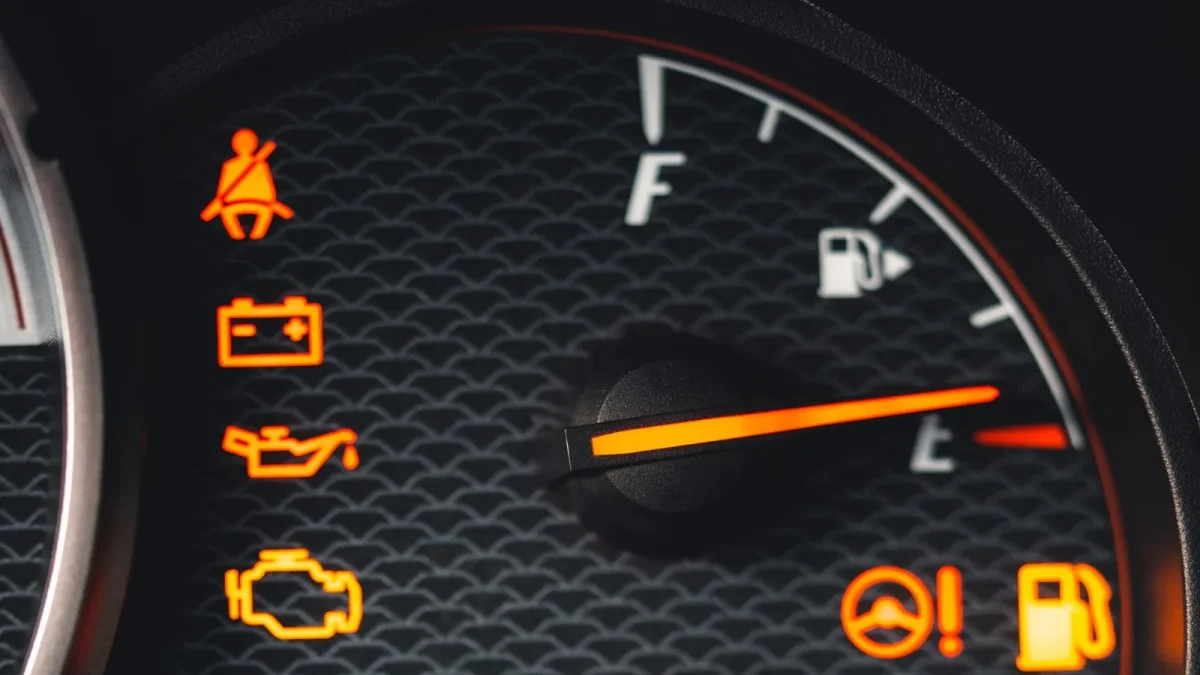
Short answer: reduce your load, get off the road safely, and stop driving as soon as you can. A check engine light flashing means the engine is misfiring right now, pushing raw fuel into the exhaust where it can destroy the catalytic converter. A tow averages about $109. A new converter costs about $400-$2,500 or more.
What should you do when the check engine light is flashing?
- Ease off the throttle. Misfire damage is worse under hard acceleration, towing and highway speeds. Lift off gently. Do not floor it to pass.
- Find a safe place to stop. Signal, pull onto the shoulder or into a parking lot. Get everyone out of the car if you are on a busy road.
- Watch the car. Shaking, power loss, a strong fuel smell, smoke, or a rising temperature gauge all mean stop now. AAA‘s guidance is to pull over as soon as it is safe if the car is losing power, shaking or acting abnormally.
- Turn the engine off. Wait a minute, restart. If the light now shows solid, or the engine runs smoothly, you still should not treat it as fixed. The cause is still there.
- Decide: tow or short drive.
– Tow it if the engine shakes badly, loses power, smells of fuel, or the gauge is rising. This is the safe choice and usually the cheaper one.
– Drive gently to a nearby shop only if the car runs close to normal, the shop is a few miles away, and you can keep the engine speed low. Many sources say that if you must drive at all, drive very gently. - Get codes read. Auto parts stores often read codes free; a shop diagnostic is about $75-$150 (Jerry). Look for P0300-P0306. See P0300 code.
- Fix the cause before you drive normally again, and ask the shop to check the catalytic converter.
If you have roadside assistance (AAA or through your insurer or car maker), call them. Check what your plan covers before you pay out of pocket.
Why is a flashing check engine light different from a solid one?
The engine computer monitors every combustion event. When a cylinder fails to burn its fuel, unburned gasoline travels into the catalytic converter. The converter works by burning leftover pollutants at high temperature, so a stream of raw fuel can overheat it and damage the internal honeycomb. Some cars cut fuel to a misfiring cylinder to protect the converter, but others do not, so you cannot count on it.
Most sources we reviewed agree: flashing means urgent, solid means schedule soon.
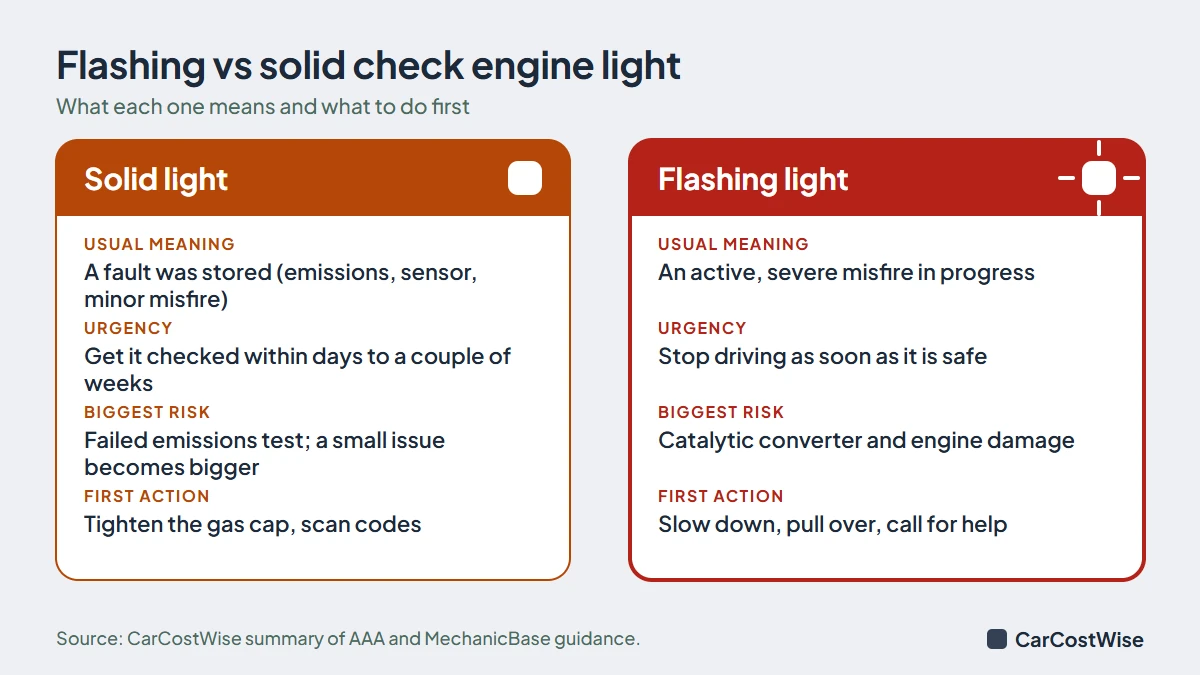
Solid vs flashing check engine light: what is the difference?
| Solid light | Flashing light | |
|---|---|---|
| Usual meaning | A fault was stored (emissions, sensor, minor misfire) | An active, severe misfire in progress |
| Urgency | Get it checked within days to a couple of weeks | Stop driving as soon as it is safe |
| Drive it? | Usually yes, if the car runs normally | Avoid it. Tow if the car shakes or loses power |
| Biggest risk | Failed emissions test; small issue becomes bigger | Catalytic converter and engine damage |
| Typical causes | Gas cap, O2 sensor, converter, plugs | Spark plugs, coils, injectors, vacuum leak |
| Typical cost | $0 (gas cap) to a few hundred dollars | Plug jobs $250-$900, coil jobs $227-$335; converter damage adds $400-$2,500+ |
| First action | Tighten gas cap, scan codes | Slow down, pull over, call for help |
What causes a flashing check engine light, and what does it cost?
Worn plugs and failing coils are the most commonly listed causes of a misfire. Others cost more.
| Cause | Typical repair | Cost range |
|---|---|---|
| Worn spark plugs | Replace plugs | $250-$900 total (Jerry guide); RepairPal model pages run from about $90 to about $700 depending on the car |
| Failed ignition coil | Replace coil(s) | RepairPal average $227-$335 per job |
| Fuel injector problem | Clean or replace | About $150-$500 per injector in one guide (Fuel Logic); Sunbit lists parts of $100-$1,000 plus labor of $110-$406 each |
| Vacuum / intake leak | Replace hose or gasket | Hose and clamp work $75-$250 and a smoke test $100-$200 (Jerry); manifold work costs more |
| Fuel delivery fault (pump, filter) | Replace part | Varies widely by car: RepairPal model pages show fuel pumps from about $320 to over $2,500 and fuel filters from about $170 to $460 |
| Internal engine problem | Engine repair | Usually the most expensive category; get a written diagnosis first |
| Catalytic converter damaged by the misfire | Replace converter | $400-$2,500 (MechanicBase); OEM up to $4,500 and luxury or hybrid $3,000-$6,000+ (Budget Seniors) |
| Diagnosis | Scan and test | $75-$150 for about an hour of labor |
| Tow | Hook-up + mileage | National average about $109; hook-up $35-$100 plus $2.50-$7 per mile (SuperMoney, citing J.D. Power) |
Sources disagree on several of these numbers, and many come from pricing guides rather than official surveys. AAA says labor rates alone range from under $100 to over $200 an hour, with almost half of shops between $120 and $159.
The money logic: a tow of about $109 plus a plug or coil repair is the cheap outcome. Drive another 50 miles on a hard misfire and you may add a $400-$2,500 converter on top. That is the reason shops tell you not to push it.
What should you tell the mechanic?
A misfire is easier to find when the shop knows how it behaved. Before you hand over the keys, write down a few facts:
- When it started. Did the light begin flashing right after a fill-up, a rainstorm, a car wash or a recent repair? Bad fuel and water get into the picture quickly, and a recent repair can leave a loose connector behind.
- When it flashes. Constantly, or only under acceleration or at highway speed? A light that flashes only when the engine is working hard points toward ignition or fuel delivery trouble.
- How the car felt. Shaking at idle, hesitation, a smell of fuel, or a sudden loss of power all help narrow it down.
- What was last done. Spark plugs, coils and air filters are all on a maintenance schedule. If you are past the interval in your owner manual, say so.
- Any codes you already pulled. If a parts store or your own scanner showed P0300 or a cylinder-specific code, tell the shop.
Do not clear the codes before the appointment. Clearing them erases the evidence a technician needs and resets the emissions readiness monitors.
What does a shop do after a flashing check engine light?
The usual sequence is cheap checks first. The technician reads the stored codes and the data saved when the fault occurred, then inspects the ignition parts, which are the most commonly listed cause of a misfire. AAA lists worn spark plugs, wires and ignition coils as typical culprits. If the plugs and coils are healthy, the next steps are the fuel system and then air leaks, which is where a smoke test comes in (Jerry puts one at $100 to $200). A mechanical check of the engine is the last and most expensive step.
Because the main risk is the catalytic converter, ask the shop to tell you plainly whether the converter looks healthy after the misfire is fixed. If it was damaged, you will likely see P0420 code appear sooner or later. Fixing the misfire first matters: a new converter installed while the misfire is still active can be ruined the same way as the old one. AAA makes the same point in general terms, noting that a converter problem usually means a problem somewhere else in the car, so replacing the converter alone would likely not solve it.
After the repair
- Confirm the light is off and stays off. Ask the shop to rescan the car and to tell you which fix it made.
- Keep the paperwork. If the failed part is covered by a parts or labor warranty, you will need the invoice.
- Check your emissions warranty. The EPA says the catalytic converter and the emission control computer are covered for 8 years or 80,000 miles on 1995 and newer light vehicles. Coverage can be denied if the failure came from misuse or poor maintenance, such as overdue spark plugs, so a misfire caused by skipped service is a weak warranty claim. If your car is inside that window and the converter failed, call the dealer before you pay.
- Fix the cause of the cause. If plugs were overdue, set a reminder for the next interval. If a coil failed, ask whether the others are the same age. If the fault was fuel or air, ask what the shop found so it does not repeat.
Mistakes that make a flashing light more expensive
- Driving on it to see if it clears. An intermittent flash that stops is still a stored fault. The cause has not gone away.
- Pouring in additives and hoping. If one cylinder is not firing because a coil has failed, nothing in the fuel tank will bring it back.
- Ignoring a solid light for weeks. A solid light is an earlier warning of the same family of problems. It is cheaper to fix when it is solid.
- Replacing parts at random. Replacing plugs, coils and injectors all at once is expensive, and it may not fix the real cause. Test first and change one thing at a time unless the plugs are clearly overdue.
- Calling the wrong help. A flat bed tow is safer for a misfiring car than driving to a shop. Tell the dispatcher the light is flashing and the car is shaking, and ask whether your roadside plan covers the distance.
Other things that can trigger a flashing light
Most flashing lights are misfires, but a few other issues can look similar:
– Severe fuel or air problems causing multiple cylinders to misfire at once
– Water or bad fuel in the tank after a fill-up
– Mechanical failure such as a timing or compression fault
If your car also shows low oil pressure, overheating or a red warning light, that is a separate emergency. Stop and turn off the engine.
How can you avoid a flashing check engine light?
- Replace spark plugs at the interval in your owner manual.
- Deal with a solid check engine light quickly; it can turn into a flashing one.
- Fix rough idle and hesitation early.
- Keep up with air filter and fuel system maintenance.
- Buy a basic OBD-II reader so you can see codes right away. See our OBD2 scanner guide (guide coming soon).
More on misfires and converter damage
- P0300 code Random misfire causes and repair cost
- P0420 code Catalytic converter efficiency, the code that follows ignored misfires
- Check engine light: common causes and costs (guide coming soon)
- repair vs replace Is the repair worth it?
- Is it worth fixing my car? The 50% rule for big repair bills
FAQ
Can I drive with a flashing check engine light?
Avoid it. A flashing light signals an active misfire that can damage the catalytic converter. If you have to move the car, keep speed and load low, go only a short distance, and prefer a tow if the car shakes or loses power.
How far can I drive with a blinking check engine light?
There is no safe distance that applies to every car. Sources we reviewed say “as little as possible.” Every mile under load adds risk.
Why did my check engine light start flashing then stop?
Misfires can be intermittent. The light may go solid when the misfire eases. The fault is still stored, and the underlying cause is still there. Get it scanned.
Will a flashing check engine light damage my engine?
The catalytic converter is the main risk. AAA also warns that an untreated misfire could develop into a catastrophic problem for the vehicle, so do not assume the damage stops at the exhaust.
How much does it cost to fix?
A plug job runs about $250-$900 (Jerry) and a coil job about $227-$335 (RepairPal). If the converter has been damaged, add roughly $400-$2,500 or more, and a tow averages about $109.
Sources
- AAA, check engine light common causes
- Oregon/Idaho AAA, dealing with the check engine light
- MechanicBase, why is my check engine light flashing
- Art’s Automotive, can I keep driving with a check engine light
- Jerry, P0300 guide
- RepairPal, ignition coil replacement cost
- MechanicBase, catalytic converter replacement cost
- Budget Seniors, catalytic converter replacement cost
- SuperMoney, cost to tow a car (J.D. Power average $109, hook-up and per-mile fees)
- RepairPal, spark plug, fuel pump and fuel filter model pages and second source
- Jerry, vacuum leak costs
- Fuel Logic, fuel injector replacement cost
- EPA, emissions warranty consumer guide (8 years/80,000 miles for the converter and emission control computer)
- AAA, mechanic labor rates 2026
This page is general information, not professional mechanical advice. If you are unsure whether your car is safe to drive, stop and call a tow or a qualified mechanic.
Updated October 2026 | By Rasel Hakkani