Direct answer: Put winter tires on when daily temperatures consistently fall below 45°F, not when the first snow arrives. That is Michelin’s guidance: below 45°F, summer and all-season tires become stiff, which reduces traction and increases stopping distances. In much of the northern US that means October or November, and in the South it can be December or later.
What is the 45°F rule for winter tires?
The 45°F rule is the most repeated timing advice from tire makers. Michelin says the time to fit winter tires is when average daily temperatures consistently approach 45°F, which it says typically happens in late autumn depending on your region. In its tire-type guide, Michelin explains that summer tires are designed for conditions above 45°F, while winter tires are built for conditions at or below it, because their compound stays flexible in the cold.
Two things about the rule are worth knowing:
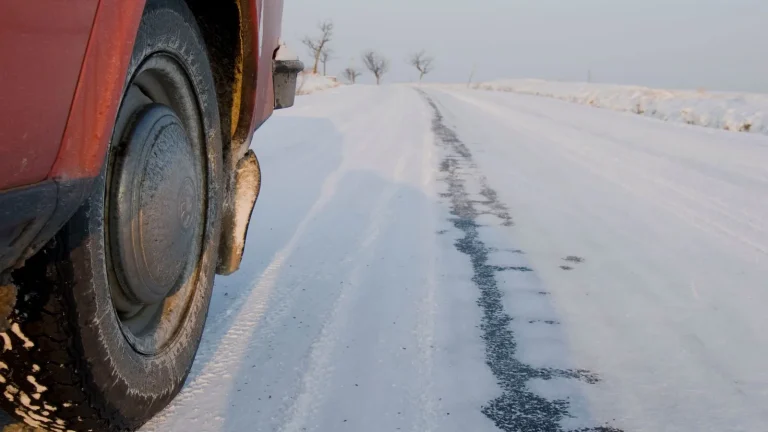
- It is about the compound, not the snow. Michelin says all-season rubber begins stiffening below 45°F, which reduces grip on cold, dry roads before any snow appears. Waiting for the first storm means you may have driven weeks on tires that are already past their comfort zone.
- It is a guideline, not a switch. Look for a settled cooling trend in your forecast rather than reacting to a single cold night. Michelin’s wording is “consistently,” and the point is to be ready before the cold sets in.
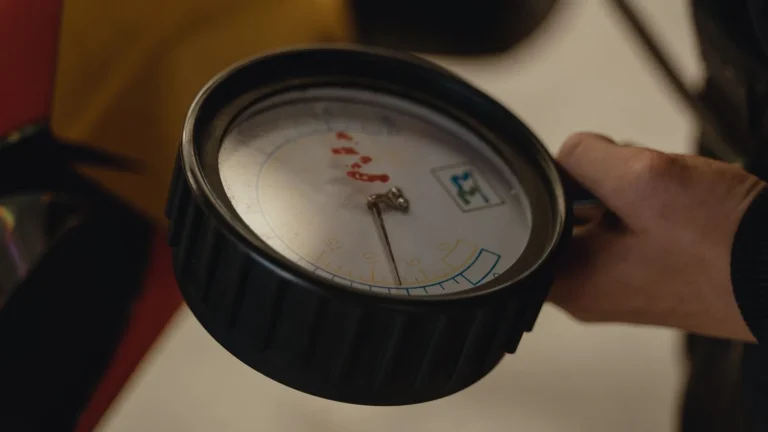
Cold air also lowers tire pressure. Michelin says tires lose about 1 PSI for every 10°F drop in temperature, so a tire inflated in September may be several PSI low by December. Use the pressure on your driver’s door jamb or in the owner’s manual, not the number printed on the tire sidewall, and read tpms sensor replacement cost if the warning light keeps coming on.
When to put on winter tires in your area: when do temperatures drop below 45°F?
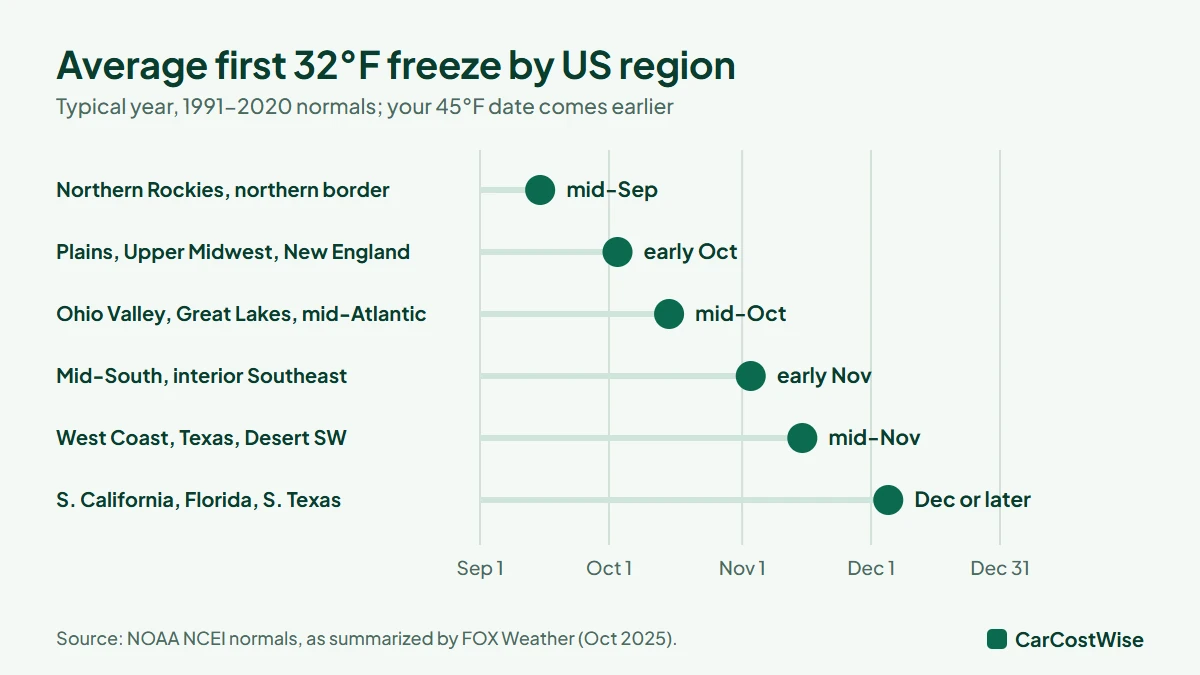
There is no official national “winter tire date,” so the easiest way to place yourself is to use the average first freeze, the first day of the fall when the temperature reaches 32°F. The National Centers for Environmental Information (NCEI) publishes this from its 1991-2020 climate normals. A freeze arrives after daily temperatures have already been dropping through the 40s, so our reading is that the first-freeze date is the latest you should be on winter tires, and your 45°F date comes earlier.
Here is a summary of typical first-freeze timing, from FOX Weather’s October 2025 summary of the NCEI normals:
| Typical first 32°F freeze | Where it happens | What it suggests |
|---|---|---|
| Early to mid-September | Northern and central Rockies, northern Great Basin, northern Plains and Upper Midwest near the Canadian border, highest peaks of New England and the Adirondacks | Plan to be on winter tires by early October at the latest |
| Early October | Central and High Plains, Upper Midwest, northern Great Lakes, Adirondacks to the central Appalachians, much of New England | Book your swap for early to mid-October |
| Mid-October | Four Corners, most of the central Plains, parts of the Mississippi Valley, southern Great Lakes, Ohio Valley, lower elevations of the Northeast and mid-Atlantic | Mid to late October for most drivers in this band |
| Early November | Southern Oklahoma, West Texas, the mid-South, the interior Southeast | Late October to early November |
| Mid-November | Much of the West Coast, Desert Southwest, central and eastern Texas, parts of the lower Mississippi Valley, northeastern Gulf Coast | Only needed if you drive to snow country, so time it to the trip |
| December or later | Parts of Southern California, southern and southeastern Texas, southern Louisiana, southeastern Georgia, Florida | Usually no winter tires, and some years no freeze at all |
The third column is our advice drawn from the first two, not a tire-maker rule. FOX Weather notes that a strong cold front can bring the first freeze weeks earlier than the average, and a persistent high can push it later, and NCEI notes that the first freeze at some high-mountain and northern locations can come even before August 31.
What if you drive to the mountains?
Your home climate may be mild while your trips are not. A few state rules put dates on the calendar:
- Colorado: the Traction Law is in effect each year from September 1 through May 31 on the I-70 Mountain Corridor between Dotsero and Morrison, according to the Colorado Department of Transportation. It requires winter, all-weather or M+S tires with at least 3/16 inch of tread, or chains or an approved traction device, and the penalty for noncompliance is a $50 fine and a $17 surcharge.
- Washington: studded tires are legal from November 1 to March 31, and drivers must remove them by the end of the day on March 31 or risk a $137 fine, WSDOT says. It notes Oregon shares the March 31 removal deadline.
- California: AAA says studded tires are allowed from November 1 to April 30, with chain controls in mountain areas.
Rules change by year, road and storm, so check your state transportation department before a trip.
When should you take winter tires off?
The mirror image of the 45°F rule applies in spring. Michelin says summer and all-season tires deliver their best grip above 45°F, so once your daily temperatures stay above that, the case for winter tires fades. Consumer Reports adds a cost reason: winter tires wear more quickly than all-season tires, with some compromise of handling and grip on cleared roads, and it says that if you remove them at the end of each winter you may get three or four seasons of good use out of them.
Do not remove them early in a place that still gets late-season snow. Washington’s WSDOT warns that late-season snow is possible, especially in mountain passes, even as studded tires must come off by March 31. An old calendar rule of thumb is “Thanksgiving to Tax Day,” which CBS News repeated in 2010. It works as a rough guide in the Northeast and Midwest but not in the South or West.
How do you plan the swap?
- Check your forecast in September. Note the week the highs and lows start staying in the 40s.
- Book early. Shops fill up before the first storm. Washington’s WSDOT notes that tire shops get busy ahead of its spring deadline, and the same crowding happens in autumn.
- Buy a set of four. Mixing winter and all-season tires is a handling risk. See are winter tires worth it for prices and what to look for.
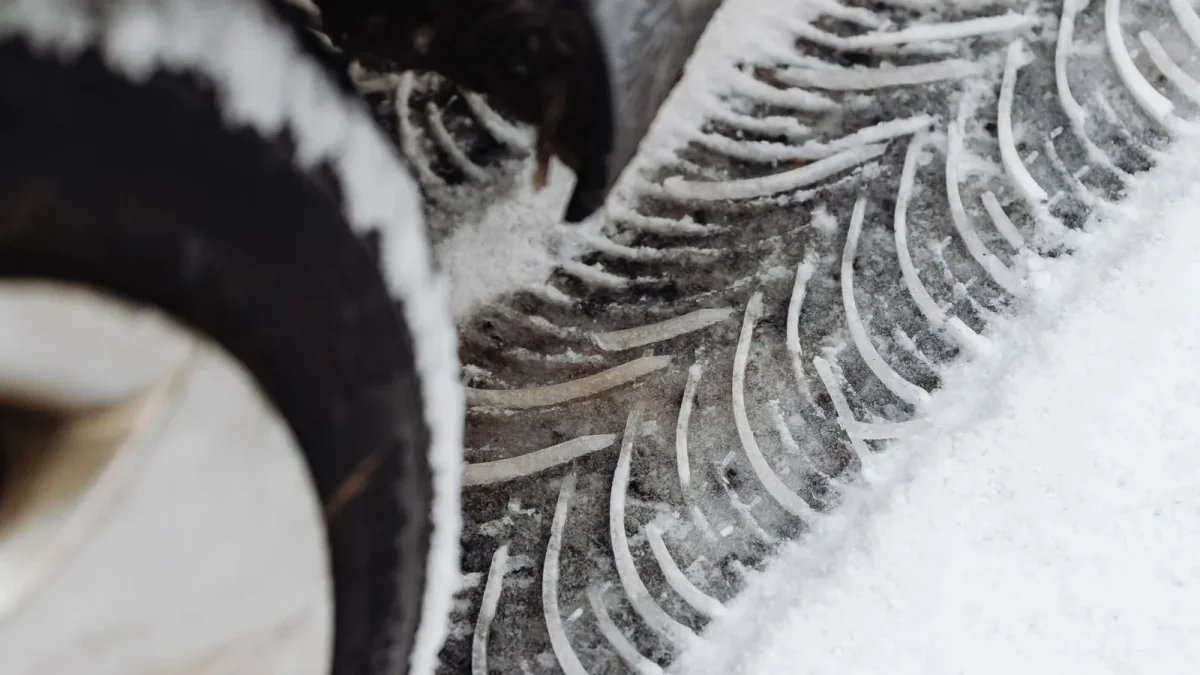
- Look for the 3PMSF symbol (three-peak mountain snowflake), which Michelin says certifies severe snow traction. The M+S mark on all-season tires does not.
- Check pressure after the swap and after the first cold snap. Michelin’s rule is 1 PSI lost per 10°F.
- Store the off-season set properly, or use a shop’s seasonal storage.
What if you only see snow a few days a year?
Then the tire question is about the next trip, not the calendar. If your freezes are rare, the practical option is all-weather tires, which carry the 3PMSF mark and which Michelin calls a middle ground for drivers who want certified cold-weather performance without managing two sets. If you drive only on cleared roads at moderate temperatures, healthy all-season tires may be enough. For help with a dashboard warning that appears in cold weather, see more diagnostics guides and check engine light flashing.
FAQ
What temperature should you put on winter tires?
Michelin recommends installing winter tires when daily temperatures consistently fall below 45°F, because summer and all-season tires become stiff below that point and grip drops, even on dry pavement.
What month should you put on winter tires?
It depends on your region. In the northern Rockies and along the northern border it can be early October, in the Midwest and Northeast mid-October to November, and in the mid-South and interior Southeast early November. In Florida and southern Texas you usually do not need them.
Is it OK to put winter tires on early?
You can, but it costs wear. Consumer Reports says winter tires wear more quickly than all-season tires and compromise handling on cleared roads. Waiting until temperatures settle below 45°F is the usual balance.
When do you take winter tires off?
When daily temperatures stay consistently above 45°F, Michelin’s cutoff for the compounds working best, and after the risk of late snow has passed. States with studded tire dates set a legal deadline, such as March 31 in Washington and Oregon.
Do you need winter tires if you have all-season tires?
Only if your winter has regular snow, ice or temperatures below 45°F. Michelin says all-seasons are workable in mild winters but not where temperatures regularly fall below freezing with snow and ice. All-weather 3PMSF tires are a middle option.
Sources
- Michelin USA, “Winter Tire Timing & PSI Tips” (45°F rule, 1 PSI per 10°F)
- Michelin USA, “Summer vs. Winter vs. All-Season Tires” (45°F, 3PMSF, all-weather)
- NOAA NCEI, “When to Expect the First Fall Freeze” (1991-2020 U.S. Climate Normals)
- FOX Weather, “Here’s when to expect the first freeze of the season” (October 2, 2025; regional summary of NCEI normals)
- Colorado Department of Transportation, new Traction Law requirements (November 20, 2025)
- Washington State Department of Transportation, studded tire deadline (March 30, 2026)
- AAA, “How much do winter tires cost?” (January 30, 2026; California studded tire dates)
- Consumer Reports, “Winter/Snow Tires vs. All-Season Tires: How They Compare” (updated November 10, 2017)
- CBS News, “Are Winter Tires Worth It?” (November 22, 2010; “Thanksgiving to Tax Day”)
Dates are averages and local weather varies. Check your forecast and your state transportation department.
Updated October 2026. By Rasel Hakkani.
This article is general information, not mechanical advice.