
Direct answer: Winter tires are worth it if you regularly drive on snow, ice or temperatures below 45°F. A set of four typically costs $400 to $1,200, according to AAA, and AAA says tests show they reduce stopping distance on wintery roads by up to 30 percent versus regular tires. If your winters are mild and your roads are plowed, good all-season tires are usually enough.
How much do winter tires cost?
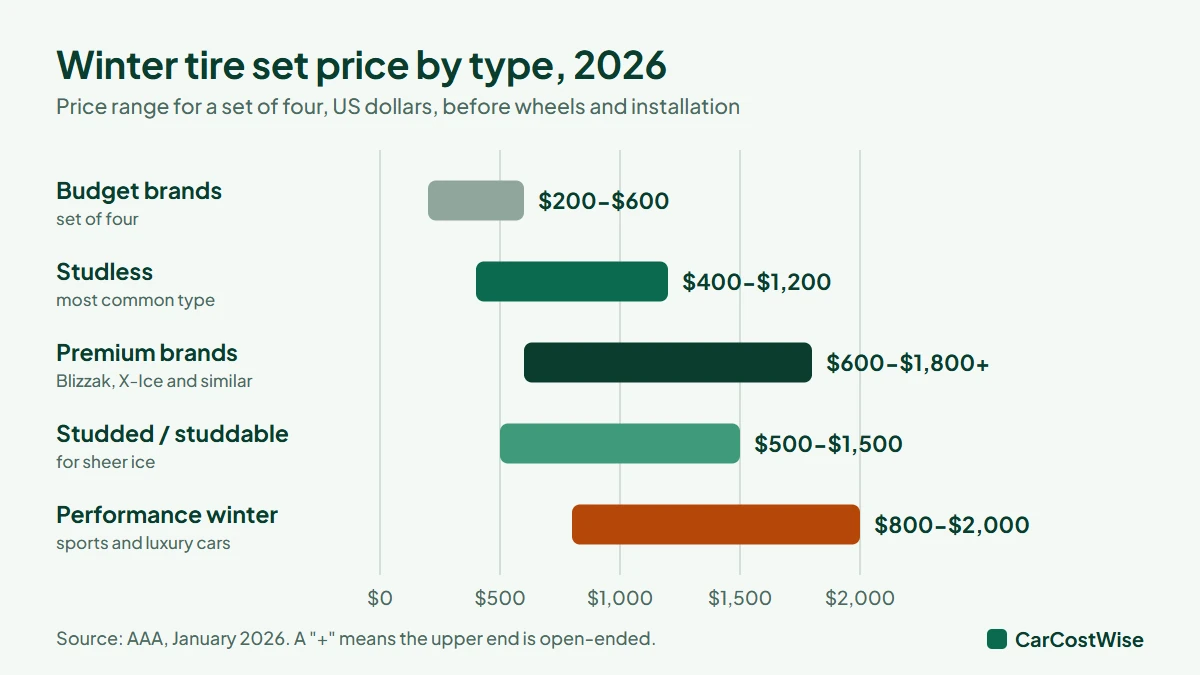
AAA’s January 2026 guide gives the most useful US price ranges we found. They are for a set of four tires, and the price depends on the type, brand and your vehicle’s tire size.
| Winter tire type | Price for a set of four | Source |
|---|---|---|
| Budget brands | $200-$600 | AAA |
| Studless (most common) | $400-$1,200 | AAA |
| Premium (for example Bridgestone Blizzak, Michelin X-Ice) | $600-$1,800+ | AAA |
| Studded or studdable | $500-$1,500 | AAA |
| Performance winter (sports and luxury cars) | $800-$2,000 | AAA |
Your vehicle changes the bill because it sets the tire size. AAA’s examples are $400 to $800 for a compact car such as a Honda Civic or Toyota Corolla, $600 to $1,200 for a small SUV or crossover such as a Subaru Forester or Nissan Rogue, and $800 to $1,500 or more for a large SUV or truck such as a Kia Telluride or Ford F-150.
What else do winter tires cost?
The tires are not the whole bill. AAA lists these extras:
- Wheels: many drivers buy a cheap second set of wheels so the good ones are not exposed to salt. A set of rims generally costs $400 to more than $800.
- Installation and balancing: it may be free where you bought the tires. Otherwise AAA says it can cost anywhere from $200 to $600.
- Seasonal storage: $90 to $250 per season at a tire shop or dealer.
- Taxes and fees: state and local taxes, recycling and disposal fees, and federal excise tax.
If you already own a second set of wheels or have space to store the off-season set, the real cost is much closer to the tire price alone.
Do winter tires actually work better than all-season tires?
Yes, on snow and ice. Winter tires use a rubber compound that stays soft in the cold and tread cut with many small slits to bite into snow. Consumer Reports says its tests consistently show that winter and snow tires give better grip to start in snow and stop on ice, an extra margin of performance over all-season and all-terrain tires. It adds that they are good choices for all cars, whether front-, rear- or all-wheel drive, and that its ratings show some overlap between certain all-season and winter tires, so you should check individual models.
AAA’s number is that snow tires reduce stopping distance on wintery roads by up to 30 percent compared with regular tires. A CBS News demonstration on an ice rink in 2010 showed the same pattern at 10 mph: all-season tires slid nearly 36 feet while winter tires stopped in almost 18 feet. That test is old and informal, so treat it as an illustration and rely on the AAA and Consumer Reports findings for the size of the benefit.
Cold also matters without any snow. Michelin says summer and all-season rubber begins to harden below 45°F, reducing grip on cold, dry roads before any snow appears, while winter tires stay flexible. The timing is covered in when to put on winter tires.
Are winter tires worth it with all-wheel drive?
Mostly yes. All-wheel drive helps a car accelerate on snow. Tires do the braking and cornering. Consumer Reports calls winter tires good choices for all cars, including all-wheel drive. Colorado’s Traction Law reflects the same idea: since fall 2025 it applies to all 4WD and AWD vehicles, requiring winter, all-weather or M+S tires with at least 3/16 inch of tread, or chains.
Are winter tires worth the money?
A way to judge it is cost per winter. AAA says snow tires typically last three to five years or winter seasons. Our arithmetic on the AAA price range gives:
- A $400 set that lasts five winters is about $80 a winter.
- A $1,200 set that lasts three winters is about $400 a winter.
Swapping in a second set also lets you rest your all-season tires, but neither AAA nor Consumer Reports gives a number for how much longer they last, so we do not put a figure on that saving. Consumer Reports says that if you remove winter tires at the end of each winter, you may get three or four seasons of good use out of them, and that they wear more quickly than all-season tires and lose performance as they wear.
The better comparison is the cost of a crash. AAA says around 24 percent of weather-related crashes happen on snowy or icy roads. How much your own risk drops depends on where and how you drive.
Who needs winter tires?
Winter tires are worth buying if:
- You live where temperatures regularly fall below freezing and the roads see snow or ice.
- Your roads are plowed late or not at all, or you drive hills and rural roads.
- You drive in mountain states that have traction laws.
Michelin’s rule is that if temperatures regularly fall below 45°F with ice or meaningful snow accumulation, two sets (winter plus all-season or summer) is the safer approach.
Who can skip winter tires?
You can probably skip them if you live in a mild climate with occasional cold days and light frost, or where plowing is thorough. Consumer Reports says that in places where streets are plowed thoroughly, you can probably get by with good all-season tires in good condition. Michelin agrees that all-season tires are workable in mild winters, but not where temperatures regularly drop below freezing with snow and ice on the road.
Skipping is fine only if the all-season tires you have are healthy. AAA recommends replacing snow tires before tread falls below 4/32 of an inch, and worn all-seasons lose their winter ability well before they are legally bald.
What is the middle option: all-weather tires?
All-weather tires carry the 3PMSF symbol, the three-peak mountain snowflake, which certifies that the tire meets an industry standard for severe snow traction. Michelin calls them a middle ground for drivers who want certified cold-weather performance without managing two seasonal sets. All-season tires carry only the M+S (mud and snow) mark, which Michelin says does not meet winter traction standards.
Consumer Reports adds that its ratings show some overlap between certain all-season and winter tires, so look at tested results for the specific model. Price alone is not a good indicator, says AAA, which recommends comparing test results and consumer reviews.
How do you buy winter tires?
- Look for the 3PMSF symbol on the sidewall. Consumer Reports and Michelin both point to it as the sign of real snow traction.
- Buy a full set of four. AAA says installing only two winter tires can compromise stopping, steering or even cause the vehicle to spin out, and that all four should be the same brand and model. Consumer Reports gives the same advice.
- Match the size. Use the diameter, width, speed rating and load index from your current tires’ sidewall, as AAA advises.
- Check the pressure. Michelin says tires lose about 1 PSI for every 10°F drop in temperature, so check pressure after the temperature falls. If the dashboard light comes on, see tpms sensor replacement cost.
- Ask about the total price, including mounting, balancing, disposal and storage.
Are studded tires and chains legal?
It depends on the state. AAA notes that states with restrictions generally require studded tires to be removed outside a stated season, because they damage roads. In California, studded tires are allowed from November 1 to April 30. Washington allows them from November 1 to March 31 and fines drivers $137 for using them after that. Mountain states also run chain and traction laws. Check your state DOT before you buy, and see more diagnostics guides for more tire and parts guides.
Bottom line
If winter brings regular snow or ice, winter tires are one of the cheapest safety upgrades you can make. If it brings occasional frost, keep healthy all-season tires or consider all-weather tires. Either way, buy the full set, check the symbol and set a date to swap them.
For the rest of your ownership costs, browse more ownership cost guides.
FAQ
Are winter tires worth it?
Yes, if you regularly drive on snow, ice or in temperatures below about 45°F. AAA says a set costs $400 to $1,200 and reduces stopping distance on wintery roads by up to 30 percent. In mild, well-plowed areas, healthy all-season tires may be enough.
How much do winter tires cost?
AAA lists $400 to $1,200 for a set of four studless winter tires, $200 to $600 for budget brands, $600 to $1,800 or more for premium brands, and $800 to $2,000 for performance winter tires. Wheels, installation and storage cost extra.
Do I need winter tires if I have all-wheel drive?
Consumer Reports says winter tires are good choices for all cars, including all-wheel drive. AWD helps you accelerate, but stopping and cornering depend on the tires. Colorado’s Traction Law applies the same tire requirements to AWD and 4WD vehicles.
Can I put winter tires on just two wheels?
No. AAA says installing only two winter tires can compromise stopping and steering and can cause the car to spin out. Use four matching winter tires.
How long do winter tires last?
AAA says three to five years or winter seasons, and replace them before tread falls below 4/32 of an inch. Consumer Reports says three or four good seasons if you remove them at the end of each winter.
Sources
- AAA, “How much do winter tires cost?” (January 30, 2026; set prices, extras, lifespan, 30 percent stopping distance)
- Consumer Reports, “Winter/Snow Tires vs. All-Season Tires: How They Compare” (updated November 10, 2017; test findings, four tires, wear)
- Michelin USA, “Summer vs. Winter vs. All-Season Tires” (45°F, 3PMSF, M+S, all-weather)
- Michelin USA, “Winter Tire Timing & PSI Tips” (1 PSI per 10°F)
- CBS News, “Are Winter Tires Worth It?” (November 22, 2010; ice rink demonstration)
- Colorado Department of Transportation, new Traction Law requirements (November 20, 2025)
- Washington State Department of Transportation, studded tire deadline (March 30, 2026)
Prices vary by tire size, brand and shop. Get a written quote for your vehicle.
Updated October 2026. By Rasel Hakkani.
This article is general information, not financial or mechanical advice.