
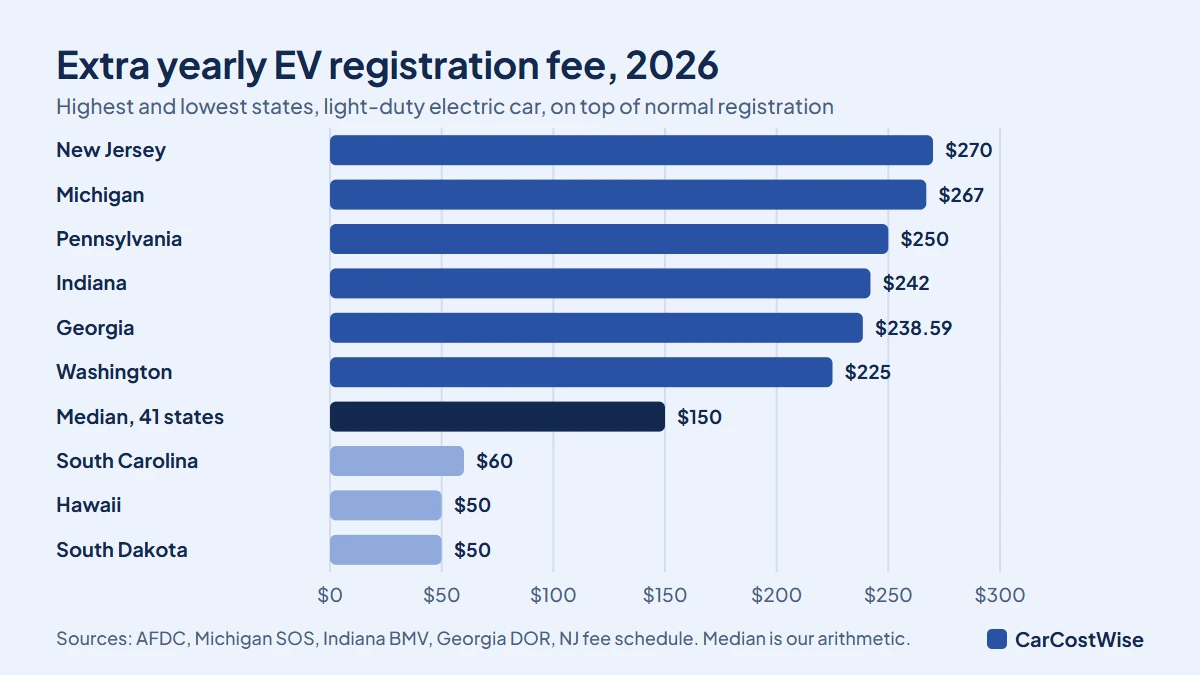
Direct answer: EV registration fees by state run from $50 a year in Hawaii and South Dakota to $270 in New Jersey and $267 in Michigan in 2026. By our count, 41 states charge an extra yearly fee for electric cars, with a median of $150. Alaska, Arizona, Connecticut, DC, Florida, Maine, Massachusetts, Nevada, New Mexico and New York charge none.
What is an EV registration fee, and why do states charge it?
An EV registration fee is an extra charge that an electric car owner pays each year on top of the normal registration, title and plate fees every vehicle pays. States add it because most of their road money comes from the gas tax, and an electric car never buys gas. The fee is a flat stand-in for the fuel tax an EV driver does not pay at the pump.
Most states set a separate, smaller fee for plug-in hybrids (PHEVs), which still burn some gas. About a dozen also charge regular hybrids (HEVs) that never plug in. A few states use a formula instead of a flat number, so the fee moves every year with inflation or with the gas tax.
Three things to know before you read the table:
- The fee is extra. None of the figures below include your state’s base registration, title fee, sales tax or plate fee. Our car ownership cost calculator lets you add it to your other yearly costs.
- Some states bill it every two years. Maryland and South Carolina collect two years at once. We show the yearly amount so you can compare states, and say so in the note.
- Heavier trucks pay more. Delaware, Michigan, Montana and Oklahoma charge more for heavy vehicles. The table shows the passenger-car tier.
How much is the EV registration fee in each state?
This table covers all 50 states and the District of Columbia. It shows the extra yearly fee for a light-duty, all-electric car, the plug-in hybrid fee and the regular hybrid fee where a state charges one, and the note or effective date. “None” means no extra fee for that type in 2026. State names link to the Department of Energy’s Alternative Fuels Data Center (AFDC) law summary, our primary source, and the notes name any state agency page we used to update a figure.
| State | EV fee per year | Plug-in hybrid fee | Hybrid fee | Note or effective date |
|---|---|---|---|---|
| Alabama | $203 | $103 | None | Rises $3 on July 1, 2027 (NCSL) |
| Alaska | None | None | None | No EV fee |
| Arizona | None | None | None | No EV fee |
| Arkansas | $200 | $100 | $50 | Annual since 2019 |
| California | $121 | None | None | Zero-emission cars, model year 2020 and later; rises with inflation (CA DMV) |
| Colorado | About $86 | $13 | None | $60.05 EV fee plus $26 road usage equalization fee, July 2026 to June 2027; PHEV pays the $13 equalization fee |
| Connecticut | None | None | None | No EV fee |
| Delaware | $110 | $85 | $60 | 6,000 lb or less; up to $900 for heavy trucks |
| District of Columbia | None | None | None | No EV fee |
| Florida | None | None | None | No EV fee |
| Georgia | $238.59 | Only with an AFV plate | None | July 1, 2026 to June 30, 2027 (Georgia DOR); rises every July |
| Hawaii | $50 | None | None | Or pay 0.8 cents a mile, capped at $50; flat fee ends June 30, 2028 |
| Idaho | $140 | $75 | None | Annual |
| Illinois | $100 | None | None | Battery EVs only |
| Indiana | $242 | $81 | $81 | Current Indiana BMV fee chart; indexed yearly |
| Iowa | $130 | $65 | None | Annual |
| Kansas | $165 | $100 | $70 | Raised January 1, 2026 |
| Kentucky | $126 | $126 | None | 2025 rate; adjusted each year with a highway cost index |
| Louisiana | $110 | $60 | $60 | Road usage fee, can be prorated |
| Maine | None | None | None | No EV fee |
| Maryland | $125 | $100 | None | Collected as $250 / $200 with two-year registration |
| Massachusetts | None | None | None | No EV fee |
| Michigan | $267 | $113 | None | Since January 1, 2026; 8,000 lb or less, heavier pays $367 / $183 (Michigan SOS) |
| Minnesota | $150 minimum | $75 minimum | None | Since January 1, 2026, scaled to the car’s MSRP and age; minimum drops to $100 / $50 on July 1, 2027 |
| Mississippi | $150 plus inflation | $75 plus inflation | $75 plus inflation | Base amounts; raised each year by CPI since July 2021 |
| Missouri | $150 | $75 | None | Alternative fuel decal, RSMo 142.869: $75 base plus $15 a year from 2022 to 2026; PHEV pays half |
| Montana | $130 | $70 | None | Under 6,000 lb; one-time permanent registration option |
| Nebraska | $150 | $75 | None | Annual |
| Nevada | None | None | None | No EV fee |
| New Hampshire | $100 | $50 | None | Annual since 2023 |
| New Jersey | $270 | None | None | July 1, 2026 to June 30, 2027; rises $10 a year through 2028 |
| New Mexico | None in 2026 | None in 2026 | None | New fee starts January 1, 2027 at $70, rising to $90 by 2029 (SB 2) |
| New York | None | None | None | No EV fee |
| North Carolina | $214.50 | $107.25 | None | Annual |
| North Dakota | $120 | $50 | None | Annual |
| Ohio | $200 | $150 | $100 | Annual |
| Oklahoma | $110 | $82 | None | 6,000 lb or less; up to $2,250 for heavy trucks |
| Oregon | $145 | $30 if rated 40+ mpg | $30 if rated 40+ mpg | $115 plus $30 added December 31, 2025 (ODOT); OReGO per-mile option |
| Pennsylvania | $250 | $62.50 | None | 2026 rate; PHEV pays 25% of the EV fee |
| Rhode Island | $200 | $100 | $50 | New on January 1, 2026 |
| South Carolina | $60 | $60 | $30 | Billed every two years: $120 EV, $60 hybrid |
| South Dakota | $50 | None | None | Annual |
| Tennessee | $200 | $100 | $100 | EV fee rises to $274 in 2027 |
| Texas | $200 | None | None | New EVs pay $400 up front for the first two years |
| Utah | $143.25 | $62.25 | $24.25 | Rates as of April 1, 2025; indexed; per-mile option |
| Vermont | $89 | $44.50 | None | Annual since 2024 |
| Virginia | $135.63 | Varies by mpg | Varies by mpg | Highway use fee, July 1, 2026 to June 30, 2027 (Virginia DMV); per-mile option |
| Washington | $225 | $225 | $75 | $150 plus $75 electrification fee; plug-ins under 30 electric miles pay $75 |
| West Virginia | $200 | $100 | None | Annual |
| Wisconsin | $175 | $75 | $75 | Annual |
| Wyoming | $200 | None | None | Annual decal fee |
Sources: AFDC state law summaries, cross-checked against the American Road and Transportation Builders Association (ARTBA) table of April 2026 and the state agency pages named in the notes. Colorado’s total, the Oregon total, the Missouri 2026 step, the New Jersey 2026 step and the Pennsylvania plug-in fee are our arithmetic from the stated rules. The median of $150 and the average of about $157 across the 41 states are also our arithmetic, using each state’s light-duty yearly amount and Mississippi’s base rate.
Which states charge the highest EV registration fees?
In 2026 the five highest yearly fees for a regular electric car are:
- New Jersey, $270. The zero-emission vehicle fee started at $250 on July 1, 2024 and rises $10 every year until 2028, so it reached $270 on July 1, 2026. New cars register for four years at once, so a buyer of a new EV in New Jersey prepays the fee for all four years at delivery.
- Michigan, $267. Michigan ties its EV fee to the state gas tax. When the gas tax went up on January 1, 2026, the EV total jumped from $160 to $267 and the plug-in hybrid total from $60 to $113, according to the Michigan Secretary of State.
- Pennsylvania, $250. The fee was $200 in 2025 and rose to $250 in 2026.
- Indiana, $242. Indiana adjusts its fee every year by a fuel tax index. The current BMV fee chart lists $242 for EVs and $81 for hybrids and plug-in hybrids.
- Georgia, $238.59. Georgia recalculates its fee each July 1. A bill to repeal it, SB 394, was referred to committee in January 2026, and the Georgia Department of Revenue published the new rate for July 2026, so the fee still applies.
Washington ($225) and North Carolina ($214.50) follow. Texas is $200 a year, but new EVs pay $400 at the first registration because it covers two years. In all, 15 states charge $200 or more (our count).
Which states have no EV registration fee?
Ten jurisdictions charge no extra EV fee in 2026: Alaska, Arizona, Connecticut, the District of Columbia, Florida, Maine, Massachusetts, Nevada, New Mexico and New York. The 2026 ARTBA map shows the first nine in gray.
New Mexico is a short-lived member of this group. Senate Bill 2, signed in February 2026, adds an annual EV fee that starts at $70 on January 1, 2027, rises to $80 in 2028 and reaches $90 in 2029. ARTBA lists the full plug-in hybrid rate at $45.
No fee does not mean cheap registration. Several of these states have high base registration or excise taxes, which our table does not cover. Check the total with your DMV’s fee estimator before you compare states.
How much is the plug-in hybrid and hybrid registration fee by state?
Plug-in hybrids pay an extra fee in about 30 states, usually half the EV fee or a bit more. The highest PHEV fees are Washington ($225 for plug-ins with at least 30 miles of electric range), Ohio ($150), Kentucky ($126), Michigan ($113) and North Carolina ($107.25). Some states that charge EVs leave plug-in hybrids alone: California, Hawaii, Illinois, New Jersey, South Dakota, Texas and Wyoming.
Regular hybrids that never plug in pay an extra fee in 13 states in our table: Arkansas ($50), Delaware ($60), Indiana ($81), Kansas ($70), Louisiana ($60), Mississippi ($75 plus inflation), Ohio ($100), Rhode Island ($50), South Carolina ($30 a year), Tennessee ($100), Utah ($24.25), Washington ($75) and Wisconsin ($75). Virginia and Oregon handle high-mileage cars through their own rules: Virginia’s highway use fee applies to fuel-efficient cars based on their mpg, and Oregon added $30 to cars rated 40 mpg or better.
If you are weighing a hybrid against a gas car, these fees are small next to the fuel savings in most states, but they do push the payback date out. Our hybrid vs gas break-even guide shows how to fold a yearly fee into that math.
Free calculator
Add your state's EV or hybrid fee to your fuel costs and compare the three over five years.
Is there a federal EV registration fee?
Not yet. In May 2026 the House Transportation and Infrastructure Committee approved the BUILD America 250 Act by 62 to 2. The bill would add a federal fee of $130 a year for EVs and $35 for plug-in hybrids, collected by state DMVs at registration, starting in fiscal 2027. From 2029 the fees would rise by $5 a year, to a cap of $150 and $50. Regular hybrids would pay nothing.
Status as of October 2026: proposed, not law. A July 2026 report said the bill was waiting for the House Ways and Means Committee, and we found no report of a House floor vote. Senate leaders on the relevant committees have opposed the fee. If it passes, the federal fee would stack on top of the state fees in this table, so an EV owner in New Jersey would pay $400 a year in EV-specific fees (our arithmetic: $270 plus $130).
How much does the EV fee add to the cost of owning an electric car?
At the $150 median, the fee adds $750 over five years. In New Jersey it is $1,350 and in Hawaii $250 (our arithmetic, at 2026 rates; several states raise the fee every year, so the real total will be a little higher).
Set that against what the car saves on fuel. Charging at home costs about $54 per 1,000 miles at the U.S. average electricity price, according to our cost to charge an electric car at home by state guide. At 12,000 miles a year that is about $650 of electricity a year (our arithmetic: 12 times $54.48). A gas car rated 30 mpg uses 400 gallons for the same miles, so the gas bill is several times higher than the yearly EV fee in almost any state at recent pump prices.
The fee matters more for low-mileage drivers. Someone driving 5,000 miles a year in Michigan pays $267 whether they drive or not, which is why Hawaii, Oregon, Utah and Virginia let drivers pay by the mile instead. For a full yearly budget, put the fee next to insurance, depreciation and repairs using our guide to the cost per mile to drive a car. EVs are heavy and wear tires a bit faster too, so check how much new tires cost before you finalize the budget.
How do you pay the EV fee, and can you lower it?
You pay it with your normal registration. There is no separate bill: the DMV or county tax office adds it when you first register the car and at each renewal. A few practical points:
- Check your renewal notice. It should show the EV or hybrid fee as its own line. If it is missing on a plug-in, your state may not classify your car that way.
- Ask about a per-mile option. Hawaii, Oregon (OReGO), Utah and Virginia offer road usage programs. Low-mileage drivers can pay less than the flat fee, up to the flat fee as a cap in Hawaii and Utah.
- Watch the weight class. In Delaware, Michigan, Montana and Oklahoma a heavy electric truck pays more than a sedan. Check the weight on your title.
- Expect yearly changes. California, Colorado, Georgia, Indiana, Kentucky, Michigan, Mississippi, Utah and Virginia adjust their fees by formula. New Jersey, Tennessee and New Mexico have fixed step-ups written into law.
- Moving states? Compare the full registration cost, not only the EV fee. A state with no EV fee can still cost more overall.
Rates in this guide are for 2026 and change often. Confirm the current amount with your state DMV before you budget. More guides on running a car are in more ownership cost guides.
FAQ
Which states charge an EV registration fee?
In 2026, 41 states charge an extra yearly fee for electric cars, by our count from the AFDC and state agency data. Only Alaska, Arizona, Connecticut, DC, Florida, Maine, Massachusetts, Nevada, New Mexico and New York do not. New Mexico’s fee starts January 1, 2027.
What state has the highest EV registration fee?
New Jersey, at $270 a year from July 1, 2026, followed closely by Michigan at $267 since January 1, 2026. Pennsylvania ($250), Indiana ($242) and Georgia ($238.59) round out the top five for a regular electric car.
Do hybrids pay an extra registration fee?
Plug-in hybrids pay an extra fee in about 30 states, often about half the EV fee. Regular hybrids pay one in 13 states, from $24.25 in Utah to $100 in Ohio and Tennessee. Most states do not charge regular hybrids anything extra.
Why do electric cars pay a higher registration fee?
Because they do not pay gas tax, which funds most state road budgets. The extra fee is a flat substitute for that tax. Some states, such as Virginia, set the fee as a share of the gas tax a typical car would pay.
Is there a federal fee on electric vehicles?
No, not as of October 2026. The House BUILD America 250 Act would add $130 a year for EVs and $35 for plug-in hybrids, and it passed committee in May 2026, but it has not passed the House or Senate.
Sources
- U.S. Department of Energy, Alternative Fuels Data Center, state laws and incentives database (EV, plug-in hybrid and hybrid fee summaries for each state, retrieved October 2026)
- National Conference of State Legislatures, “Special Fees on Plug-In Hybrid and Electric Vehicles” (state fee map, Alabama increase date)
- American Road and Transportation Builders Association, “State Electric Vehicle Fees, April 2026” (42-state table and map)
- Missouri Revised Statutes 142.869, alternative fuel decal fee (via FindLaw)
- Indiana Bureau of Motor Vehicles, Fee Chart (EV supplemental fee $242, hybrid $81)
- California DMV, Registration Fees (Road Improvement Fee for zero-emission vehicles)
- Georgia Department of Revenue, Alternative Fuel and Low-Speed Vehicles Annual Licensing Fees, July 2026
- Virginia DMV, Highway Use Fee
- Oregon DMV, new fees effective December 31, 2025 (one-page summary)
- Bridge Michigan, “Michigan EV fees spike under road funding deal, now nation’s highest” (January 2026, citing the Michigan Secretary of State)
- New Jersey Coalition of Automotive Retailers, “NJMVC electric vehicle fee update” (fee schedule 2024-2028)
- New Mexico Legislature, Senate Bill 2 (2026 regular session, EV fee schedule from 2027)
- Holland and Hart, “House Transportation and Infrastructure Committee Advances $580 Billion BUILD America 250 Act” (May 22, 2026)
- News Tribune, “CBO: House highway bill would widen trust fund” (July 12, 2026; bill status and fee schedule)
Fee amounts change often, and several states adjust them every year. All figures marked “our arithmetic” are our own calculations from the sources above.
Updated October 2026. By Rasel Hakkani.
This article is general information, not financial or legal advice. Confirm your fee with your state DMV before you register or buy a vehicle.