

Direct answer: How long does an accident stay on your insurance? Usually 3 to 5 years: Progressive looks back 3, Allstate 5. If you caused it, expect your premium to rise about 45% to 49%, or roughly $1,056 a year. A not-at-fault accident often adds little or nothing, and California and Oklahoma ban that surcharge.
The surcharge is not a one-time hit. You pay it at every renewal until the accident ages out of your insurer’s lookback window, so the real cost is the yearly increase multiplied by three to five years. This guide covers how much rates go up, how long the surcharge lasts, what changes when you were not at fault, and what the law says in the states that limit surcharges.
How long does an accident stay on your insurance?
Most insurers count an accident for 3 to 5 years from the accident date. GEICO says an accident can affect your rates for three to five years on average, and AAA gives the same range, depending on severity, fault, your driving history and state rules. The exact window depends on the company. MoneyGeek (updated August 31, 2026) lists these lookback periods:
| Insurer or state | How long an at-fault accident counts | Source |
|---|---|---|
| Progressive | 3 years | MoneyGeek |
| State Farm | 3 years for minor accidents, up to 5 for serious ones | MoneyGeek |
| Allstate | 5 years | MoneyGeek |
| Most insurers (range) | 3 to 5 years | GEICO, MoneyGeek |
| California (Good Driver Discount test) | 3 years | 10 CCR 2632.13.1 |
| Massachusetts (Safe Driver Insurance Plan) | 6-year experience period, with zero points in year six | 211 CMR 134.10 |
| CLUE claims database (all claims, any fault) | Up to 7 years | MoneyGeek, Tennessee Dept. of Commerce and Insurance |
Three separate records track an accident, and they run on different clocks:
- Your insurer’s rating window. This is the one that sets your price. It is usually 3 to 5 years.
- The CLUE report. LexisNexis keeps a Comprehensive Loss Underwriting Exchange (CLUE) report of auto claims. MoneyGeek says it keeps all claim entries for seven years regardless of fault, and the Tennessee Department of Commerce and Insurance describes the report as holding up to seven years of claims history. A new insurer can see the claim there even after your current insurer stops charging for it.
- Your state driving record. The DMV record follows state law, not insurance rules. MoneyGeek notes DMV records can hold an accident for 3 to 10 years.
The surcharge does not always fall off on its own. MoneyGeek points out that the rate does not drop automatically when the window closes, so shop around at the first renewal after the accident ages out.
How much does insurance go up after an accident?
For an at-fault accident with a paid claim, national studies land in a tight range:
| Study | Typical at-fault increase | Profile or note |
|---|---|---|
| MoneyGeek (Aug 30, 2026) | 48.8%, about $1,056 a year ($88 a month) | 40-year-old, full coverage, 2021 Camry, $1,000 to $1,999 property damage claim |
| NerdWallet (April 2026 analysis) | 48% a year on full coverage | National average |
| LendingTree (2026 study) | 45.0% | At-fault claim of $2,000 or more |
| Insurify | 34% at fault, 22% not at fault | Monthly liability-only quotes |
The spread mostly comes from what each study prices. Full-coverage studies show bigger dollar jumps than liability-only ones, and a large claim costs more than a small one. AAA Club Alliance (July 2026, using January 2026 rate data) puts the average full-coverage increase at 45% for an at-fault accident with significant property damage, and says most at-fault accidents affect your rates for three to five years.
How much more does the full surcharge cost?
Our arithmetic, using MoneyGeek’s $1,056 average yearly increase:
- 3-year lookback: $1,056 x 3 = $3,168 in extra premium.
- 5-year lookback: $1,056 x 5 = $5,280 in extra premium.
That gap is why the lookback window matters as much as the percentage. The same accident can cost about $2,100 more at a 5-year insurer than at a 3-year one, if the yearly surcharge is the same (our arithmetic). In real life the surcharge often shrinks in the later years, so treat these as upper estimates for an average driver.
Which insurers raise rates the most after an accident?
Your insurer matters more than almost anything else. MoneyGeek priced the same driver before and after one at-fault accident:
| Insurer | Monthly premium, clean | After one at-fault accident | Increase |
|---|---|---|---|
| State Farm | $172 | $214 | 24.3% |
| AAA | $172 | $260 | 51.5% |
| Allstate | $224 | $341 | 52.5% |
| GEICO | $141 | $221 | 56.9% |
| Progressive | $193 | $305 | 58.1% |
State Farm’s surcharge was less than half of Progressive’s for the same driver and the same claim. If you are hit with a large increase, getting quotes from other companies is the fastest fix.
How much does insurance go up after an accident by state?
In LendingTree’s 2026 study, California has the biggest percentage increase after an at-fault accident (70.7%), Arizona the biggest dollar increase ($2,091.75 a year) and Pennsylvania the smallest. State law, local repair costs and how many drivers carry little or no insurance all change the surcharge. A September 2026 summary of LendingTree’s study lists the states where one at-fault accident costs the most:
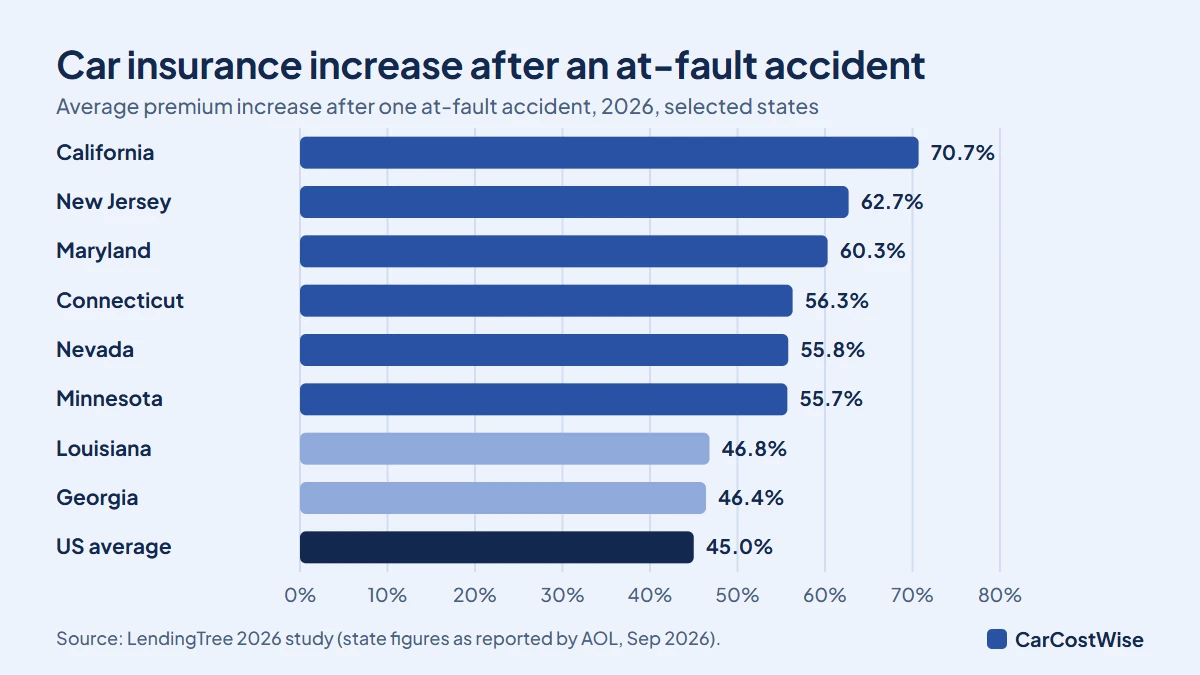
| State | Before accident (yearly) | After accident (yearly) | Increase |
|---|---|---|---|
| California | $2,382.91 | $4,066.73 | 70.7% |
| New Jersey | $3,188 | $5,188 | 62.7% |
| Maryland | not stated | not stated | 60.3% (about $1,520 a year) |
| Connecticut | $2,710 | about $4,230 | 56.3% |
| Nevada | $2,780 | $4,330 | 55.8% |
| Minnesota | $2,250 | $3,510 | 55.7% |
| Louisiana | just over $4,000 | $5,800 | 46.8% |
| Georgia | $2,690 | $3,940 | 46.4% |
Arizona has the biggest dollar jump in the same study, at $2,091.75 a year, followed by New Jersey at $1,999.64. Pennsylvania has both the smallest percentage increase and the smallest dollar increase, at $351.60 a year.
Put those against the lookback window and the gap gets large. A New Jersey driver paying about $2,000 more for three years spends about $6,000 extra. A Pennsylvania driver paying $351.60 more for three years spends about $1,055 (our arithmetic).
Will my insurance go up if the accident wasn’t my fault?
Usually not much, but it can. Insurify reports an average 22% increase after a not-at-fault accident on liability quotes, against 34% for an at-fault one. GEICO says rates are less likely to rise after a not-at-fault accident but that this does not guarantee immunity from rate changes, and that several claims in a short period can raise premiums.
The best test data on this is older but still the most detailed. In 2017 the Consumer Federation of America priced not-at-fault accidents in 10 cities and found:
- Progressive used the not-at-fault surcharge most aggressively, wherever state law allowed it.
- GEICO and Farmers sometimes raised rates 10% or more.
- Allstate occasionally penalized drivers who did not cause the crash.
- State Farm never raised premiums for a not-at-fault accident.
- The average penalty was 6.6% for a higher-income driver and 9.6% for a moderate-income driver, or $78 and $208 a year.
Why would a not-at-fault crash cost you anything? Three common reasons:
- You claimed on your own policy. A hit-and-run, or an at-fault driver with no insurance, can mean your collision or uninsured motorist coverage pays.
- You lost a claims-free discount. Some insurers drop the discount after any claim, even with no surcharge.
- Fault was shared. Insurers can split fault. In California, you are “principally at fault” only if your actions were at least 51% of the legal cause.
Which states ban rate increases after a not-at-fault accident?
Two states ban the surcharge outright, and two more limit when it can apply. This is the part of the topic most guides skip, and the rules come straight from state law:
| State | Rule | Source |
|---|---|---|
| Oklahoma | Insurers may not assign points, cancel, refuse to renew or charge a higher premium for liability or collision coverage because you were in a collision you did not cause. | 36 O.S. § 941 |
| California | An accident can count against you only if you were at least 51% at fault and it caused injury, death, or more than $1,000 of property damage. Rear-end hits, lawfully parked cars, reported hit-and-runs and animal strikes are presumed not your fault. | 10 CCR 2632.13 |
| New York | No surcharge for an accident with $2,000 or less in total property damage, unless it involved injury or you had more than one accident in the rating period. | Insurance Law § 2335 |
| Massachusetts | A surcharge needs more than 50% fault and a claim payment over $1,000. Incidents count for a 6-year period, with points set to zero in year six. | 211 CMR 134 |
California also limits how long an accident counts. A principally-at-fault accident with injury or death within the last three years makes you ineligible for the Good Driver Discount, and a property-damage-only accident adds one violation point for three years under 10 CCR 2632.13.1.
If you live in one of these states and your rate jumped after a crash you did not cause, ask the insurer in writing which incident it rated and why. If you think the rule was broken, your state insurance department takes complaints.
How can you keep an accident from raising your rates?
You cannot erase a paid at-fault claim, but you can cut what it costs you:
- Use accident forgiveness if you already have it. GEICO’s Claim Forgiveness keeps rates from rising after your first qualifying loss, but GEICO says it is not available in California, Connecticut or Massachusetts. You cannot add forgiveness after the crash.
- Shop at the first renewal after the surcharge. The insurer table above shows a gap of more than 30 percentage points between companies for the same accident.
- Ask about a shorter lookback. A 3-year insurer stops charging for the accident up to two years earlier than a 5-year insurer.
- Raise your deductible. A higher deductible lowers the premium you pay during the surcharge years.
- Check whether collision is still worth it. If your car is older and paid off, a higher post-accident premium can push collision past the point where it pays. Our guide on when to drop collision coverage runs the 10% rule.
- Think twice before claiming a small loss. If the damage is close to your deductible, paying yourself may cost less than three to five years of surcharge. Note that you still need to report the accident to your insurer.
If you still owe money on the car, a crash also raises the question of what happens if it is totaled. Read gap insurance dealer vs insurance company before you renew.
Free calculator
See how an accident surcharge changes what your car costs you per year.
Does an accident on your record affect a new insurer’s quote?
Yes. When you switch, the new company pulls your CLUE report and your driving record, so the accident follows you for as long as the new insurer’s own lookback allows. Switching does not erase the accident, but it lets you move to a company that rates it less harshly or for fewer years. You can request your own free CLUE report once a year to check for errors, such as a not-at-fault claim recorded as at fault.
To see how a surcharge changes your all-in driving cost, compare it with the figures in cost per mile to drive a car. More cost guides for drivers are in more ownership cost guides.
FAQ
How long does an accident stay on your insurance?
Usually 3 to 5 years from the accident date. Progressive looks back 3 years, Allstate 5, and State Farm 3 to 5 depending on severity, according to MoneyGeek. Claims can stay on your CLUE report for up to 7 years, and Massachusetts uses a 6-year period.
How much does insurance go up after an at-fault accident?
About 45% to 49% on average. MoneyGeek found 48.8%, or about $1,056 a year, and LendingTree found 45.0%. State Farm’s increase was 24.3% and Progressive’s 58.1% for the same driver.
Does insurance go up if the accident wasn’t your fault?
Sometimes. Insurify reports an average 22% increase for not-at-fault accidents on liability quotes, and a 2017 CFA study found 6.6% to 9.6%. State Farm did not surcharge in that study. California and Oklahoma ban the surcharge.
Which states don’t allow rate increases for not-at-fault accidents?
California and Oklahoma ban them. New York bars surcharges on accidents with $2,000 or less of property damage and no injury, and Massachusetts requires more than 50% fault and a claim over $1,000.
Does accident forgiveness stop my rates from going up?
It can for your first qualifying accident, if you had it before the crash. GEICO’s version is not offered in California, Connecticut or Massachusetts, and you can still lose a claims-free discount.
Sources
- MoneyGeek, “How Much Does Car Insurance Go Up After an Accident?” (updated August 30, 2026; 48.8% and $1,056 national average, insurer table, methodology)
- MoneyGeek, “How Long Does an Accident Stay on Your Insurance?” (updated August 31, 2026; lookback by insurer, CLUE seven years, DMV records)
- GEICO, “How Much Does Auto Insurance Go Up After a Claim?” (three to five years, not-at-fault claims, Claim Forgiveness states)
- NerdWallet, “How Much Does Insurance Go Up After an Accident?” (48% full-coverage increase, April 2026 analysis)
- LendingTree, “One At-Fault Accident Can Add Thousands to Drivers’ Insurance Costs” (2026; 45.0% average, California 70.7%, Arizona $2,091.75, New Jersey $1,999.64, Pennsylvania $351.60)
- AOL, “The 12 States Where Car Crashes Cost Drivers the Most” (September 11, 2026; LendingTree state figures)
- Insurify, “How Much Does Car Insurance Go Up After an Accident?” (34% at fault, 22% not at fault)
- AAA Club Alliance, “How Much Does Car Insurance Increase After an Accident?” (July 21, 2026; 45% average full-coverage increase, three to five years)
- Consumer Federation of America, “Major Insurance Companies Raise Premiums After Not-At-Fault Accidents” (February 13, 2017; insurer behavior, 6.6% and 9.6% penalties)
- Oklahoma Statutes, Title 36, § 941 (no higher premium for not-at-fault collisions)
- California Code of Regulations, Title 10, § 2632.13 (principally at fault, 51% and $1,000 tests, presumptions)
- California Code of Regulations, Title 10, § 2632.13.1 (three-year Good Driver Discount test)
- New York Insurance Law § 2335 ($2,000 property damage threshold)
- Massachusetts, 211 CMR 134.10 (Safe Driver Insurance Plan, six-year period, zero points in year six)
- Massachusetts Division of Insurance, “Surchargeable incidents” (more than 50% at fault, claim over $1,000)
- Tennessee Department of Commerce and Insurance, “CLUE” (up to seven years of claims history, free yearly report)
Rates, lookback periods and state rules change, and every insurer prices differently. Use these figures to set expectations, then get quotes for your own driving record.
Updated October 2026. By Rasel Hakkani.
This article is general information, not insurance, legal or financial advice. Check your policy and your state insurance department for the rules that apply to you.