
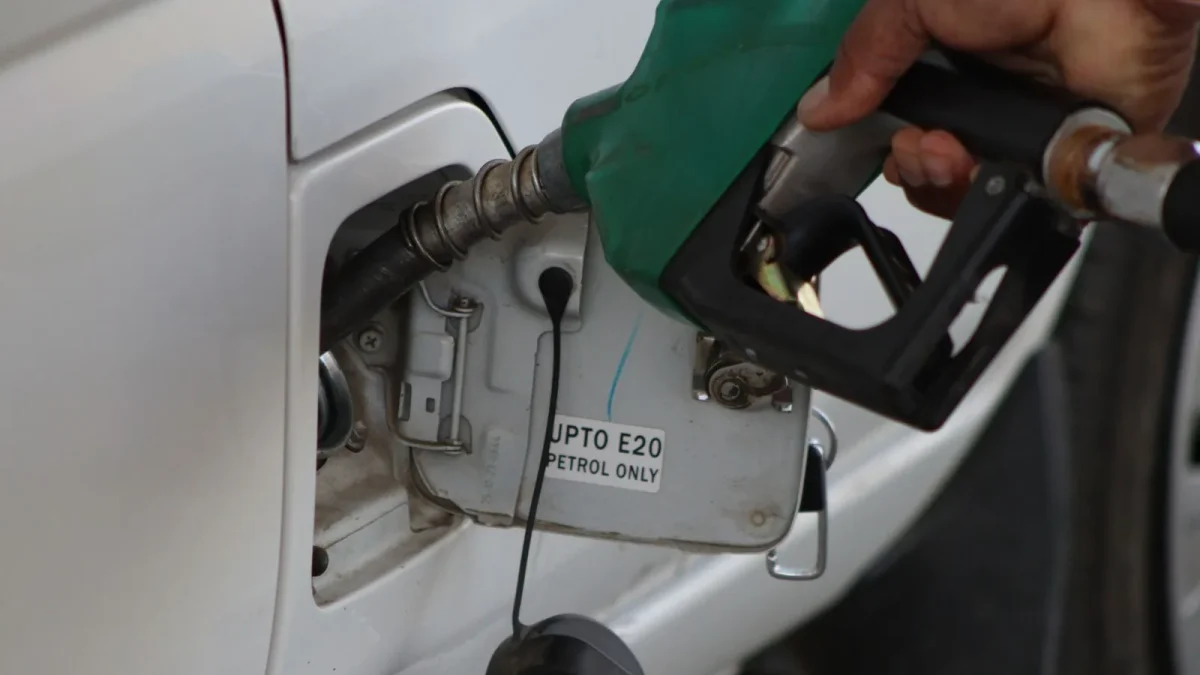
Direct answer: P0442 means your car’s computer found a small leak in the evaporative emission (EVAP) system, the sealed network that keeps gasoline vapor out of the air. P0455 means it found a large one. A loose, worn or missing gas cap is the usual cause of both and costs $15-$60. If the cap is fine, expect about $60-$650 for a hose, valve or canister.
Quick facts
| Official names | P0442: EVAP System Leak Detected (Small Leak). P0455: EVAP System Leak Detected (Large Leak) |
| Severity | Low to moderate. The car drives normally, but the light stays on and an emissions test will fail |
| Can I drive it? | Yes, for a few weeks, if the light is solid (not flashing) and the engine runs smoothly |
| DIY difficulty | Gas cap: easy. Hose or valve: moderate. Charcoal canister: hard |
| Typical cost | About $15-$60 if it is the cap; about $60-$650 for a hose, valve or canister |
| Passes an emissions test? | No. An active P0442 or P0455 is treated as a fail in areas that test |
What do P0442 and P0455 mean?
Gasoline gives off vapor. Instead of letting it drift into the air, your car routes that vapor from the fuel tank into a charcoal canister, then pulls it into the engine later to be burned. This closed loop is the evaporative emission control system, usually shortened to EVAP. It includes the gas cap, the filler neck, the tank, rubber and plastic vapor lines, the charcoal canister, a purge valve and a vent valve.
Every so often the computer seals the system and checks whether it holds vacuum or pressure. Repair guides describe two common methods: a vacuum decay test, and on newer cars a positive-pressure test (NYVIP). If the pressure falls faster than it should, the computer stores a code. P0442 is the “small leak” result. P0455 is the “large leak” or “gross leak” result: the system failed the test by a wide margin.
Two things the codes do not tell you. They do not say which part leaks, and they do not say the part is broken. Cap, hoses, valves, canister, filler neck and tank all sit inside the same sealed loop, and the code only reports that the loop lost pressure. That is why the cheap checks come first and why a smoke test is the standard next step.
How small is “small”? P0442 vs P0455 vs P0456
The size thresholds below are approximate, and sources disagree on them. Identifix, a shop-software company, lists:
| Code | Leak size (hole diameter) | What it means | Most likely causes |
|---|---|---|---|
| P0456 | About 0.020 inch | Very small leak | A tiny seal or hose pinhole |
| P0442 | About 0.040 inch | Small leak | A worn cap seal, a hairline hose crack, a weeping purge valve |
| P0455 | Commonly 0.080 inch or more | Large (gross) leak | A loose or missing cap, a disconnected hose, a purge valve stuck open |
For scale, 0.040 inch is about 1 millimeter, roughly the width of a sewing needle. Other guides give slightly different numbers, and the exact strategy is set by each manufacturer, so treat the table as a guide to the order of the codes rather than a hard rule.
The practical difference: large leaks are usually the easiest and cheapest to find, because the cause is often visible or, in the case of the gas cap, sitting in your hand. Small leaks are more likely to need a smoke test. “Large” does not mean fuel is pouring onto the ground. A gas cap that is not sealed is enough to set P0455.
What are the symptoms?
- Check engine light on, often the only sign
- A “check fuel cap” message on some vehicles
- The light appearing soon after you refuel
- A faint fuel smell near the rear of the car in some cases
- Slightly worse fuel economy with a large leak, because vapors that should burn in the engine escape
- Hard starting or a long crank after refueling, when a purge valve is stuck open
- Failing a state emissions inspection
Most drivers notice nothing else. The car runs normally because the leak is in the vapor system, not the engine. A flashing light, rough running or loss of power is a different problem, usually a misfire. If yours flashes, read check engine light flashing right away.
What causes P0442 and P0455? Ranked from most to least common
Repair guides list the same short set of suspects for both codes. The order follows how they describe these codes in general; how often each one happens depends on the vehicle and its age. Identifix lists the causes without ranking them and recommends working from the cheapest check to the most expensive.
| # | Cause | More likely to set | Typical fix | Cost range |
|---|---|---|---|---|
| 1 | Loose, worn, cracked, wrong or missing gas cap | Both. Loose or missing: P0455. Worn seal: P0442 | Tighten until it clicks, or replace the cap | $15-$60 installed (NextCarReview, Empire Auto Protect); the part alone is about $10-$22 for store brands and $32-$111 for genuine Mopar caps |
| 2 | Cracked, brittle, loose or disconnected EVAP hose, line or fitting | Hairline crack: P0442. Off its fitting: P0455 | Replace or reconnect the hose | $60-$300 across four guides |
| 3 | Purge valve that leaks or sticks open | Weeping: P0442. Stuck open: P0455 | Replace the purge valve | $100-$400; RepairPal’s generic average is $210-$251 |
| 4 | Vent valve or its solenoid that does not seal | Both | Replace the vent valve | $120-$300 |
| 5 | Cracked or corroded filler neck, leaking tank seal, or a failed tank pressure sensor | Both | Replace the part | Part alone: filler neck $50-$250, sensor $25-$150 (A-Premium). Get a written quote for labor |
| 6 | Cracked charcoal canister (it sits low and takes road hits) | Both | Replace the canister | $200-$650 |
Why the gas cap comes first
The cap is cheap, quick to check and the most common single cause in every guide we read. One technical reference says a loose or degraded cap is responsible for a significant share of P0440, P0442, P0455 and P0456 codes. A mechanic checks it first for the same reason you should: a leak you can fix in ten seconds should be ruled out before you pay for diagnosis.
Not every cap is equal. Cheap aftermarket caps sometimes do not seal as well as the original. One owner on a car forum reported a $10 store-brand cap that did not hold, and an $18 generic cap that cleared the light for only about a month. Treat that as one data point, but it explains why a fresh cap that does not fix the code is still worth swapping for the right one for your car. Check the part number against your VIN before you buy.
What about hidden leaks?
Sometimes the cap is not the problem. Owner reports show how varied the real causes can be:
- P0442, Corvette C5: two cracked plastic EVAP hoses, one near the fuel rail and one near the firewall. Replacing both cleared the code.
- P0442, 2012 Mazda 5: the canister vent solenoid, replaced with a part that cost about $44.
- P0442, Ford Expedition: a smoke test found a very small crack in the plastic fuel tank just below the vapor valve nipple.
- P0455, Subaru Outback: the owner tightened a loose cap and still saw the light return after about 100 miles.
- P0455, 2015 Subaru WRX (summarized by Go-Parts): a corroded EVAP pipe under the intake manifold, visible only with a mirror and confirmed with a smoke test.
- P0442, Chevrolet Tahoe: one owner replaced several parts and still saw the code come back, a reminder that a fix is not guaranteed without finding the actual leak.
These are single reports, years old in some cases, not rules. They show why a cap that does not fix the code should lead to a smoke test, not a second round of guessing.
How much does it cost to fix P0442 or P0455?
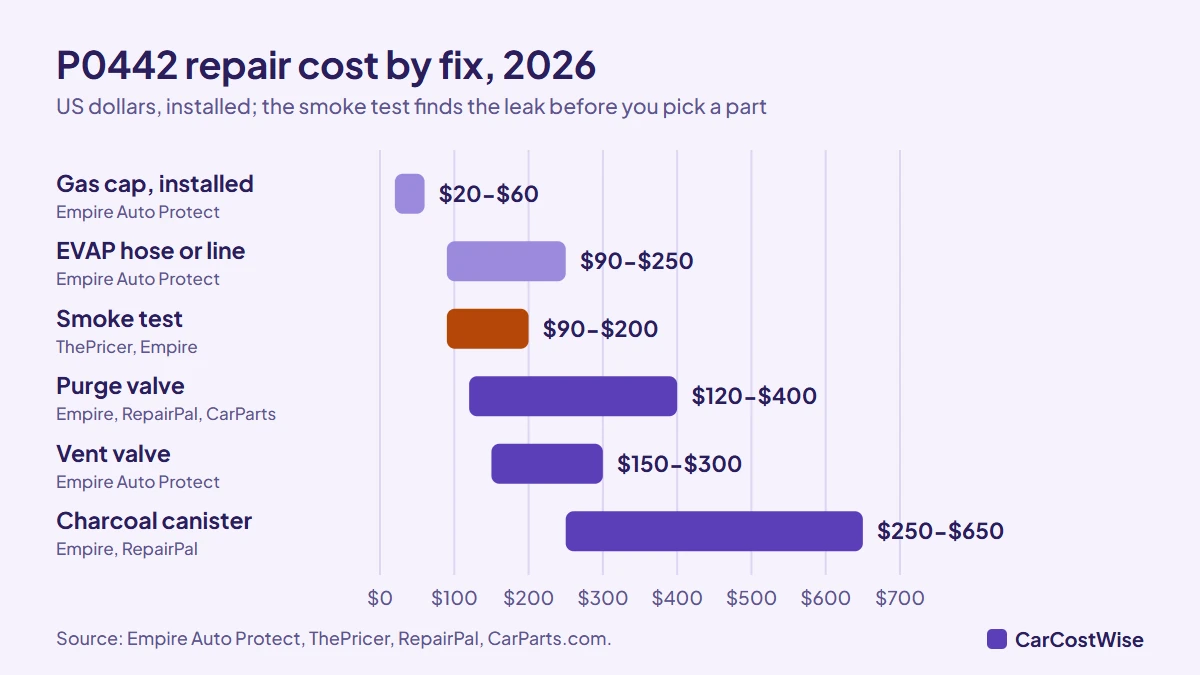
Published ranges overlap but do not match. Vehicle type, how hard the part is to reach and local labor rates all change the total. AAA says labor rates run from under $100 to over $200 an hour, and that almost half of shops charge $120-$159.
| Repair | Low | High | Source note |
|---|---|---|---|
| Gas cap, replace | $15 | $60 | NextCarReview $15-$60; Empire Auto Protect $20-$60. Part alone: AutoZone Duralast $9.99-$18.99; Stant at Walmart $14.99-$22.19; genuine Mopar $31.86-$111.04 |
| EVAP hose or line | $60 | $300 | NextCarReview $60-$180; Empire Auto Protect $90-$250; Engine Fix $100-$300 |
| Smoke test (diagnosis) | $60 | $200 | Car Talk $60-$150; Empire Auto Protect $90-$150; ThePricer $100-$200 for a standalone test |
| Purge valve | $100 | $500 | NextCarReview $100-$250; Empire Auto Protect $120-$400; RepairPal generic average $210-$251 (September 2026); Engine Fix $170-$500 (purge or vent) |
| Vent valve | $120 | $500 | NextCarReview $120-$300; Empire Auto Protect $150-$300; Engine Fix $170-$500 (purge or vent) |
| Charcoal canister | $200 | $650 | Empire Auto Protect $250-$650, national average about $430; NextCarReview $250-$600; Engine Fix $400-$650; RepairPal’s average shop estimate is $555-$640. Over $1,000 if the tank or exhaust must come off (Engine Fix) |
A few things worth knowing about these numbers:
- The cap is the cheap end. A store-brand cap is about $10-$22 at the parts counter. Even a genuine dealer cap tops out around $111, and for most cars it is far less.
- Parts are cheap, labor and diagnosis are not. A-Premium lists typical online part prices (September 2026) of $25-$120 for a purge valve, $25-$120 for a vent valve, $5-$60 for an EVAP hose or connector and $100-$400 for a canister. The rest of a shop bill is labor and diagnosis. Some shops fold the smoke test into a broader diagnostic fee, so ask whether your quote includes the scan.
- Your car may differ. RepairPal’s purge valve page shows Toyota Camry at $344-$369 and Nissan Altima at $299-$345 while a Dodge Journey runs $123-$157, so get a written quote for your exact car.
- Some sources sell repair plans. Empire Auto Protect sells vehicle service contracts, so its figures may lean high. We list it next to independent sources for that reason.
- Our arithmetic: if you replace a $15-$60 cap first and the light stays on, adding a $60-$200 smoke test and a $100-$400 purge valve puts the whole path at about $175-$660. If the smoke test finds a bad canister instead ($200-$650), the same path totals about $275-$910. Guessing at valves one by one can cost more than paying for the test.
How do you diagnose an EVAP leak? Cheapest steps first
- Check the gas cap. Remove it, look at the rubber seal for cracks or flat spots, wipe the sealing surface, then reinstall it and turn it until it clicks. Check the filler neck for rust or damage where the cap seals. On a capless filler, inspect the flap and seal. Replace a cap that does not seal with one made for your vehicle.
- Read all codes and the freeze frame. A P0440 beside it points to a system-wide fault. If P0446 or another vent-circuit code is stored too, A-Premium points to the vent valve, its wiring or its filter. The freeze frame shows the fuel level and coolant temperature when the code set.
- Inspect the visible EVAP hoses. Work from the filler neck to the canister and the purge valve. Check elbows, quick-connect fittings and spots where a line rubs against metal. Heat and age make plastic lines brittle. For P0455, look for a hose that has come off its fitting.
- Test the purge and vent valves. The purge valve should hold vacuum when closed, and the vent valve should not leak when commanded shut. A scan tool that commands the valves makes this quick; NextCarReview suggests listening for a click.
- Do a smoke test. A shop feeds low-pressure smoke, about 0.5 psi or less, into the sealed system with an approved machine and looks for where it escapes, often with a UV light. A proper smoke test takes about 15 minutes according to Apex Tech Nation, and it is the most reliable way to find a pinhole leak. A-Premium warns against shop air or homemade smoke sources because they can damage the system. If no smoke shows, the fault may be a valve that does not seal or a sensor rather than a physical hole.
- Replace only what the test shows. Valves are the classic parts-cannon trap. Swapping both “just in case” can double the bill. Do not skip straight to the charcoal canister either. It is the priciest part on the list, and every guide we read puts the cap, hoses and valves ahead of it.
- Repair, then confirm. Clearing the code resets the EVAP monitor, so the car must complete its test again before the repair counts as proven. See the next section.
How long until the light goes off after the fix?
The computer has to run its own EVAP test and pass it before it clears the light. That test does not run on every trip. Apex Tech Nation says it often runs when the tank is between one quarter and three quarters full, and many makers also require a cold start, with coolant below about 86 degrees F. A-Premium says there is no universal drive cycle, because the test depends on fuel level, temperature, soak time and how you drive.
Guides that discuss timing say the light typically goes out after about 3 to 5 drive cycles once the leak is fixed, which can take up to a week or more. A scan tool can clear the code at once, but that does not repair anything. If the cause is still there, the light returns, often within 50-75 miles of normal driving. Some cars need the fault to show up on two separate drive cycles before the light comes on, according to NYVIP, which also means it can take a few trips for it to go away.
Do not disconnect the battery as a shortcut. That also wipes the readiness monitors.
Will P0442 or P0455 fail an emissions test?
In areas that test emissions, yes. Empire Auto Protect and Engine Fix both say an active EVAP leak code will cause an inspection fail, and the light generally needs to be off to pass. The fix has to be real, too. Clearing the code the day before the test can leave the EVAP monitor “not ready,” which some states treat as a fail. Drive normally for a week or so after the repair and use a scan tool to confirm that all monitors show ready before you go in.
Can I drive with P0442 or P0455?
For a short period, usually yes, provided that:
- the check engine light is solid, not flashing,
- the engine runs smoothly with no loss of power, and
- there is no strong fuel smell.
Carparts.com says P0455 is not a severe drivability problem, and Empire Auto Protect says the car runs normally, with no misfires, stalling or power loss. Guides generally say a few days or weeks is acceptable, but not months. The main risks are a failed emissions inspection, slightly lower fuel economy and a cracked hose or stuck valve getting worse. A strong gasoline smell is different. Fuel vapor is flammable, so have a shop look at the car quickly.
If the light flashes, stop driving as soon as you safely can. That signals an active misfire, which can destroy the catalytic converter quickly. See check engine light flashing.
Is an EVAP repair covered by warranty?
Possibly, if the car is new enough. Empire Auto Protect, citing the EPA, says the federal emissions warranty covers many emission parts for 2 years or 24,000 miles on newer cars, and the EPA’s consumer guide covers specified major components for 8 years or 80,000 miles. Whether a cap, hose, valve or canister counts depends on the maker’s warranty booklet, and the maker can deny a claim caused by misuse or poor maintenance. If your car is young, call a dealer before you pay. This single step can save you the whole bill.
Can you fix it yourself?
The cap is a DIY job for anyone. Hoses and valves are moderate: many sit in plain view in the engine bay and are held by clips, but some are hidden behind the intake or near the tank. A canister is hard on most cars because it sits under the vehicle near the tank, and shops charge for the labor.
Do not buy parts by guessing. A purge valve alone can run $25-$120 for the part, but replacing it when the leak is a cracked hose just adds cost. A smoke test is cheaper than buying the wrong part twice. One Mercedes owner with an intermittent P0455 fixed it with a purge valve, which can be right, but it is also why a smoke test belongs before a valve purchase on many cars.
Which cars get these codes? Model notes
We only list what we could verify. Manufacturers do publish bulletins that mention EVAP leak codes, but we did not find a pattern that justifies calling any one brand “known” for P0442 or P0455, so we are not naming one. If you own a specific car, search the NHTSA technical service bulletin database for your make, model and the code.
What related codes should you check?
- P0456, a very small leak (page coming)
- P0440, a general EVAP system fault (page coming)
- P0446, an EVAP vent control circuit fault, often the vent valve or its wiring
- P0171 and P0174, lean codes. A purge valve stuck open can also let unmetered vapor into the intake: P0171 code
- P0420, the catalytic converter efficiency test, a different system that also fails an emissions test and costs far more ($400-$2,500): P0420 code
- More: codes and more diagnostics guides
Is it worth repairing?
Almost always. An EVAP leak is rarely a “repair or replace” question, since most fixes cost under $400. The exception is a canister or tank problem on an old car. If a quote is more than half the value of your car, the math changes. See our guide to repairing vs replacing a car, then use the calculator below.
FAQ
What is the difference between P0442 and P0455?
Both mean the EVAP system lost pressure in its self-test. P0442 is a small leak, commonly about 0.040 inch, and P0455 is a large leak, commonly about 0.080 inch or more. A missing or loose gas cap often sets P0455, while a worn cap seal, a hairline hose crack or a weeping purge valve often sets P0442.
Can a loose gas cap cause P0442 or P0455?
Yes. A loose, worn or missing gas cap is the most common cause of both. Tighten it until it clicks and check the rubber seal. A new cap costs about $10-$22 for a store brand or up to about $111 for a genuine Mopar part, and the light may take a few drive cycles to go out.
How much does it cost to fix an EVAP leak?
A gas cap runs $15-$60, an EVAP hose $60-$300, a purge valve $100-$500, a vent valve $120-$500 and a charcoal canister $200-$650. A smoke test to find the leak is about $60-$200. Get a written quote for your exact car.
Can I drive with a P0442 or P0455 code?
Yes, for a short time. The car usually runs normally if the light is solid and the engine is smooth. Plan to fix it within weeks, because an active EVAP code fails an emissions test. If the light flashes or you smell strong fuel, get it checked right away.
How long does it take for the code to go away after replacing the gas cap?
Typically 3 to 5 drive cycles, which can take up to a week or more depending on your driving and the car’s test conditions. Clearing the code with a scan tool is faster but does not fix the cause, and the light returns if the leak is still there.
Sources
- Identifix, P0442 code: leak size thresholds, causes and diagnostic steps
- Empire Auto Protect, P0455 code repair cost 2026 (gas cap, hose, purge valve, vent valve, canister, smoke test)
- Empire Auto Protect, EVAP canister replacement cost 2026 ($250-$650, average about $430)
- NextCarReview, P0455 code: EVAP system large leak (2026 shop estimates, causes, DIY tips)
- Engine Fix, how much does it cost to fix a P0455 code
- A-Premium, P0455 code large EVAP leak (September 2026 part prices, smoke test, drive cycle)
- Car Talk, P0455 code EVAP system large leak detected (smoke test $60-$150)
- Carparts.com, P0455 code meaning, causes, symptoms and fixes
- ThePricer, EVAP smoke test cost ($100-$200)
- RepairPal, purge valve replacement cost estimate ($210-$251, updated September 2026)
- RepairPal, gas cap replacement cost estimate
- CarParts.com, canister purge valve solenoid symptoms and replacement cost ($150-$300)
- AutoZone, Duralast fuel tank cap 6817A ($9.99)
- AutoZone, Duralast fuel tank cap 6840 ($18.99)
- Walmart, Stant fuel caps ($14.99-$22.19)
- Mopar, genuine gas caps ($31.86-$111.04)
- Apex Tech Nation, P0442: finding a small EVAP leak (smoke test, fuel level and cold-start conditions)
- NYVIP, EVAP system monitor (test methods, two-drive-cycle light)
- CarKiller, gas cap OEM or aftermarket (owner report)
- Go-Parts, OBD-II code P0442 overview
- Go-Parts, P0455 on 2015-2021 Subaru WRX (corroded EVAP pipe example)
- CorvetteForum, DTC P0442 thread (cracked hoses)
- Mazdas247 forum, P0442 evap leak solved (vent solenoid)
- Expedition Forum, trying to get rid of P0442 (tank crack found by smoke test)
- Tahoe Yukon Forum, P0442 small evap leak mystery
- Subaru Outback forum thread, P0455 error code and gas cap (owner report)
- Benzworld forum thread, P0455 intermittent, replaced purge valve (owner report)
- AAA, average mechanic labor rates 2026
- EPA, emissions warranty consumer guide
This page is general information, not financial or professional mechanical advice. Have a qualified technician inspect your vehicle before you make repair decisions.
Updated November 2026: our separate P0455 guide was merged into this page, so small and large EVAP leaks are covered in one place. | By Rasel Hakkani