
Direct answer: P0171 means bank 1 of your engine runs lean, and P0174 means bank 2 does. The computer has added as much fuel as it is allowed to, and the exhaust still shows too much air. A vacuum leak or a dirty mass air flow (MAF) sensor causes most cases. Most fixes cost $15-$450; a fuel pump runs $400-$1,000. If both codes are stored, look for one shared fault before you buy anything.
Quick facts
| Official names | P0171: System Too Lean (Bank 1). P0174: System Too Lean (Bank 2) |
| Which engines | Any engine can set P0171. Only two-bank engines (V6, V8, V10, flat/boxer) can set P0174 |
| First question to ask | Is only one code stored, or both? Both together point to one shared cause |
| Severity | Moderate. Fix it within days to a couple of weeks |
| Can I drive it? | Short trips, usually, if the light is solid and the engine runs smoothly. No hard acceleration or towing |
| DIY difficulty | Reading the code is easy; cleaning a MAF sensor or replacing a hose is easy to moderate; fuel pump or manifold gasket jobs are hard |
| Typical cost | $15-$25 to clean the MAF sensor; $90-$260 for a hose; $200-$450 for a new MAF sensor; $350-$1,100 for an intake manifold gasket; $400-$1,000 for a fuel pump |
| Passes an emissions test? | No. An active lean code is normally an automatic fail |
What do P0171 and P0174 mean?
Both are generic OBD-II trouble codes for a lean air-fuel mixture. They run the same test on different sides of the engine.
An engine burns air and fuel in a tightly controlled ratio. The computer measures the air coming in, decides how much fuel to add, and then checks the result with the upstream oxygen sensor on each bank. If a sensor reports leftover oxygen, the mixture is “lean”: too much air, not enough fuel. The computer adds more fuel. That correction is called a fuel trim.
When the trim on one bank reaches its limit and the mixture is still lean, the computer stores the code for that bank and turns on the check engine light. Samarins, a diagnostic reference, says lean codes usually set when the short- or long-term trim passes about +25%.
Neither code names a failed part. MechanicBase, a repair guide written by a certified diagnostic technician, makes the same point. The codes name a symptom: extra air is getting in, the air reading is too low, or too little fuel is arriving. That is why the bill can range from a few dollars to over $1,000.
Bank 1 or bank 2: which side of the engine is it?
A V-shaped engine has two rows of cylinders, called banks. Bank 1 is the row that holds cylinder number 1, and bank 2 is the other row. A four-cylinder engine has only one bank, so it can set P0171 but should never set P0174.
Which side bank 2 sits on depends on the engine, not on a fixed rule. It can be the driver’s side on one engine and the passenger’s side on another, even within the same brand. Engines mounted sideways in front-wheel-drive cars put the banks at the front and back of the engine bay instead.
Find it for your own vehicle before you buy anything:
| How to find bank 2 | What to look for |
|---|---|
| Service manual or repair database | A diagram showing cylinder 1. Bank 2 is the opposite row |
| Firing order sticker or engine cover | Cylinder numbers are sometimes cast or printed on the intake |
| Ask the shop | Any shop with a scan tool can confirm which upstream oxygen sensor is bank 2 sensor 1 |
This matters for the bill. On many V6 engines the rear bank sits against the firewall, and that is where labor hours go.
One code or both: what is the difference?
This is the most useful thing the scan tells you. It decides where you look first.
| What the scan shows | What it usually means | Check these first |
|---|---|---|
| P0171 only (any engine) | Bank 1 is lean. On a four-cylinder this is the only lean code you can get | Intake boot and hoses, MAF sensor, PCV valve, fuel pressure |
| P0174 only | Only bank 2 is lean, so the cause is likely on that side | Vacuum leak near bank 2 runners, bank 2 intake gasket, an exhaust leak ahead of the bank 2 oxygen sensor, a restricted bank 2 injector, the bank 2 upstream sensor and wiring |
| P0171 and P0174 together | Both banks are lean at once, so the cause is something every cylinder shares | MAF sensor, intake air duct after the MAF, PCV system, fuel pressure, intake manifold gasket |
| Either code plus misfire codes | The lean condition is severe enough to cause misfires | Fix the lean cause, then recheck. See our P0300 random misfire guide |
General Motors made this point in a 2012 preliminary information bulletin (PIP4577K) for 2007-2009 Cadillac SRX, STS and XLR models with the 4.6L V8. GM wrote that P0171 and P0174 “will be stored and freeze frame data will normally indicate that they set at approximately the same time.” It blamed a small air leak, distortion or misalignment in the air induction system. GM’s checklist starts with the PCV pipes, the oil fill cap and dipstick seals, the purge line, loose intake clamps, a loose or deformed air box and non-GM air filters. Only then does it move to fuel pressure.
That order is the cheap one. Notice how few of those items cost real money.
Samarins also describes Ford bulletins where a contaminated MAF sensor, and on other engines a leaking intake manifold gasket, set both codes together. Different brands, same pattern: two lean codes usually mean one shared fault, not two broken parts. Do not replace parts on both banks because you see two codes.
What are the symptoms?
- Check engine light on (solid)
- Rough idle, or an idle that shakes at stoplights and smooths out as you speed up
- Hesitation or weak acceleration
- Hard starting or occasional stalling
- Engine knock or pinging when you climb a hill or accelerate hard
- A hissing sound from the engine bay, which points to a vacuum leak
- A ticking sound from one side of a cold engine, which can point to an exhaust leak on that bank
- Slightly worse fuel economy in some cars
- Failing a state emissions inspection
Some drivers notice nothing except the light. That is common, and it is one reason people let the code sit.
What causes P0171 and P0174? Ranked from most to least common
Repair guides do not agree on an exact order, and it varies by engine. The list below follows how MechanicBase, Samarins, Empire Auto Protect and the GM bulletin describe these codes.
| # | Cause | Usually affects | Typical cost |
|---|---|---|---|
| 1 | Vacuum or intake air leak (cracked boot, loose clamp, split hose, brake booster line) | Both banks if it is upstream of the manifold; one bank if it is near its runners | $90-$260 for a hose at a shop (Car Dogs); $20-$400 overall (Empire Auto Protect) |
| 2 | Dirty or failing MAF sensor | Both banks | $15-$25 to clean (NextCarReview); $200-$450 to replace (Empire Auto Protect) |
| 3 | Stuck PCV valve, or unmetered air through the oil cap or dipstick seal | Both banks | $60-$250 for a PCV valve (Empire Auto Protect); a cap or seal is usually cheap |
| 4 | Leaking intake manifold gasket | One bank or both, depending on where it leaks | $350-$900 (Car Dogs); $350-$1,100 (Empire Auto Protect). Labor is most of it |
| 5 | Low fuel pressure: weak pump, clogged filter, failing regulator | Both banks | Pump $400-$1,000; filter $40-$200; regulator $200-$500 (Empire Auto Protect) |
| 6 | Exhaust leak ahead of one bank’s upstream oxygen sensor | That bank only | Exhaust manifold gasket examples from about $206 to $622 (YourMechanic) |
| 7 | Restricted or leaking fuel injector | That bank only | $243-$709 for one injector (Jerry, October 2026) |
| 8 | Faulty upstream oxygen sensor or wiring | That bank only | $150-$400 (NextCarReview, Empire Auto Protect) |
| 9 | Stuck-open EVAP purge valve, or a badly fitted aftermarket air intake | Both banks | Varies; ask for a written quote |
Why a dirty MAF sensor causes a lean code
The MAF sensor sits in the intake tube and measures the air entering the engine. A film of dirt, or oil from an over-oiled aftermarket air filter, makes it read low. The computer then thinks there is less air than there really is and adds too little fuel. Cleaning it with a spray made for MAF sensors is the cheap first step. Empire Auto Protect contrasts a diagnosis that costs about $30 with a $450 sensor bought on a guess, which is the mistake to avoid.
Why an exhaust leak can set a lean code
An exhaust leak sounds unrelated to air and fuel, but MechanicBase lists it as a lean-code cause. A crack or blown gasket ahead of the oxygen sensor lets outside air into the exhaust. The sensor reads that extra oxygen as a lean mixture, and the computer adds fuel the engine does not need.
Why the oxygen sensor is near the bottom
Several guides warn against replacing the oxygen sensor first. The sensor is usually telling the truth: the exhaust really does contain too much oxygen. Swap it first and the code tends to come back. Rule out leaks, the MAF sensor and fuel pressure before you pay $150-$400 for a sensor.
How much does it cost to fix P0171 or P0174?
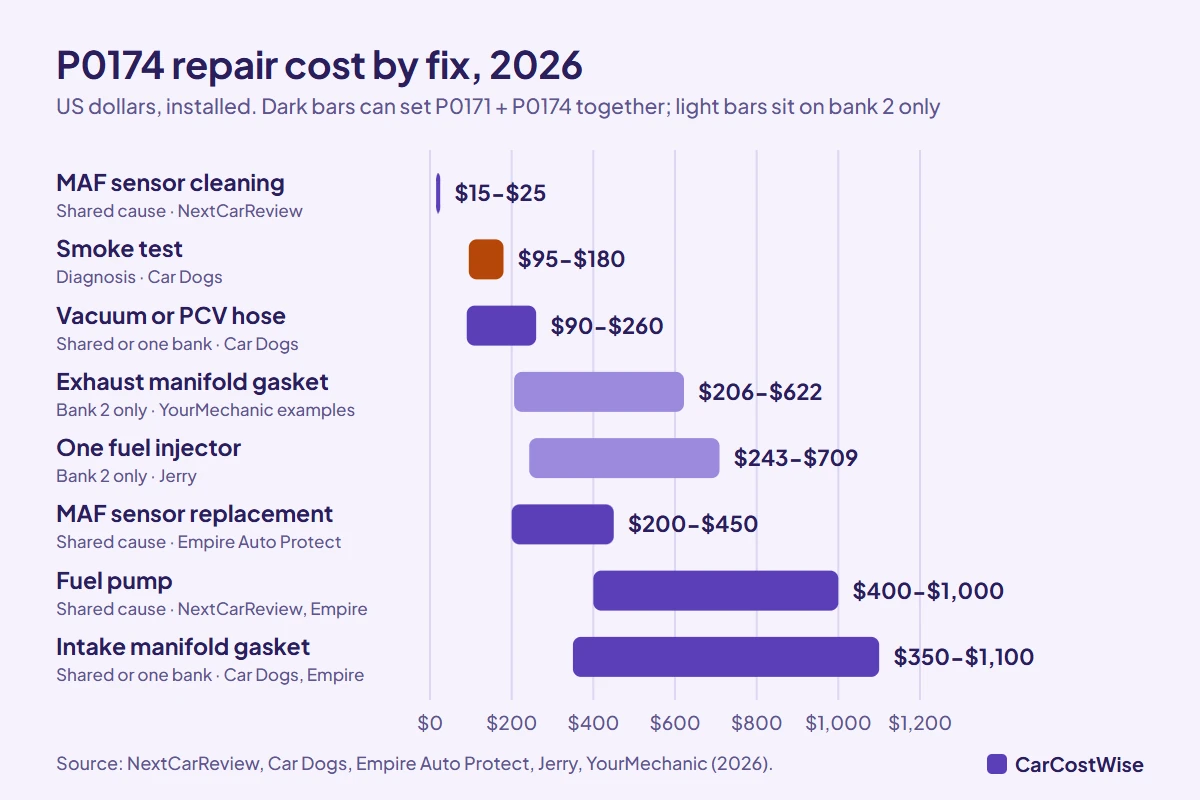
The ranges below come from published guides. They disagree with each other, which is normal because engine type, parts access and labor rates change the total.
| Repair | Low | High | Source note |
|---|---|---|---|
| Smoke test / diagnosis | $95 | $180 | Car Dogs. Many shops waive part of it if you do the repair there |
| MAF sensor cleaning | $15 | $25 | NextCarReview (a can of cleaner; shops charge more) |
| Vacuum or PCV hose, installed | $90 | $260 | Car Dogs. The hose itself can cost $10-$30 (NextCarReview) |
| PCV valve, installed | $60 | $250 | Empire Auto Protect |
| MAF sensor replacement, installed | $200 | $450 | Empire Auto Protect (August 2026) |
| MAF sensor replacement, other estimators | $240 | $684 | Jerry (July 2025) |
| Fuel filter, installed | $40 | $200 | Empire Auto Protect $40-$200; NextCarReview $60-$200 |
| Fuel pressure regulator, installed | $200 | $500 | Empire Auto Protect |
| Upstream oxygen sensor, installed | $150 | $400 | NextCarReview $150-$350; Empire Auto Protect $200-$400 |
| Exhaust manifold gasket, installed | $206 | $622 | YourMechanic averages: about $206 on a Ford Focus, about $622 on a V6 Ford Edge |
| One fuel injector, installed | $243 | $709 | Jerry (updated October 2026) |
| Intake manifold gasket, installed | $350 | $1,100 | Car Dogs $350-$900; Empire Auto Protect $350-$1,100 |
| Fuel pump, installed | $400 | $1,000 | NextCarReview $500-$1,000; Empire Auto Protect $400-$1,000 |
| Catalytic converter (if damage follows) | $400 | $2,500+ | See our catalytic converter cost guide |
What moves the number:
- Most bills are small. Empire Auto Protect says most P0171 repairs fall between $150 and $500. The expensive cases are the manifold gasket and the fuel pump.
- Labor, not parts, on a V-engine. YourMechanic’s Ford Edge example is about $52 in parts and $570 in labor for an exhaust manifold gasket. On a V6 or V8 the intake manifold has to come off for a gasket, which is why Car Dogs lists the job up to $900.
- One code or two. With both codes, the likely fix is a single shared part, often the cheap end of the table. With one code on a V-engine, the fix may be on the hard-to-reach bank.
- A dealer software step can add cost. The Cost Guys list $50-$150 for a dealer software reset after some MAF replacements (their prices date from December 2022).
- Shop rates differ. AAA says labor rates run from under $100 to over $200 an hour depending on the state, so get two quotes for anything over $300.
- Our arithmetic: a $95-$180 smoke test that finds a $90-$260 hose leak totals $185-$440. A $15-$25 MAF cleaning that clears both codes is the best case. Buying a $400-$1,000 fuel pump without a pressure test is the worst.
How do you diagnose a lean code? Cheapest steps first
- Read every stored code and the freeze frame. If P0171 and P0174 set at about the same time, treat them as one shared fault, as GM’s bulletin does. If one code is alone on a V-engine, focus on that bank. If misfire codes are present, read P0300 code.
- Compare the two banks’ fuel trims (V-engines). If one bank is far more positive than the other, the cause is on that bank. If both are high together, it is shared.
- Check trims at idle and at higher rpm, such as 2,500. Samarins says a short-term trim above +15-20% at idle that drops at higher rpm points to a vacuum leak. A trim that is normal at idle and climbs with rpm points to the MAF sensor, low fuel pressure or a clogged converter.
- Look and listen. With the engine idling, check that the air box is closed and the duct between the MAF sensor and throttle body is not cracked or loose. Look for hoses that have popped off. A hiss that changes when you cover a hose end is a strong clue. GM’s list adds the oil fill cap and the dipstick seal.
- Clean the MAF sensor with MAF-safe cleaner, let it dry, and refit it. If your car has an oiled aftermarket air filter, that oil may be the problem.
- Check the PCV valve and hose. A stuck valve or cracked hose lets in unmetered air and is cheap to replace.
- Pay for a smoke test if you see nothing. At $95-$180 it finds leaks under the intake that you cannot see, and it is cheaper than guessing.
- For a single-bank code, listen for an exhaust tick on that bank when cold, and ask the shop to check that bank’s injector.
- Test fuel pressure before buying a pump. GM’s bulletin suggests watching pressure during a 10-minute hot soak; a drop of more than 5 psi calls for a leak check.
- Replace the upstream oxygen sensor only if the data says it is slow.
- Check for software updates or bulletins for your year, make and model. Some lean codes are fixed by a computer update. Do not assume yours has one.
Do not clear the code and hope. The computer re-runs its test and the light returns after a few drive cycles if the fault is real. And do not replace spark plugs to cure a lean code: a severe lean condition can cause misfires, but new plugs will not stop the extra air. If the plugs are actually due, see why spark plug replacement is so expensive on V6 engines.
Can I drive with P0171 or P0174?
For a short period, usually yes, provided that:
- the check engine light is solid, not flashing,
- the engine idles and pulls without stalling,
- you hear no knock or pinging, and
- you avoid hard acceleration, towing and long highway runs.
Treat it as a fix-this-week problem. NextCarReview calls it a soon-to-fix job, because a long lean run can harm the pistons and valves. Empire Auto Protect says it is generally safe for short distances but should not be ignored for more than a few days. MechanicBase says a steady light with normal running allows a short drive to arrange a diagnosis.
The money risk is the catalytic converter. Many V6 and V8 engines have a converter on each bank, and a lean condition left for months can lead to converter codes. Empire Auto Protect lists that repair at $1,000-$2,500; MechanicBase puts a converter at $400-$2,500, the range we use site-wide. See our P0420 catalytic converter guide. Either way, a cheap hose today beats an exhaust repair later.
If the light flashes, the engine is misfiring hard. Stop driving as soon as it is safe and read check engine light flashing.
What related codes should you check?
- P0300, random misfire, which can appear when a lean mixture is severe: P0300 code
- P0420, a catalytic converter efficiency code that a long lean run can contribute to: P0420 code
- P0442 and P0455, EVAP leak codes. The purge valve in cause 9 belongs to the EVAP system, and GM lists the purge line as a possible air leak: P0442 code
- More: codes and more diagnostics guides
Is it worth repairing?
Almost always. Most lean-code fixes sit at the cheap end of the table above. The question gets harder only on an older car with a $1,000-plus quote for a fuel pump or a manifold gasket job. Read our guide to repairing vs replacing a car, then run your numbers below.
FAQ
What does P0171 system too lean bank 1 mean?
It means the engine’s computer sees too much air or too little fuel on bank 1, the cylinder row that holds cylinder 1, and has run out of room to correct it. Common causes are a vacuum leak, a dirty MAF sensor or a weak fuel pump.
What causes P0171 and P0174 at the same time?
Something both banks share. Look at the MAF sensor, the intake duct after it, the PCV system, the oil cap and dipstick seals, and fuel pressure. GM’s bulletin for 4.6L Cadillacs says both codes usually set together from a small air induction leak.
Why would only P0174 set and not P0171?
Because the fault is on the bank 2 side only. Common one-sided causes are a vacuum leak near that bank’s intake runners, an exhaust leak ahead of the bank 2 oxygen sensor, a restricted injector on that bank, or the bank 2 sensor and its wiring.
Which side is bank 2 on a V6?
Bank 2 is the row opposite cylinder 1. Whether that is the driver’s or passenger’s side depends on the engine, so check a service diagram or ask the shop to confirm which oxygen sensor is bank 2 sensor 1.
Can a dirty MAF sensor cause P0171?
Yes. A dirty sensor reads low, so the computer adds too little fuel. Cleaning it with MAF cleaner costs under $25 and is a standard first step. Replacement runs about $200-$450 per Empire Auto Protect.
Will a gas additive or clearing the code fix a lean code?
No. The code points to air, fuel delivery or a sensor, and clearing it only resets the test. If the cause remains, the light returns, and clearing before an emissions test also resets the readiness monitors.
Sources
- MechanicBase, P0174 system too lean bank 2 (definition, causes, P0171 pairing, driving advice; updated October 2026)
- General Motors, preliminary information PIP4577K, SES light with DTCs P0171 and P0174 (January 2012)
- Samarins, code P0171 symptoms, causes and diagnosis (fuel trim thresholds, Ford bulletins for both codes)
- Empire Auto Protect, P0171 code repair cost (August 2026; most repairs $150-$500, MAF $200-$450, fuel pump $400-$1,000, filter $40-$200, regulator $200-$500)
- Car Dogs, vacuum leak symptoms and smoke testing (smoke test $95-$180, hose $90-$260, intake gasket $350-$900)
- NextCarReview, P0171 code simple fixes (MAF clean $15-$25, O2 sensor $150-$350, fuel pump $500-$1,000)
- Jerry, mass airflow sensor replacement estimate ($240-$684, July 2025)
- Jerry, fuel injector replacement cost ($243-$709 per injector, October 2026)
- YourMechanic, exhaust manifold gasket replacement, Ford Edge (about $622): and Ford Focus (about $206) and second source
- The Cost Guys, system too lean bank 1 repair cost (dealer MAF software reset $50-$150, December 2022 prices)
- AAA, average mechanic labor rates 2026
- MechanicBase, catalytic converter replacement cost ($400-$2,500)
This page is general information, not financial or mechanical advice. Have a qualified technician inspect your vehicle before you make repair decisions.
Updated November 2026: our separate P0174 guide was merged into this page, so both lean codes are covered in one place. | By Rasel Hakkani