

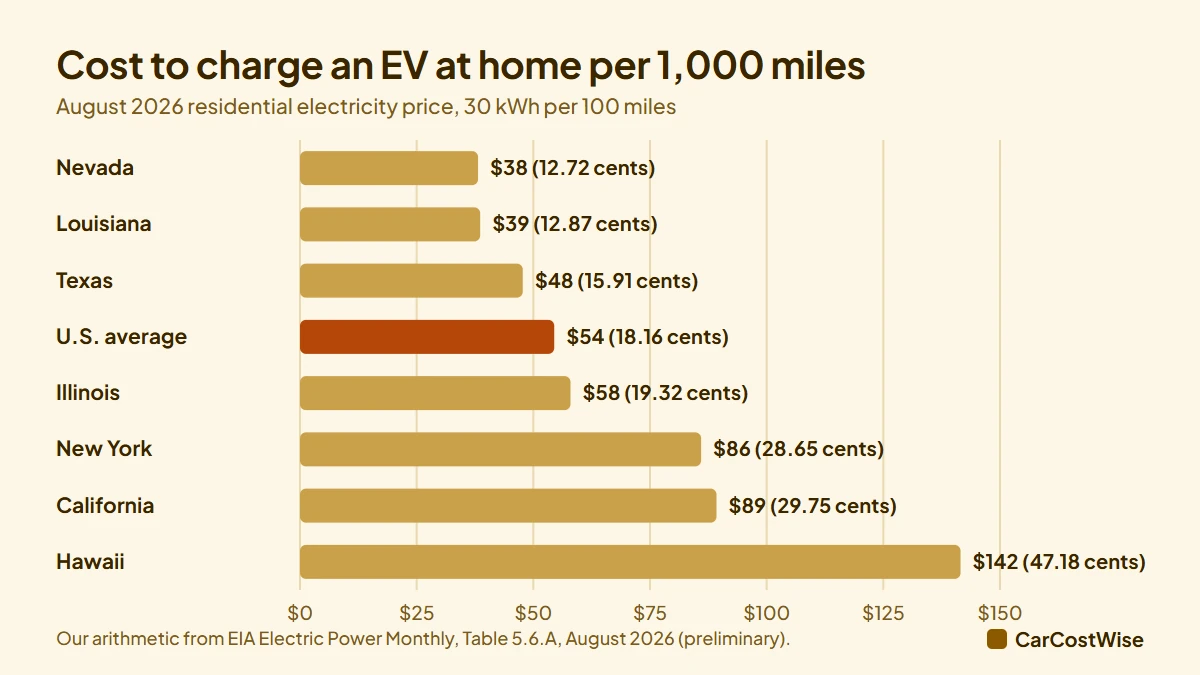
Direct answer: The cost to charge an electric car at home by state runs from about $38 per 1,000 miles in Nevada to $142 in Hawaii, with a U.S. average of about $54. A full charge of a 75 kWh battery costs about $16 at the August 2026 average of 18.16 cents per kWh (EIA price, our arithmetic).
How much does it cost to charge an electric car at home?
Home charging cost is simple multiplication: the kWh your car uses times your price per kWh. The price changes a lot by state, and the efficiency changes a little by car. Everything on this page comes from two public data sets and three stated assumptions.
- Electricity price: the U.S. Energy Information Administration (EIA) publishes the average residential price for every state each month. This page uses Table 5.6.A of the Electric Power Monthly, the August 2026 column, which is the latest month published and is preliminary. The U.S. average is 18.16 cents per kWh, up from 17.57 cents in August 2025.
- Car efficiency: the EPA combined rating on fueleconomy.gov, shown as kWh per 100 miles. EPA measures it at the wall, so it already includes typical charging losses.
Our assumptions
- Efficiency: 30 kWh per 100 miles. That is the EPA rating of the 2026 Hyundai Ioniq 5 RWD and the 2026 Nissan Leaf 75 kWh on fueleconomy.gov. It sits between the efficient sedans (about 24) and the electric pickups (about 48). So 1,000 miles uses 300 kWh from the wall.
- Battery size: 75 kWh, charged from empty to full. That matches the Leaf 75 kWh and is a common size for a compact electric SUV. Your car may be smaller or larger.
- Charging loss: 15%. InsideEVs reports that the average loss when charging an EV on AC power is around 15%. To put 75 kWh into the battery you draw about 88.2 kWh from the wall (75 divided by 0.85). We apply this loss only to the full-charge column, because the EPA efficiency figure used for the 1,000-mile column already includes it.
At 18.16 cents, 88.2 kWh costs $16.02 for a full charge and 300 kWh costs $54.48 for 1,000 miles (our arithmetic). That lines up with the Department of Energy example on its Alternative Fuels Data Center page, which uses 27 kWh per 100 miles at 10.7 cents per kWh and gets about 3 cents per mile. Electricity costs more today than in that example, so the same car costs more per mile now.
One caution on the EIA number. It is the average price paid by all residential customers in a state: total revenue divided by kWh sold. Your own plan may charge more or less per kWh, and August is a summer month when many utilities charge their highest tier. Treat each state figure as a solid starting estimate, not a quote, and check your bill.
What does it cost to charge an EV in each state?
This table covers all 50 states and the District of Columbia. The price column is the EIA residential price for August 2026. The last two columns are our arithmetic using the assumptions above: price times 88.2 kWh for a full charge, and price times 300 kWh for 1,000 miles, which is close to a month of driving for many people.
| State | Residential price, Aug 2026 (cents/kWh) | Full charge, 75 kWh battery | 1,000 miles |
|---|---|---|---|
| Alabama | 16.33 | $14.41 | $48.99 |
| Alaska | 29.41 | $25.95 | $88.23 |
| Arizona | 15.05 | $13.28 | $45.15 |
| Arkansas | 14.37 | $12.68 | $43.11 |
| California | 29.75 | $26.25 | $89.25 |
| Colorado | 17.17 | $15.15 | $51.51 |
| Connecticut | 24.51 | $21.63 | $73.53 |
| Delaware | 18.70 | $16.50 | $56.10 |
| District of Columbia | 25.98 | $22.92 | $77.94 |
| Florida | 14.99 | $13.23 | $44.97 |
| Georgia | 15.90 | $14.03 | $47.70 |
| Hawaii | 47.18 | $41.63 | $141.54 |
| Idaho | 13.37 | $11.80 | $40.11 |
| Illinois | 19.32 | $17.05 | $57.96 |
| Indiana | 17.02 | $15.02 | $51.06 |
| Iowa | 17.06 | $15.05 | $51.18 |
| Kansas | 15.47 | $13.65 | $46.41 |
| Kentucky | 13.80 | $12.18 | $41.40 |
| Louisiana | 12.87 | $11.36 | $38.61 |
| Maine | 32.11 | $28.33 | $96.33 |
| Maryland | 21.40 | $18.88 | $64.20 |
| Massachusetts | 30.48 | $26.89 | $91.44 |
| Michigan | 22.99 | $20.29 | $68.97 |
| Minnesota | 17.20 | $15.18 | $51.60 |
| Mississippi | 14.43 | $12.73 | $43.29 |
| Missouri | 16.02 | $14.14 | $48.06 |
| Montana | 15.57 | $13.74 | $46.71 |
| Nebraska | 13.54 | $11.95 | $40.62 |
| Nevada | 12.72 | $11.22 | $38.16 |
| New Hampshire | 27.64 | $24.39 | $82.92 |
| New Jersey | 24.61 | $21.71 | $73.83 |
| New Mexico | 16.51 | $14.57 | $49.53 |
| New York | 28.65 | $25.28 | $85.95 |
| North Carolina | 14.95 | $13.19 | $44.85 |
| North Dakota | 13.31 | $11.74 | $39.93 |
| Ohio | 19.38 | $17.10 | $58.14 |
| Oklahoma | 14.82 | $13.08 | $44.46 |
| Oregon | 15.92 | $14.05 | $47.76 |
| Pennsylvania | 21.77 | $19.21 | $65.31 |
| Rhode Island | 28.18 | $24.86 | $84.54 |
| South Carolina | 15.76 | $13.91 | $47.28 |
| South Dakota | 15.15 | $13.37 | $45.45 |
| Tennessee | 13.42 | $11.84 | $40.26 |
| Texas | 15.91 | $14.04 | $47.73 |
| Utah | 13.31 | $11.74 | $39.93 |
| Vermont | 23.84 | $21.04 | $71.52 |
| Virginia | 17.64 | $15.56 | $52.92 |
| Washington | 14.63 | $12.91 | $43.89 |
| West Virginia | 16.31 | $14.39 | $48.93 |
| Wisconsin | 19.41 | $17.13 | $58.23 |
| Wyoming | 14.43 | $12.73 | $43.29 |
| U.S. average | 18.16 | $16.02 | $54.48 |
Source for the price column: EIA, Electric Power Monthly, Table 5.6.A, residential sector, August 2026 (preliminary, released October 2026). Cost columns are our arithmetic: full charge = 75 kWh battery with 15% charging loss; 1,000 miles = 30 kWh per 100 miles.
The spread is wide. The cheapest states are Nevada (12.72 cents), Louisiana (12.87), and North Dakota and Utah (13.31 each). The most expensive are Hawaii (47.18 cents), Maine (32.11), Massachusetts (30.48), California (29.75), Alaska (29.41) and New York (28.65). A driver in Hawaii pays about 3.7 times as much per mile as a driver in Nevada for the same car (our arithmetic: 47.18 divided by 12.72).
Which states are cheapest and most expensive for home charging?
Cheapest: the Mountain West, Gulf Coast, Plains and Tennessee Valley. Nevada, Louisiana, North Dakota, Utah, Idaho, Tennessee and Nebraska are all under 14 cents per kWh in the August data. That works out to about $11 to $12 for a full charge and about $38 to $41 per 1,000 miles. EIA’s table reports the price, not the reasons behind it, so check your own utility for what drives your rate.
Most expensive: Hawaii, California, Alaska, and most of New England and the Mid-Atlantic. In California, 1,000 miles costs about $89 at the state average, and in Hawaii about $142. That can still undercut a gas car, but the gap is much smaller than in Nevada. For a sense of scale, our Thanksgiving road trip gas cost guide prices a 500-mile round trip in a 27 mpg car at about $79 in gas; the same 500 miles costs about $27 in electricity at the U.S. average (our arithmetic: 150 kWh times 18.16 cents).
Free calculator
Enter your miles, gas price and electricity rate to compare yearly fuel cost.
Prices moved a lot over the past year. Compared with August 2025, Hawaii rose from 38.53 to 47.18 cents, Maine from 28.14 to 32.11, and New Hampshire from 24.44 to 27.64. A few states went the other way: Connecticut dropped from 30.17 to 24.51 cents and California from 30.92 to 29.75. If you are budgeting for an EV purchase, use your utility’s current rate rather than a year-old figure from another website.
How much does it cost to fully charge popular EVs at home?
Efficiency matters as much as geography. A sedan and a full-size pickup can differ by a factor of two. The table uses the EPA combined rating and range from fueleconomy.gov and the price in three places: Nevada (cheapest, 12.72 cents), the U.S. average (18.16 cents) and California (29.75 cents).
| Vehicle (fueleconomy.gov) | kWh per 100 mi | EPA range | Wall energy to drive the full range | Per 100 mi: NV / US / CA | Full range: NV / US / CA |
|---|---|---|---|---|---|
| Tesla Model 3 Standard RWD, 2026 | 24 | 321 mi | 77 kWh | $3.05 / $4.36 / $7.14 | $10 / $14 / $23 |
| Nissan Leaf 75 kWh, 2026 | 30 | 288 mi | 86 kWh | $3.82 / $5.45 / $8.93 | $11 / $16 / $26 |
| Hyundai Ioniq 5 RWD, 2026 | 30 | 318 mi | 95 kWh | $3.82 / $5.45 / $8.93 | $12 / $17 / $28 |
| Chevrolet Equinox EV FWD, 2026 | 31 | 319 mi | 99 kWh | $3.94 / $5.63 / $9.22 | $13 / $18 / $29 |
| Ford F-150 Lightning 4WD ER1, 2025 | 48 | 320 mi | 154 kWh | $6.11 / $8.72 / $14.28 | $20 / $28 / $46 |
Efficiency and range come from fueleconomy.gov. Everything in the last three columns is our arithmetic: kWh per 100 miles times the price, and “wall energy to drive the full range” is EPA range times kWh per 100 miles divided by 100.
Two notes on reading it. First, “full range” here means the wall energy needed to drive the EPA range, not the size of the battery. Because the EPA figure includes charging losses, it is larger than the battery’s rated capacity, which is why the Leaf needs 86 kWh at the wall, close to our 88.2 kWh full-charge assumption. Second, you rarely charge from empty to full. Most drivers top up a few times a week, so the per-mile numbers are the better planning figures. The Department of Energy makes the same point with its own example: a fully depleted 54 kWh battery at 10.7 cents costs about $6 to reach a full charge.
What does it cost to charge a Tesla Model 3 at home?
At the U.S. average price, the 2026 Model 3 Standard RWD uses 24 kWh per 100 miles, so 100 miles costs about $4.36 and the full 321-mile range costs about $14 (our arithmetic). That is about $3.05 per 100 miles in Nevada and $7.14 in California. Other Tesla models and trims use more energy, so check the fueleconomy.gov page for your exact trim before you plug in your own numbers.
How much does it cost per month to charge an EV at home?
Multiply your monthly miles by the per-mile cost. A driver covering 1,000 miles a month spends about $54 at the U.S. average (30 kWh per 100 miles, our arithmetic). The same driving costs about $38 in Nevada, $48 in Texas, $58 in Illinois, $86 in New York, $89 in California and $142 in Hawaii. Scale up or down for your own commute: 1,500 miles a month is 1.5 times the table figure.
Plug-in hybrids are a different case, since only the electric miles count here. Our hybrid vs gas break-even guide covers the math for hybrids, and cost per mile to drive a car puts fuel next to insurance, depreciation and repairs. EVs also skip some engine work, such as oil changes and the timing belt vs timing chain question, but they still wear out tires, often a little faster because of their weight. Budget for that with our guide to how much new tires cost.
Level 1 vs Level 2 charging: does the charger change the cost?
Mostly it changes how fast you charge, not what a kWh costs. The two home options are:
| Level 1 | Level 2 | |
|---|---|---|
| Power source | Standard 120 V outlet | 240 V circuit, like a dryer |
| Speed (U.S. DOE) | About 5 miles of range per hour | About 25 miles of range per hour |
| 40 miles of range | About 8 hours | About 1.6 hours (our arithmetic) |
| Equipment | Cord that comes with most cars | Wall unit, $300-$800 for the hardware |
| Typical install | Often none, if you have a suitable outlet | About $800-$2,500 all-in |
Speeds are from the Alternative Fuels Data Center, and actual rates vary by car and battery level. Install costs are from Eviqo (updated July 2026: $1,000-$2,500 all-in, hardware $300-$650, labor $200-$1,200) and Sunrun (February 2026: $800-$2,500, hardware $400-$800, permit $50-$300). Both are installer-side estimates and the ranges differ, so get a local quote.
Is Level 2 cheaper per mile than Level 1?
Slightly, not much. Charging loses some energy as heat, and slower charging tends to lose a bigger share. In one German ADAC test reported by InsideEVs (March 2024), a Renault Zoe lost 24.2% of the energy on a household socket and 9.7% on an 11 kW wall box. That is one small car in Europe, so do not apply it to every EV, but the direction is clear. If those two numbers held for your car, the wall box would use about 16% less electricity for the same miles (our arithmetic: 1 / 0.758 is 1.32, and 1 / 0.903 is 1.11). On a $54 month, that is a few dollars. Level 2 pays for itself in time saved, not in electricity.
Do you need a Level 2 charger at home?
Often not. If you drive 40 miles a day, an overnight Level 1 session of 10 or 12 hours adds about 50 to 60 miles at 5 miles per hour, which covers it. A Level 2 charger makes sense if you drive more than that, own a large-battery pickup, or want to refill quickly between trips. If a panel upgrade is needed, Sunrun lists $1,000-$4,000 or more and Eviqo $4,500-$8,500 for a full 60A or 100A service upgrade, which can double the project. Ask for the panel assessment first.
Incentives change often. The AFDC notes that state and utility incentives may offset equipment costs, and some utilities offer cheaper off-peak rates for EV charging. Confirm any federal charger credit with the IRS before counting on it, since eligibility rules and dates have shifted and sources disagree.
How can you lower your home charging cost?
- Check your utility’s time-of-use or EV plan. Charging overnight on an off-peak rate can cut the per-kWh price well below the state average in the table. Rates and hours vary, so read your plan.
- Charge at home instead of relying on public chargers. The table uses an average residential price. Public fast charging is typically priced higher per kWh, so your cost rises if you depend on it.
- Set the charge limit. Many cars let you stop at 80% for daily driving, which also reduces battery wear.
- Pre-condition while plugged in. Heating or cooling the cabin from the wall instead of the battery saves range.
- Drive smoothly and keep tires inflated. Efficiency drops with speed and low tire pressure.
- Compare against gas. Run your own numbers in the fuel cost calculator before assuming either side wins.
FAQ
How much does it cost to charge an electric car at home per month?
About $54 for 1,000 miles at the August 2026 U.S. average residential price of 18.16 cents per kWh and 30 kWh per 100 miles (our arithmetic). It ranges from about $38 in Nevada to $142 in Hawaii, depending on your state’s rate.
What is the cheapest state to charge an electric car?
Nevada, at 12.72 cents per kWh in August 2026 (EIA), which is about $3.82 per 100 miles at 30 kWh per 100 miles. Louisiana (12.87 cents), North Dakota and Utah (13.31 each) are next. Hawaii is the most expensive at 47.18 cents.
How much does it cost to fully charge an electric car at home?
About $16 for a 75 kWh battery at the U.S. average, assuming 15% charging loss (our arithmetic: 88.2 kWh times 18.16 cents). By state it runs from about $11 in Nevada to $42 in Hawaii. Smaller batteries cost less to fill.
How much does it cost to charge a Tesla Model 3 at home?
About $14 to drive the full 321-mile EPA range of a 2026 Model 3 Standard RWD at the U.S. average price, or $4.36 per 100 miles (our arithmetic from 24 kWh per 100 miles on fueleconomy.gov). It is about $10 in Nevada and $23 in California.
Is Level 2 charging cheaper than Level 1?
Not by much. The price per kWh is the same. Level 2 may waste a little less energy as heat and is about five times faster, roughly 25 miles of range per hour versus 5, according to the Department of Energy.
Sources
- U.S. Energy Information Administration, Electric Power Monthly, Table 5.6.A, “Average Price of Electricity to Ultimate Customers by End-Use Sector, by State” (residential, August 2026 preliminary and August 2025)
- U.S. Department of Energy and EPA, fueleconomy.gov, 2025-2026 EV ratings (Model 3 Standard RWD, Leaf 75 kWh, Ioniq 5 RWD, Equinox EV FWD, F-150 Lightning 4WD ER1)
- Alternative Fuels Data Center, “Charging Electric Vehicles at Home” (cost per mile and full-charge examples)
- Alternative Fuels Data Center, “Electric Vehicle Charging Stations” (Level 1 and Level 2 speeds)
- InsideEVs, “How Efficient Is Each Type Of EV Charger?” (March 8, 2024; ADAC loss tests and about 15% average AC loss)
- Eviqo, “EV Charger Installation Cost in 2026” (updated July 2026; installation, hardware, labor, panel upgrade)
- Sunrun, “How Much Does It Cost to Install an EV Charger at Home” (February 2026)
Electricity prices, charger prices and efficiency vary by utility, plan, car and trim. All figures marked “our arithmetic” are estimates, not quotes. More fuel guides in more fuel cost guides.
Updated October 2026. By Rasel Hakkani.
This article is general information, not financial, electrical or mechanical advice. Get a licensed electrician’s quote before installing a charger.