

Direct answer: AAA puts the average cost to own and operate a new car at 77 cents a mile when you drive 15,000 miles a year, or $11,577 a year. It falls to 66 cents at 20,000 miles and rises to $1.00 at 10,000. Only fuel, maintenance and tires change with each mile you drive, and those add up to about 24 cents at AAA’s gas price and roughly 29 cents at today’s $4.33.
What is the average cost per mile to drive a car?
The most widely used benchmark is AAA’s annual Your Driving Costs study, published every year since 1950. The 2025 edition looks at five top-selling models in each of nine vehicle categories and averages the results. The overall cost to own and operate a new car is $11,577 a year, which is $719 less than in 2024, based on an average sales-weighted sticker price of $38,938.
How much that is per mile depends on how far you drive, because most of the cost is fixed. You pay for depreciation, financing, insurance and registration whether you drive 5,000 miles or 25,000.
| Miles driven per year | Average cost per mile (new car) |
|---|---|
| 10,000 | $1.00 |
| 15,000 | 77 cents |
| 20,000 | 66 cents |
The takeaway is that a car costs less per mile the more you use it, but more in total. Driving 20,000 miles at 66 cents costs about $13,200 a year (our arithmetic), more than the $11,577 at 15,000 miles, even though each mile is cheaper.
What does the 77 cents a mile include?
AAA breaks the average into six parts. Depreciation, finance, insurance and registration are priced per year, while fuel and maintenance are priced per mile. The last column is our arithmetic, dividing the yearly figures by 15,000 miles.
| Cost | AAA figure | Cents per mile at 15,000 miles |
|---|---|---|
| Depreciation | $4,334 a year | 28.9 |
| Insurance | $1,694 a year | 11.3 |
| Finance | $1,131 a year | 7.5 |
| License, registration and taxes | $813 a year | 5.4 |
| Fuel | 13 cents a mile | 13.0 |
| Maintenance, repair and tires | 11.04 cents a mile | 11.0 |
| Total | $11,577 a year | 77.2 |
Depreciation is the largest item, and it is not cash out of your pocket until you sell or trade the car. AAA calculates it as the difference between the purchase price and the estimated trade-in value after five years and 75,000 miles. The finance line assumes a five-year loan with 15 percent down at the national average rate, and includes taxes and first-year registration. Insurance assumes a full-coverage policy for a driver under 65 with more than six years of experience and no accidents.
The maintenance line includes manufacturer-specified routine maintenance, a comprehensive extended warranty, repairs to wear-and-tear items during five years of operation and one set of replacement tires. It describes a new car, so an older car with more wear will usually cost more to keep running.
How does cost per mile vary by vehicle type?
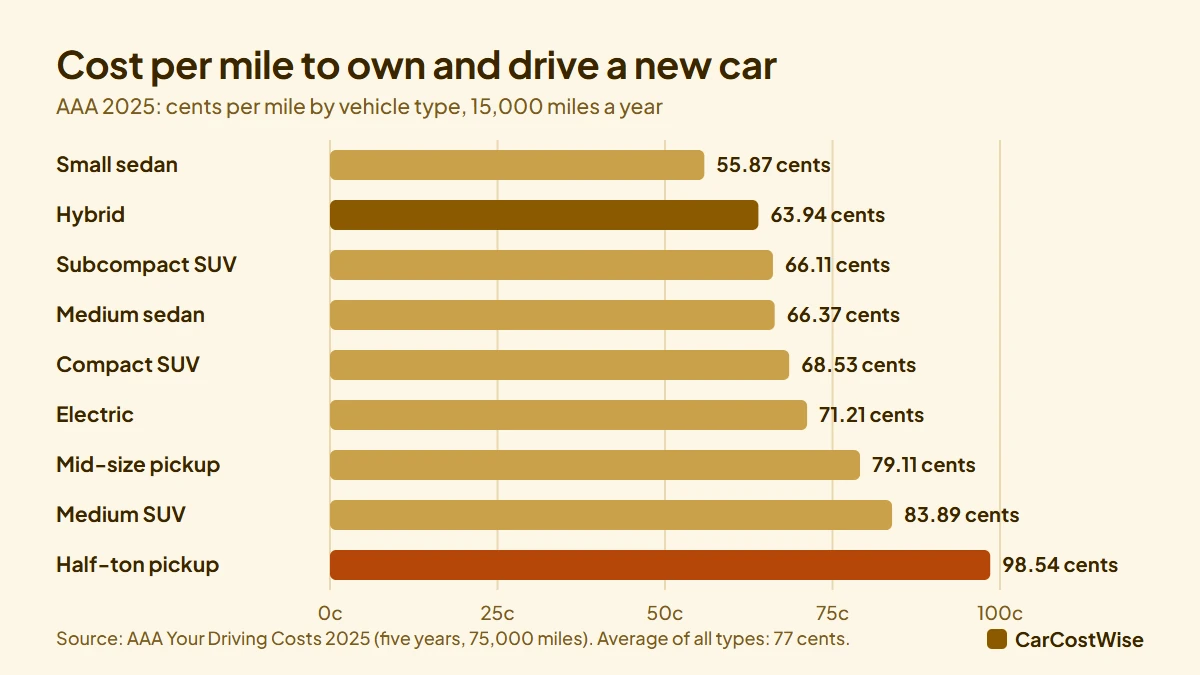
AAA’s categories show how much the type of car matters. These are average costs per mile for new vehicles, as published.
| Vehicle category | Cost per mile | Yearly cost at 15,000 miles |
|---|---|---|
| Small sedan | 55.87 cents | $8,381 |
| Hybrid | 63.94 cents | $9,591 |
| Subcompact SUV | 66.11 cents | $9,917 |
| Medium sedan | 66.37 cents | $9,956 |
| Compact SUV | 68.53 cents | $10,280 |
| Electric | 71.21 cents | $10,682 |
| Mid-size pickup | 79.11 cents | $11,867 |
| Medium SUV | 83.89 cents | $12,584 |
| Half-ton pickup | 98.54 cents | $14,781 |
AAA says small sedans are the cheapest overall and a popular choice for first-time buyers, and half-ton pickups are the most expensive. Hybrids are the second cheapest category for fuel behind electric vehicles, and third lowest in maintenance and depreciation. Electric vehicles are cheapest for maintenance, repair and tires but highest for depreciation. The yearly column is our arithmetic.
If you want to see how a hybrid compares with its gas twin, our guide to hybrid vs gas break even works through the payback math.
How much does fuel cost per mile now?
Fuel is the part that moves fastest. AAA’s study priced regular gas at an average of $3.151 a gallon over the 12 months ending in May 2025. On October 16, 2026 the AAA national average was $4.327 a gallon, up from $3.057 a year earlier. The Energy Information Administration shows $4.331 for the week of October 12.
Fuel cost per mile is simply the price of gas divided by your mpg. Here is that for several fuel economies, including 27.2 mpg, which the EPA’s Automotive Trends Report gives as the average real-world fuel economy of new vehicles in model year 2024 (a record high).
| Combined mpg | Cents per mile at $3.151 (AAA’s study price) | Cents per mile at $4.33 (today) |
|---|---|---|
| 20 | 15.8 | 21.6 |
| 25 | 12.6 | 17.3 |
| 27.2 (new-car average) | 11.6 | 15.9 |
| 30 | 10.5 | 14.4 |
| 40 | 7.9 | 10.8 |
| 50 | 6.3 | 8.7 |
AAA’s 13 cents a mile at $3.151 implies a fleet average of about 24 mpg (our arithmetic). If that same fleet fills up at $4.33, fuel is about 17.9 cents a mile, or roughly 4.9 cents more. That lifts the all-in cost at 15,000 miles from 77 cents to about 82 cents, and it is the main reason an efficient car looks better this autumn than it did a year ago.
What is the real cost per mile of a car you already own?
AAA’s 77 cents is a total ownership cost for a new vehicle. If you already own the car, outright or on a loan you cannot change, the costs that depend on each mile are different and much smaller. That is the number to use for a trip decision.
- Fuel: 13 cents a mile at AAA’s gas price, or about 17.9 cents at $4.33 for the same fleet average. Use your own mpg, as in the table above.
- Maintenance, repair and tires: 11.04 cents a mile on a new car, per AAA. An older car with more wear costs more.
- Together: about 24 cents a mile at AAA’s gas price, or about 29 cents at $4.33 gas (our arithmetic).
So a 500-mile round trip costs roughly $120 to $145 in extra wear and fuel for the average new car at current prices, not the $385 you would get by multiplying 500 miles by 77 cents. Depreciation also depends partly on mileage, and extra miles reduce resale value, so the true marginal cost sits between the two figures. For a quick trip budget, fuel plus 11 cents a mile for maintenance and tires is a fair estimate.
What is the IRS mileage rate, and is it the same thing?
The IRS standard mileage rate is the other number people quote. For 2026, the IRS set the business rate at 72.5 cents a mile, up 2.5 cents from 2025, announced on December 29, 2025. The medical rate is 20.5 cents, and the charitable rate is 14 cents, which is set by law and unchanged.
The business rate is based on an annual IRS study of the fixed and variable costs of operating a car, so it lands close to AAA’s 77 cents. But the two answer different questions. The IRS rate is what an employer can reimburse tax-free, or what a self-employed driver can deduct, for business miles. It is not a personal budget figure, and it applies to gas, diesel, hybrid and electric vehicles alike. AAA’s figure is a better guide to what a new car actually costs you.
What does cost per mile mean for a commute or a road trip?
Two quick examples show how to use the marginal figure. Take a 30-mile round-trip commute, five days a week for 50 weeks. That is 7,500 miles a year. At about 29 cents a mile for fuel, maintenance and tires, the extra cost of driving to work is roughly $2,175 a year (our arithmetic). Multiply the same miles by AAA’s full 77 cents and you get $5,775, which is closer to what the car costs you in total if you would not own it otherwise. The IRS business rate of 72.5 cents would value the same miles at $5,438, but only self-employed or reimbursed business driving qualifies.
For a road trip, compare it with flying. AAA said last Thanksgiving that a roundtrip domestic flight averaged $700. A 1,000-mile round trip in a car at 24 to 29 cents a mile costs roughly $240 to $290 in fuel and wear (our arithmetic), whether one person or four ride along. Four plane tickets at $700 would be $2,800. Driving wins easily for a family, though the gap narrows once you add lodging, meals and time.
How can you lower your cost per mile?
The biggest levers are the ones you decide before you buy:
- Pick a cheaper category. AAA’s most expensive category costs 98.54 cents a mile, almost 43 cents more than the cheapest. At 15,000 miles that gap is more than $6,400 a year (our arithmetic).
- Keep the car longer. Depreciation is the largest line in AAA’s study, so keeping a car longer spreads it out. Our is it worth fixing my car guide explains when repairs beat replacing.
- Shop insurance. It is the second largest line, at $1,694 a year in AAA’s study.
For the fuel line, the Department of Energy’s fueleconomy.gov gives these figures:
- Each 5 mph over 50 mph costs roughly an extra $0.30 a gallon at $4.33 gas, and slowing down 5 to 10 mph can improve fuel economy by 7 to 14 percent.
- Aggressive driving can lower mileage by 15 to 30 percent at highway speeds and 10 to 40 percent in stop-and-go traffic.
- Every extra 100 pounds of cargo cuts mpg by about 1 percent.
- A large roof-top cargo box can cut highway fuel economy by 6 to 17 percent, and by 10 to 25 percent at 65 to 75 mph.
Maintenance matters too, because skipping routine work often leads to bigger bills. Read tpms sensor replacement cost and car battery replacement cost for two common costs.
How do you calculate your own cost per mile?
Use three steps. First, add up what you paid in the last 12 months for fuel, maintenance and repairs, tires, insurance, registration, loan interest and depreciation. Second, divide that total by the miles you drove. Third, repeat it with only fuel, maintenance and tires to get your marginal cost per mile.
You can do the fuel part in seconds with our calculators.
For the whole picture, including insurance and depreciation, use the car ownership cost, and check your mileage with the mpg. More cost guides are in our more fuel cost guides hub and more ownership cost guides hub.
FAQ
What is the average cost per mile to drive a car in 2026?
AAA’s latest study puts the average at 77 cents a mile for a new car driven 15,000 miles a year, or $11,577 annually. It is 66 cents at 20,000 miles and $1.00 at 10,000. The IRS business rate for 2026 is 72.5 cents. Fuel and upkeep alone are about 24 to 29 cents a mile.
What is the IRS mileage rate for 2026?
The business standard mileage rate is 72.5 cents a mile, up 2.5 cents from 2025. The medical rate is 20.5 cents and the charitable rate is 14 cents. The IRS announced them on December 29, 2025, and they apply to gas, diesel, hybrid and electric vehicles.
How much does gas cost per mile?
Divide the price of gas by your mpg. A 27.2 mpg car, the average real-world figure for new vehicles in model year 2024, costs about 15.9 cents a mile at $4.33 a gallon. A 40 mpg hybrid costs about 10.8 cents.
Why is the cost per mile higher if I drive less?
Most costs are fixed. Depreciation, insurance, registration and finance charges are spread over fewer miles, so each mile carries more of them. AAA’s figure is $1.00 a mile at 10,000 miles a year and 66 cents at 20,000.
Which type of car has the lowest cost per mile?
In AAA’s 2025 study the small sedan is the cheapest at 55.87 cents a mile, followed by hybrids at 63.94 cents and subcompact SUVs at 66.11 cents. Half-ton pickups are the most expensive at 98.54 cents. These figures are for new vehicles.
Sources
- AAA, Your Driving Costs 2025 fact sheet and brochure (cost per mile, category costs, methodology)
- AAA, Gas Prices (national average, October 16, 2026)
- AAA, Thanksgiving Travel Forecast 2025 (average roundtrip domestic airfare of $700)
- U.S. Energy Information Administration, Gasoline and Diesel Fuel Update (week of October 12, 2026)
- IRS, “IRS sets 2026 business standard mileage rate at 72.5 cents per mile” (December 29, 2025)
- U.S. EPA, Automotive Trends Report highlights (model year 2024 fuel economy of 27.2 mpg)
- fueleconomy.gov (U.S. DOE and EPA), driving habits and fuel savings
AAA’s study covers new vehicles over five years and 75,000 miles, so an older car, a different region or different driving habits will give different numbers. Treat the per-mile figures as benchmarks, not quotes.
Updated October 2026. By Rasel Hakkani.
This article is general information, not financial or tax advice. Ask a tax professional about mileage deductions.