
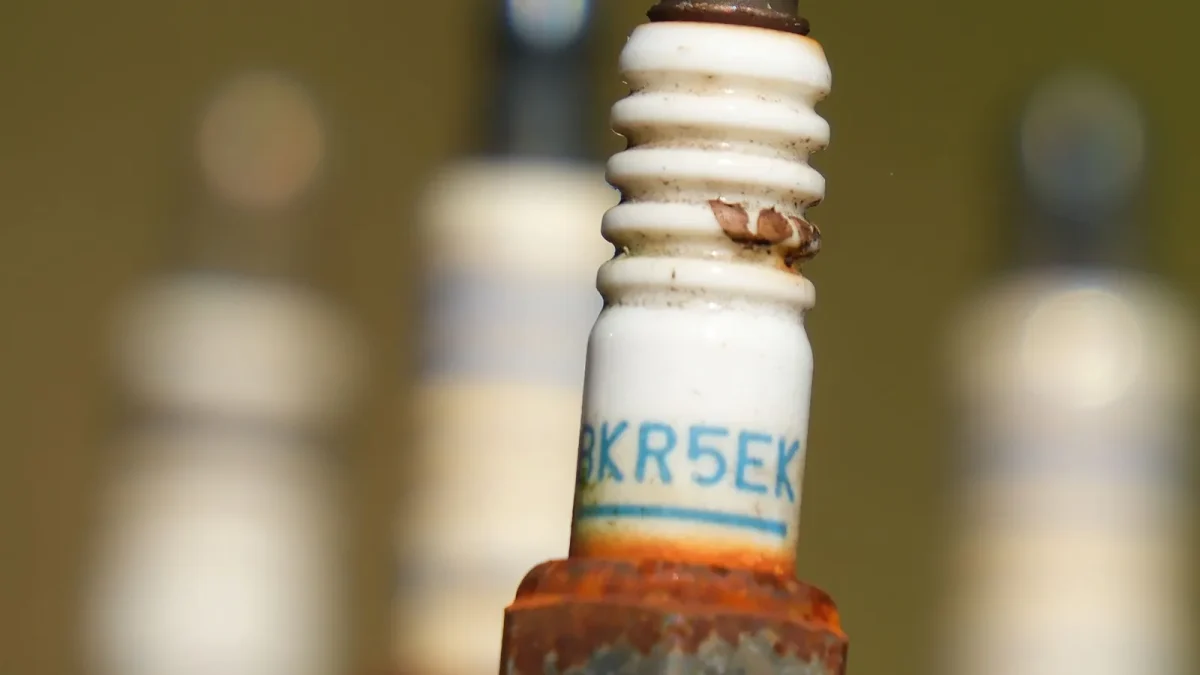
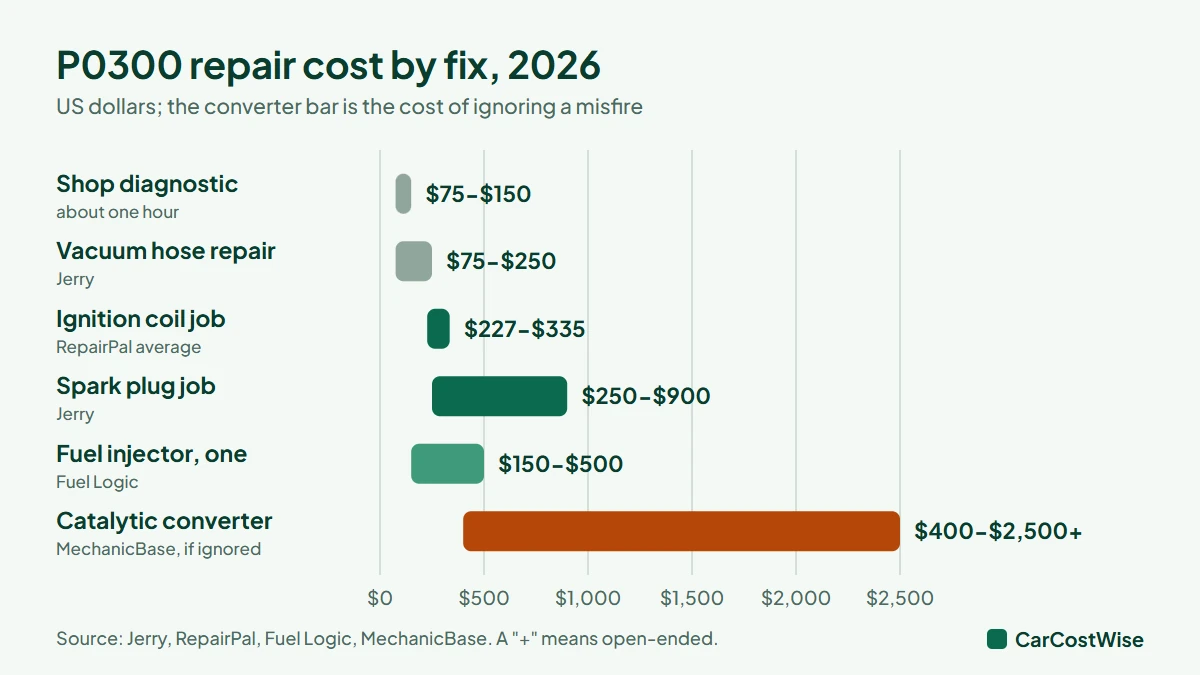
Direct answer: The P0300 code means your engine computer has detected misfires that are random or spread across several cylinders. The usual culprits are worn spark plugs, failing ignition coils, or a fuel or air problem. A spark plug job runs about $250 to $900 (Jerry) and a coil job about $227 to $335 (RepairPal). Hard-to-reach plugs, injectors, intake leaks and mechanical faults can cost more.
Quick facts
| Official name | Random / Multiple Cylinder Misfire Detected |
| Severity | Moderate if the light is solid; severe if the light is flashing |
| Can I drive it? | Short, gentle trips only if solid and the car runs acceptably. Do not drive if the light is flashing |
| DIY difficulty | Easy to moderate on engines with accessible plugs and coils; hard when the intake must be removed |
| Typical cost | About $250-$900 for plugs; $227-$335 for a coil job; $75-$150 for diagnosis; more for injectors or intake repairs |
What does the P0300 code mean?
A misfire is a cylinder that fails to burn its fuel properly. The engine computer (the powertrain control module, or PCM) watches crankshaft speed during each combustion event and notices when a cylinder fails to add its share of power (Identifix). If it can name the cylinder, you get a specific code such as P0301 (cylinder 1) or P0304 (cylinder 4). If the misfires jump around, involve several cylinders, or cannot be pinned on one cylinder, it sets P0300 instead.
That detail helps diagnosis. Random misfires usually point to something shared by all cylinders (fuel pressure, air leaks, old spark plugs, bad fuel) rather than a single failed coil. Repair guides repeat the same warning: the cause is often something that affects every cylinder, not the ignition part you were about to buy (Identifix, Service Sage Auto).
The code applies to every gasoline car sold in the US since the OBD-II standard arrived in 1996, so you will see the same meaning on a Ford, a Toyota or a Chevrolet. What changes from car to car is the labor needed to reach the parts.
What are the symptoms of P0300?
- Check engine light, solid or flashing
- Rough idle, shaking or shuddering
- Hesitation or stumbling when you accelerate
- Loss of power, especially going uphill
- Fuel smell from the exhaust
- Worse fuel economy
- Hard starting
- Engine stalling in worse cases
A flashing check engine light means a severe misfire is happening right now and unburned fuel is reaching the exhaust. Read check engine light flashing before you drive any further.
What causes P0300? Ranked from most to least common
| # | Cause | Fix | Cost range |
|---|---|---|---|
| 1 | Worn spark plugs | Replace plugs | $250-$900 total (Jerry); RepairPal model pages run from about $90 to about $700 depending on the car |
| 2 | Failing ignition coils | Replace bad coil(s), usually plugs too | RepairPal average $227-$335 per job (parts $155-$229, labor $72-$106) |
| 3 | Vacuum / intake air leak (cracked hose, loose intake boot, bad gasket) | Replace hose or gasket | Hose and clamp work about $75-$250 (Jerry); gasket and manifold work costs more |
| 4 | Dirty or failing fuel injectors | Clean or replace injectors | About $150-$500 per injector in one guide (Fuel Logic); Sunbit lists parts of $100-$1,000 plus labor of $110-$406 each |
| 5 | Low fuel pressure (weak pump, clogged filter) | Replace pump or filter | Varies widely: RepairPal model pages show fuel pumps from about $320 to over $2,500, and fuel filters from about $170 to $460 |
| 6 | Bad or contaminated fuel, water in fuel | Drain tank, fresh fuel | Ask for a quote; we found no reliable price survey |
| 7 | Mechanical problems (low compression, worn valves, timing issues) | Engine repair | Usually the most expensive category; get a written diagnosis and quote before approving work |
| 8 | Sensor problems (crank/cam position, mass airflow) | Replace sensor | Mass airflow sensor $250-$399 (RepairPal); crankshaft sensors range from under $200 to about $1,000 on RepairPal model pages |
Several repair guides rank plugs and coils at the top because they wear out on a schedule, and they are cheap parts. Fuel and mechanical causes are less common but cost much more, which is why it pays to work through the list in order. A weak battery or charging problem is also on the shop checklist, because Identifix includes battery and charging voltage in its diagnostic order; our guide to car battery replacement cost shows what that fix costs.
How much does it cost to fix P0300?
| Item | Low | High | Notes |
|---|---|---|---|
| Diagnostic at a shop | $75 | $150 | About one hour of labor |
| Spark plug job, total | $250 | $900 | Jerry guide; RepairPal model pages range from about $90 (simple older car) to about $700 (Porsche 911), with trucks around $314-$452 |
| Ignition coil replacement, total | $227 | $335 | RepairPal estimator average (parts $155-$229, labor $72-$106) |
| Fuel injector, one | $150 | $500 | Fuel Logic; Sunbit gives parts of $100-$1,000 each plus labor of $110-$406 per injector |
| Vacuum hose repair | $75 | $250 | Jerry |
| Smoke test for leaks | $100 | $200 | Jerry (includes scan data review) |
| Shop labor (hourly) | under $100 | over $200 | AAA; almost half of shops charge $120-$159 per hour |
Where sources disagree: Spark plug jobs show $250-$900 in Jerry’s guide, while RepairPal’s model pages run from about $90 to about $700. The difference is mostly engine layout. A four-cylinder with plugs on top is cheap, while a V6 with plugs under the intake manifold takes far more labor. Always ask for a quote that lists the number of plugs and the labor hours.
How do you diagnose P0300? Cheapest steps first
- Read every stored code, and save the freeze-frame data before clearing anything. Freeze-frame data records engine speed, load, temperature and fuel trims at the moment the fault was stored, and it disappears when codes are cleared (Identifix). If you also see P0301-P0306, one cylinder is leading the problem. If you see lean codes (P0171/P0174), suspect an air leak. If you see P0420, misfires may already have hurt the converter: P0420 code.
- Check when it happens. Cold start only, under load, or at idle? Misfires only under load often point to plugs, coils or fuel delivery. Idle-only roughness often points to a vacuum leak.
- Look at maintenance history. If spark plugs are past the interval in your owner manual, replace them first. It is the cheapest likely fix.
- Inspect the visible stuff. Cracked or disconnected vacuum hoses, loose intake boots, oil on the plug wells, or damaged coil boots.
- Swap coils (if you are comfortable). Move a suspect coil to another cylinder and see if the misfire follows. This works best when you have one dominant cylinder code.
- Test for vacuum leaks. A smoke test at a shop locates leaks quickly. Jerry puts one at $100 to $200 including a scan data review, and a simple hose repair at $75 to $250.
- Check fuel pressure and injectors if the cheaper checks come up clean.
- Compression and mechanical checks are the last step and the most expensive to ignore.
Avoid “parts cannon” repair, where you replace plugs, coils and injectors all at once. Add one fix at a time unless the plugs are clearly overdue. Both Identifix and Service Sage Auto warn against replacing every plug and coil before looking at fuel trims, because trims show whether the engine is running lean or rich across all cylinders.
What do P0301-P0306 mean, and how do they differ from P0300?
The last digit of a cylinder-specific misfire code is the cylinder number. P0301 is cylinder 1, P0302 is cylinder 2, and so on up to P0306 on a six-cylinder engine (Identifix). Larger engines go higher, up to P0308 on a V8 and beyond.
P0300 can appear alone, or alongside these codes. The cylinder with the highest misfire count may set its own code, while the overall pattern sets P0300 (Identifix). Here is how to read the combinations:
- P0300 only: misfires are scattered. Think shared causes first: old plugs, air leaks, fuel delivery, bad fuel.
- P0300 plus one cylinder code: that cylinder is the worst offender. Check its plug, coil, injector and compression, but do not assume the others are healthy.
- P0300 plus two or three cylinder codes: look for what those cylinders share. Cylinders that sit next to each other, or on the same side of a V engine, may share a coil pack, a fuel rail, an intake runner or a head gasket.
- Cylinder codes that change from trip to trip: the fault moves around, which again points to a shared cause rather than a single bad part.
A single cylinder code with no P0300 is usually a cheaper job, because the fault is localized. Our quote ranges in this guide apply to both cases, but a single-cylinder fix may only need one coil rather than a full set.
What will the shop do when you bring it in?
Knowing the order of work helps you judge a quote. According to the diagnostic flow Identifix publishes for technicians, a thorough shop will:
- Scan every module and record stored, pending and permanent codes before clearing anything.
- Save the freeze-frame data and review misfire counters, engine load, speed, coolant temperature, fuel trims and oxygen sensor readings.
- Ask when the misfire happens: idle, cold start, under load, or across the full range.
- Check battery and charging voltage.
- Test the ignition coils and their circuits, then inspect the spark plugs.
- Check for vacuum leaks, using fuel trims and a smoke test if needed.
- Test fuel pressure, fuel volume and injectors using the manufacturer’s procedure.
- Check sensors against live data before replacing any of them.
- Run a compression or cylinder leakage test if one cylinder keeps misfiring or the other checks do not isolate the fault.
- Look for service bulletins and calibration updates for your model, and verify the repair afterward.
Expect to pay for roughly an hour of diagnostic labor, about $75 to $150 in the ranges above. A shop that quotes a big repair without any of this data is guessing. Ask to see the misfire counts or the freeze-frame data. Identifix also lists the pitfalls that waste money: replacing plugs or coils before reading scan data, clearing codes before recording freeze-frame data, blaming an oxygen sensor just because it reports a rich or lean condition, and replacing the catalytic converter without fixing the misfire that damaged it.
If the shop’s first answer is a catalytic converter, ask whether a misfire code was ever tested out. That is the mistake that turns a $227-$335 coil job into a repeat visit.
Can I drive with P0300?
- Solid light, car runs fairly smooth: short, gentle trips to a shop or home are generally acceptable. Avoid towing, hard acceleration and long highway runs.
- Flashing light, shaking, or strong loss of power: stop driving. Several sources, including AAA, warn that a flashing light signals a serious misfire and that continued driving can destroy the catalytic converter, which is the repair in P0420 code and the most expensive outcome of ignoring a misfire.
- Overheating gauge rising: do not drive. Call a tow.
Identifix lists the same stop signs: severe shaking, major power loss, overheating, abnormal noise or a strong raw-fuel smell. A tow is cheaper than a converter. SuperMoney, citing J.D. Power, puts the national average tow near $109, with a hook-up fee of $35 to $100 and $2.50 to $7 per mile.
What happens if you ignore P0300?
Waiting costs money in two ways. The first is slow: a misfiring cylinder wastes fuel, so economy gets worse, and a worn plug or a weak coil usually gets worse, not better.
The second is the expensive one. When a cylinder does not burn its fuel, the raw fuel goes out into the exhaust, and the catalytic converter is where it ends up. Repair guides describe the converter as not designed to handle a stream of unburned fuel, and a sustained misfire can overheat and destroy its internal honeycomb. One shop guide says this can happen within minutes if the misfire is severe, which is why a flashing light is treated as an emergency (Service Sage Auto).
Put the numbers side by side, all from the tables on this page:
- A coil job: $227-$335.
- A spark plug job: $250-$900.
- A tow: about $109.
- A new catalytic converter: about $400-$2,500 or more (MechanicBase), with OEM and luxury or hybrid setups far higher, as we show on the P0420 code page.
Even the low end of a converter ($400) is more than the top of a coil job ($335), and the high end is more than double the top of a plug job ($900). Ignoring a solid light for a few weeks may be fine. Ignoring a flashing light for a long drive can turn a cheap ignition repair into a four-figure exhaust repair. There is also a pocketbook rule of thumb: if you must choose between a tow and driving on a flashing light, take the tow.
Federal emissions warranty rules cover the catalytic converter on newer cars, as we explain on the P0420 page, so check your age and mileage before you pay for a converter that a misfire damaged.
Which cars get P0300? Model notes
We did not find a trustworthy, source-backed list of vehicles that commonly throw P0300, so we are not publishing one. Cost differences by vehicle are real, though: RepairPal’s spark plug estimates alone span roughly $90 to $700 across models. Ask any shop how many labor hours your engine needs, and whether the intake has to come off to reach the plugs.
Manufacturers do publish technical service bulletins for some engines. Identifix gives examples that mention P0300, including a Ford bulletin for the 2013 Mustang 5.0L (TSB 13-1-11), a Nissan bulletin for the 2022 Pathfinder (NTB22-069) and a GM bulletin about lifter problems on some 5.3L and 6.2L V8 engines (15-06-01-002O). We list these only to show that bulletins exist, not to say your car is affected. To find out whether your make has a known issue, search the NHTSA technical service bulletin database for your year, make and model.
What related codes should you check?
- P0301-P0312, misfire on a specific cylinder (our page for these is coming)
- P0420, catalytic converter efficiency, often a downstream effect of ignored misfires: P0420 code
- P0171 / P0174, system too lean, a vacuum-leak clue (page coming)
- Flashing check engine light: check engine light flashing
- More: more diagnostics guides
Is it worth repairing?
If the quote involves engine internals on an older, high-mileage car, run the numbers first with our repair vs replace guide and the calculator below.
FAQ
What is the most common cause of P0300?
Worn spark plugs and failing ignition coils are the most commonly cited causes in repair guides, and they are among the cheapest to fix.
How much does it cost to fix P0300?
A plug job runs about $250 to $900 (Jerry) and a coil job about $227 to $335 (RepairPal), plus $75-$150 if you need a diagnostic. Injector, vacuum, fuel-pump or mechanical faults can cost more.
Can I just clear the code?
You can, but if the cause is still there the misfire and light return. Clearing it also hides the evidence a mechanic needs and will reset emissions readiness monitors.
Is P0300 the same as P0301?
No. P0301 names cylinder 1. P0300 means the misfires are random or involve several cylinders. You can have both at once.
Will bad gas cause P0300?
It can. Water or poor fuel can make several cylinders misfire at once. If the problem began right after a fill-up, tell your mechanic.
Can a P0300 code damage the catalytic converter?
Yes. A misfire sends unburned fuel into the exhaust, which can overheat and destroy the converter. A new one costs about $400 to $2,500 or more, so treat a flashing light as an emergency.
Sources
- Jerry, P0300 code guide (diagnostic and plug costs)
- Identifix, P0300 code guide to diagnostics and repair (how misfires are detected, P0301 pattern, diagnostic order, pitfalls, bulletin examples)
- Service Sage Auto, P0300 causes and diagnosis (causes order, fuel trims first, converter risk)
- RepairPal, ignition coil replacement cost
- RepairPal, spark plug replacement model pages (for example Ford F-150, GMC Sierra 1500, Porsche 911, Geo Prizm)
- RepairPal, mass airflow sensor replacement cost
- RepairPal, fuel pump, fuel filter and crankshaft position sensor model pages and second source
- Jerry, vacuum leak costs (hose $75-$250, smoke test $100-$200)
- Fuel Logic, fuel injector replacement cost
- Sunbit, fuel injector cost
- MechanicBase, catalytic converter replacement cost ($400-$2,500)
- AAA, check engine light causes
- AAA, mechanic labor rates 2026 (under $100 to over $200 per hour; almost half of shops $120-$159)
- SuperMoney, cost to tow a car (J.D. Power average $109, hook-up and per-mile fees)
This page is general information, not professional mechanical advice. Have a qualified technician inspect your vehicle before you make repair decisions.
Updated October 2026 | By Rasel Hakkani