Direct answer: TPMS sensor replacement cost is about $70 to $250 per sensor installed, according to Carista, covering the part and labor. Other sources run from $50 to $280 per sensor. The sensor itself is $25 to $150 and labor is $50 to $100, with a possible $100 to $200 programming fee per vehicle.
How much does TPMS sensor replacement cost?
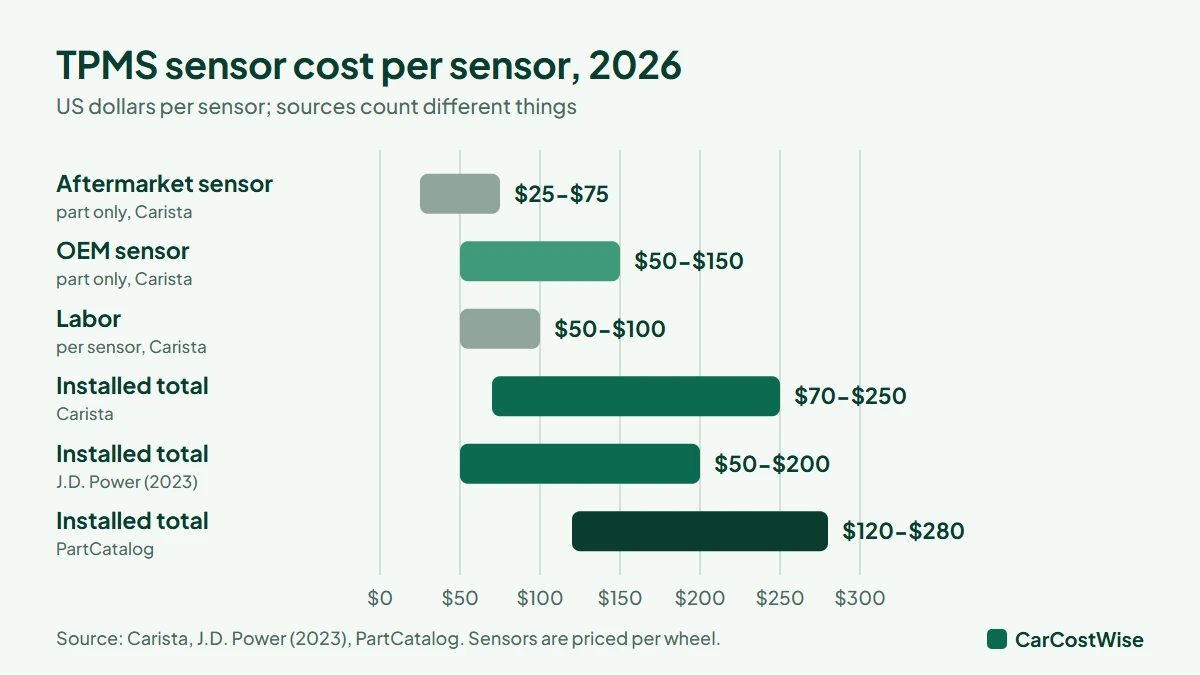
Prices vary because the sources count different things. One includes programming, another does not, and one lists a parts retailer’s view of dealer labor. We show each source rather than average them.
| Item | Low | High | Source |
|---|---|---|---|
| Aftermarket sensor, part only | $25 | $75 | Carista |
| OEM sensor, part only | $50 | $150 | Carista |
| Sensor, part only (budget to premium) | $35 | $180 | PartCatalog |
| Labor, per sensor | $50 | $100 | Carista |
| Labor, per sensor (budget to premium) | $40 | $220 | PartCatalog |
| Programming or relearn, per vehicle | $100 | $200 | Carista |
| Installed total, per sensor | $70 | $250 | Carista |
| Installed total, per sensor | $50 | $200 | J.D. Power (2023) |
| Installed total, per sensor | $120 | $280 | PartCatalog |
J.D. Power puts the average at about $100 to $150 per tire and says the cost can be much higher for specialized sensors or at a dealership. PartCatalog says costs can climb to $300 to $400 in high-labor-rate urban areas or for luxury vehicles and diesel trucks, and that a metro area can cost 40 to 50 percent more than a rural one. PartCatalog sells parts, and the J.D. Power guide dates from July 2023, so treat both as guides and get a written quote.
How much for a full set of four?
Each wheel has its own sensor, so a full set is roughly four times the per-sensor price. Our arithmetic on the sources above:
- Carista’s $70 to $250 per sensor gives $280 to $1,000 for four.
- J.D. Power’s $100 to $150 average gives $400 to $600.
- PartCatalog’s $120 to $280 gives $480 to $1,120.
If a shop charges a programming fee per vehicle, as Carista describes, it is paid once and not four times.
What does a TPMS sensor do?
A direct tire pressure monitoring system has a small battery-powered sensor inside each wheel that reports pressure to the car. Federal rules define when the light must come on. Under Federal Motor Vehicle Safety Standard 138, the low tire pressure warning must illuminate within 20 minutes once one or more tires, up to four, reach a pressure 25 percent below the manufacturer’s recommended cold inflation pressure (or a minimum value in the standard’s table, whichever is higher). For a tire that should be at 35 PSI, 25 percent below is about 26 PSI (our arithmetic). The standard applies to all vehicles certified starting September 1, 2007.
Why do TPMS sensors fail?
Mostly the battery. Carista says TPMS sensors typically last between 5 and 10 years, or approximately 100,000 miles, and that the batteries are built in and cannot be replaced, so a dead battery means replacing the whole sensor.
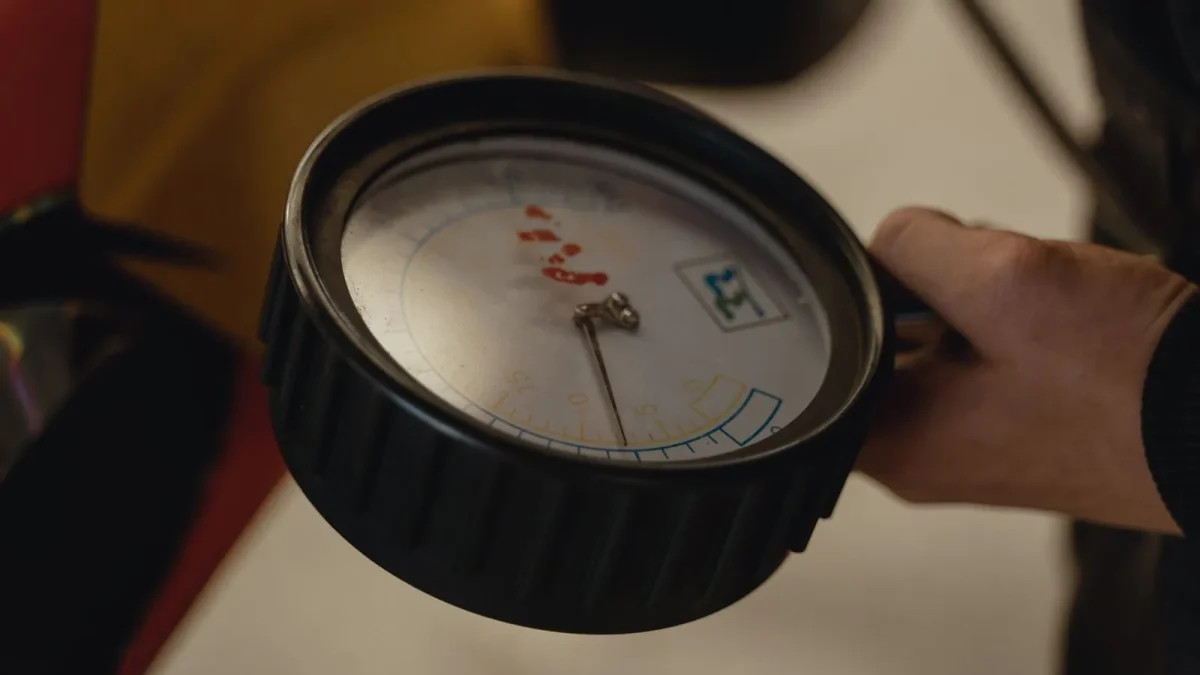
Do not assume the light means a bad sensor. A tire that is simply low causes the same light. Michelin says tires lose about 1 PSI for every 10°F drop in temperature, so the light often appears on the first cold morning of the year. Check and inflate all four tires to the pressure on your driver’s door jamb first, which costs nothing.
What does the TPMS warning light mean?
There are two different signals:
- Solid light: one or more tires are well below the recommended pressure. Check pressure and add air.
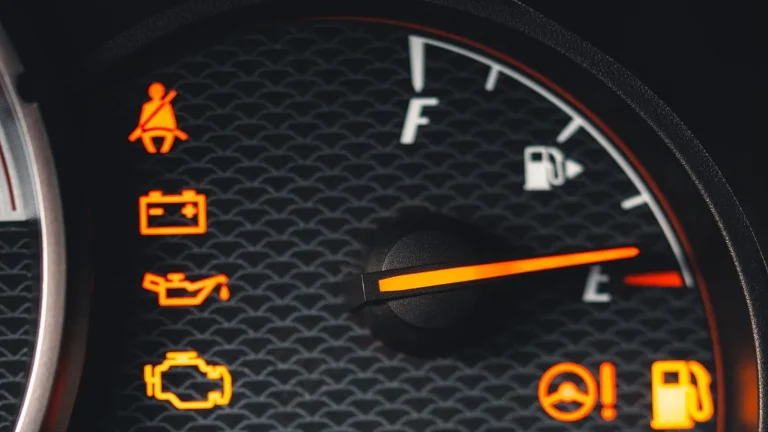
- Light that flashes, then stays on: a system fault. On cars with a combined low-pressure and malfunction light, the standard says the light must flash for 60 to 90 seconds when the car is started with a fault, then remain on until the problem is fixed.
A sensor fault does not mean the tire is losing air, but the system cannot warn you if one does. Keep checking pressure by hand until it is fixed.
What affects TPMS sensor replacement cost?
OEM versus aftermarket sensors
Carista puts OEM sensors at $50 to $150 and aftermarket sensors at $25 to $75. Ask the shop which type it is quoting.
Programming or relearn
New sensors have to be introduced to the car. Carista lists programming at $100 to $200 per vehicle when it is charged separately, and says it is needed if your vehicle requires it. Some shops include it in their per-sensor price and some charge extra, so ask before you agree.
Where you go
Dealers usually cost the most, and J.D. Power says a dealership may charge more than an independent mechanic. Independent shops and tire chains usually fall in the middle of the ranges above. Doing it yourself costs only the sensors, but you need tire removal tools, a TPMS programming tool and a way to rebalance the tire, according to Carista’s DIY procedure.
Vehicle type
PartCatalog lists the premium tier of its range for diesel trucks, turbocharged engines, tight engine bays and European makes, and for dealership service in high-cost metro areas.
Should you replace one sensor or all four?
Replace the failed one if the others test fine and are young. But sensors are installed inside the wheel, so every sensor job means removing and remounting a tire. Because all four sensors have the same age and battery life, our reasoning is that if the car is 7 to 10 years old, or you are already buying tires, replacing all four at once avoids paying for the tire work again when the next one dies. Carista’s 5 to 10 year life range is the basis for that timing.
How can you save on TPMS sensor replacement?
- Check the tire pressure first. A low tire is the most common reason the light comes on, and it is free to fix.
- Replace sensors with new tires. The tire is already off the wheel, so the labor overlaps.
- Compare quotes for the same job: sensor type, programming and rebalancing included.
- Ask about aftermarket sensors. Carista puts them at $25 to $75 versus $50 to $150 for OEM.
- Price the dealer against an independent shop, since J.D. Power says dealers may charge more.
When do you need to get it fixed?
Fix a failed sensor before your next tire change or inspection if you can. With a failed sensor the system can no longer warn you of a slow leak. J.D. Power notes that under-inflated tires reduce braking performance, increase tire wear and raise fuel consumption. If cold weather is why you are checking pressure, see are winter tires worth it and when to put on winter tires for timing and cost.
If the cost is a bigger part of an older car’s bill, compare it with the rest of the repairs before you decide.
For more parts guides, see more diagnostics guides, car battery replacement cost and wheel bearing replacement cost.
FAQ
How much does it cost to replace a TPMS sensor?
About $70 to $250 per sensor installed, according to Carista. J.D. Power gives $50 to $200 per tire, with $100 to $150 as the average, and PartCatalog gives $120 to $280. The sensor is $25 to $150 and labor is $50 to $100.
How much does it cost to replace all four TPMS sensors?
Roughly four times the per-sensor price, or about $280 to $1,000 using Carista’s range. Programming is usually charged once per vehicle, at $100 to $200 when billed separately.
Can you drive with a bad TPMS sensor?
Yes, in the sense that the car still drives, but the system can no longer warn you about low pressure. Check the tires by hand until it is fixed.
How long do TPMS sensors last?
Carista says 5 to 10 years or about 100,000 miles. The battery is sealed in the sensor and cannot be replaced, so the whole sensor is replaced.
Why is my TPMS light on after the weather got cold?
Cold air lowers pressure. Michelin says tires lose about 1 PSI for every 10°F drop in temperature. Inflate the tires to the pressure on the driver’s door jamb. If the light flashes, then stays on, the system has a fault.
Sources
- Carista, “TPMS Sensor Replacement Cost, Procedure and DIY Guide” (OEM $50-$150, aftermarket $25-$75, labor $50-$100, programming $100-$200, battery life)
- J.D. Power, “How Much Does It Cost To Replace A TPMS Sensor?” (July 18, 2023; $50-$200 per tire)
- PartCatalog, “TPMS Sensor Replacement Cost: What to Expect” ($120-$280 per sensor installed)
- eCFR, 49 CFR 571.138, FMVSS No. 138 Tire pressure monitoring systems (25 percent threshold, 20 minutes, malfunction indicator, September 1, 2007)
- Michelin USA, “Winter Tire Timing & PSI Tips” (1 PSI per 10°F)
Prices change by shop, vehicle and sensor type. Get a written quote for your vehicle.
Updated October 2026. By Rasel Hakkani.
This article is general information, not mechanical advice.